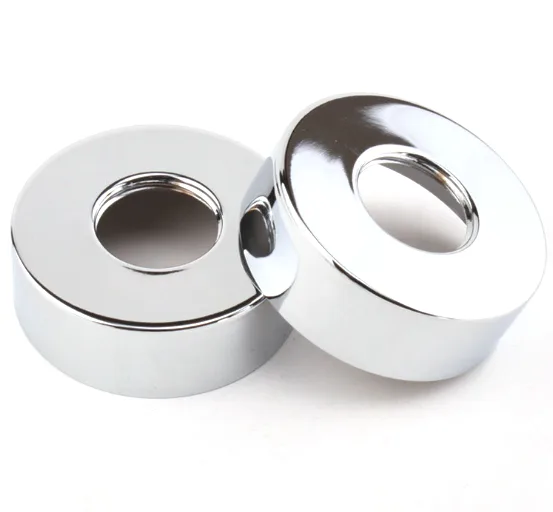
A polished round cap is judged on a surface you cannot measure with a ruler
Polished stainless steel round drawn caps are the smallest and most visually demanding parts in this family. There is no thread, no seal, no tolerance chain – the part is a shallow drawn disc with an edge, and essentially all of its value is in how it looks. That makes it unusual, because a cosmetic part’s requirements cannot be expressed as dimensions. Optical polish, colour consistency across a batch, the appearance of the draw marks, and the feel of the edge are all real requirements and none of them is a number.
We deep draw from coil or blank with in-process annealing so walls thin evenly, and first articles verify the whole flow before the run is released, on mechanical presses from 5 to 250 T and hydraulic presses 250-500 T with in-line annealing furnaces, with first articles and batch samples checked on the CMM. Turned secondary features to +/-0.03 mm and as-drawn walls to +/-0.1 mm, with critical dimensions carrying CMM data with the shipment. Stock covers carbon steel in SPCC and DC01 grades, 304 and 316 stainless steel, aluminium and brass, with grade and temper confirmed in writing before tooling. Zinc, nickel or chrome plating, anodising, passivation or e-coat are available, with alternatives quoted with the quotation and samples approved in writing. This page is about specifying a surface appearance, which is a different discipline from specifying a part.
The finish options, and only one of them is a true polish
“Polished” on a stainless steel cap can mean four quite different things, and they are not interchangeable:
| Mechanically polished | Abrasive belts or wheels bring the surface progressively finer. It leaves a directional lay, it removes material, and it can produce a slightly domed or faceted surface if the part is not fixtured well. On a shallow drawn cap the risk is that the polish follows the dome and exaggerates any waviness in the draw. |
|---|---|
| Electropolished | A controlled electrochemical removal that produces a bright, smooth, isotropic surface with no directional lay. It polishes the interior as well as the exterior, it does not work-harden the surface, and it is more consistent from part to part than mechanical polishing. On a drawn cap it is usually the better answer for a bright cosmetic surface. |
| Passivated | Not a polish at all – a chemical cleaning that removes free iron and restores corrosion resistance. The surface is as-drawn. Worth stating clearly, because “polished and passivated” is a common combination on a stainless steel cosmetic part and the passivation does not improve appearance. |
| Plated | Nickel or chrome gives a bright surface on a different basis, and it is a coating rather than the metal itself. It can be brighter than a polished stainless steel, it hides the draw marks completely, and it changes every dimension it touches. Where the cap has a fitted feature, plating is a real complication. |
So the first thing to resolve is which of these is meant. “Polished stainless steel” does not distinguish between a mechanical polish and an electropolish, and the two look different, cost differently, and have different dimensional effects.
Draw marks: the thing a polish cannot always remove
A drawn cap carries the marks of its own manufacture, and whether they survive polishing depends on how deep they are relative to how much material the polish removes:
- Draw lines from the punch are circumferential and vary in depth around the cap, because the punch’s surface varies and because the material moved more in some places. A polish that removes a few microns will leave a pattern behind; a polish that removes more will remove the pattern and change the cap’s geometry.
- The transition between the cap’s flat and its wall is the most visible region on a polished shallow cap, because the eye reads the highlight change at that transition as a defect. A generous radius here is the design measure that helps most.
- Surface waviness – a cap whose face is not flat but gently curved – is not a mark but a shape, and a polish will not remove it. A shallow drawn cap with a dished face will look dished however well it is polished, and the only fix is a coining operation or a different geometry.
- The blank’s own surface condition is visible through a polish. A cap made from coil with visible roll marks or scale will show them, and no amount of polishing on the part will fix what the material brought with it.
Stainless Steel, and the specific issues on a cosmetic part
Stock covers carbon steel in SPCC and DC01 grades, 304 and 316 stainless steel, aluminium and brass, with grade and temper confirmed in writing before tooling. On a polished cosmetic cap the material choice is a surface decision:
- 304 stainless steel is the standard for a polished cosmetic cap. It polishes to a bright surface, it is readily available in the thin gauges a shallow cap uses, and it resists the staining and handling marks that ruin a cosmetic part.
- 316 stainless steel where the environment is aggressive. It polishes just as well and costs more, and on a purely cosmetic part specified for a mild environment it is an unnecessary expense.
- Aluminium takes a bright polish but has one characteristic disadvantage on a cosmetic part: it will show fingerprints and it has an oxide that dulls over time. An anodised or polished aluminium cap is common on a product where lightness matters more than durability of the finish.
- Carbon steel plated is the alternative route to a bright surface, and it is cheaper than stainless steel. It is a coating rather than the metal, so it will chip, and a chip on a visible cosmetic part is a visible defect. It is a reasonable choice on a hidden part and a poor one on a visible one.
- Brass takes the best polish of any of these and has a warm colour that suits a premium cosmetic product, and it will tarnish if not protected.
Turned secondary features, and why they matter on a cosmetic part
Turned secondary features at +/-0.03 mm suggests this cap has a machined feature, and on a cosmetic part that is likely one of three things – each of which has a visible consequence:
- A knurled or serrated edge for grip. This interrupts the polished surface at the cap’s perimeter, and the transition from polished to knurled has to be designed – a knurl that runs right to the edge will look unfinished, and a knurl that stops short needs a defined plain band.
- A step or a rebate that locates the cap in an assembly. This is a visible feature and its position on the cap’s face matters aesthetically, because an off-centre step is immediately obvious.
- A hole for a fastener, a vent, or a light pipe. Its edge quality is visible on a polished face, and a punched hole’s burr is a defect on a cosmetic part where it would be a minor issue on a functional one.
Name the polish explicitly: mechanical, electropolished or plated
Eight things, and more of them are about appearance than about metal:
- Which polish – mechanical, electropolished, or plated. This is the first line of the finish specification and it is currently ambiguous.
- A retained reference sample, agreed in writing. On a cosmetic part this is not a nice-to-have; it is the specification, because “bright” and “smooth” are not measurable in words.
- Surface roughness as a number, in addition to the reference sample – typically in the low nanometre Ra range for a bright polish, or in the micrometre range for a brushed or satin finish. The number gives the process a target and the sample settles the argument.
- Which surfaces are polished – both faces, the edge, or the face only. A cap polished on one side and satin on the other is a normal specification and it needs saying.
- How the draw marks should read, if they are to be visible. On a brushed or bead-blasted finish, draw marks are part of the appearance and should be uniform; on a mirror polish they should not be visible.
- Which features are masked, and whether dimensions apply before or after the finish.
- Edge condition – deburred, with a stated burr height, and whether the edge is to be broken or radiused. A sharp edge on a part a person touches is both a quality and a safety issue.
- Corrosion protection stated – passivation on stainless steel – since an un-passivated stainless steel cap will spot with handling.
The process question worth asking
Is this part better as a drawn cap or as a machined or turned one? For a shallow cosmetic cap, a turned cap from bar or a machined cap can achieve a flatter face, a cleaner edge, and a more consistent surface than a drawn one – and it eliminates the draw marks entirely. The economics are the trade: a turned cap costs more per part and needs a bar feed, while a drawn cap is very cheap at volume and carries the material efficiency of a blank-based process.
For a cosmetic product where the surface is the product, the more expensive process is often the right one, and the question is worth asking explicitly rather than defaulting to drawing because that is what the family normally uses. The reverse is also true – where the cap is visible but not the focus, a drawn and lightly finished cap is entirely adequate and much cheaper.
If you are weighing drawing against machining or welding for this geometry, the guide to deep drawn covers sets out where each route wins; the full Precision Deep Drawn Parts range is linked from the overview page.
Specifications
| Item | Polished Stainless Steel Round Drawn Caps |
|---|---|
| Brand | AUNOV |
| Designing | Your drawing sets the part – samples are reverse-measured into a controlled drawing; the same drawing is used for every repeat order. |
| Tooling | Dies, fixtures and gauges are made in our own toolroom, so die cost stays transparent, and maintenance is tracked against the part number. |
| Samples | Samples are issued for approval before the run, so any deviation is corrected at sample stage, and mass production is gated on that approval. |
| Materials | Stock covers carbon steel (SPCC / DC01), 304 / 316 stainless steel, aluminium and brass; grade and temper are confirmed in writing before tooling. |
| Surface finish | Zinc, nickel or chrome plating, anodising, passivation or e-coat; alternatives quoted with the quotation, samples approved in writing. |
| Processing | Deep drawing from coil or blank, with in-process annealing so walls thin evenly; first articles verify the whole flow before the run is released. |
| Equipment | Mechanical presses from 5 to 250 T and hydraulic presses 250-500 T, with in-line annealing furnaces; first articles and batch samples are checked on the CMM. |
| Tolerance | +/-0.03 mm on turned secondary features, +/-0.1 mm on as-drawn walls; critical dimensions carry CMM data with the shipment. |
| Delivery terms | FOB, with DDP offered for EU and US addresses, payment by T/T, L/C at sight or D/P; price breaks tie to annual volume. |