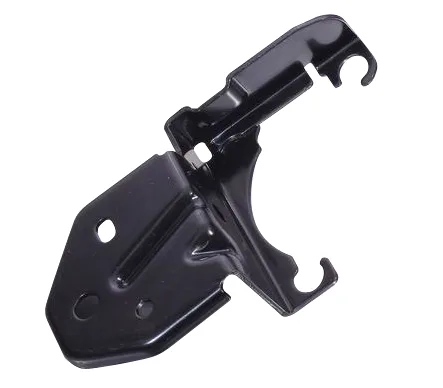
Black powder coat is a specification with a colour match, a film thickness, and an adhesion test
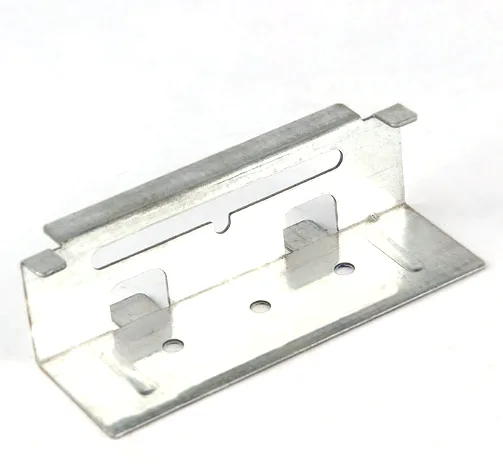
Black powder-coated automotive stamped bracket sounds like the least engineered description in this family – a bracket, painted black. In reality a powder coat on an automotive bracket is a multi-layer system where every layer has a job, and most of the failures people attribute to “powder coating” are failures of the surface preparation rather than of the coating itself. The colour is also a specification with a real tolerance problem: “RAL 9005” and “the black on the previous batch” are not the same thing, and only one of them is testable.
On this part we stamp and form in a progressive die with minimal secondary work, on a press shop with 5-250 T mechanical presses and dedicated dies plus in-house toolmaking keeping dies and fixtures maintained. Formed features to +/-0.05 mm and overall length to +/-0.1 mm, and capability is checked on the first article before the run continues. Batch records are filed so a repeat order starts from approved data. Zinc, nickel or chrome plating, anodising, passivation or e-coat are all available with masking and laser marking where needed, and special material grades are sourced to the drawing when volumes justify. This page is about the coating system, and about why a powder-coated bracket’s spec is longer than an e-coated one’s.
Why powder coating on an automotive bracket is a system
A powder coat is not a paint layer. It is a dry polymer powder, electrostatically sprayed while electrically floating, melted and cross-linked on the surface. Every one of those steps is a requirement on the part and on the process:
- Cleaning. The powder is sprayed onto the surface as a dry, static-attracted layer and then melted. Anything on the surface – drawing oil, cutting fluid, fingerprints, dust – does not evaporate; it burns into the film. This is the single most common cause of a coating failure, and it happens before the coating is even applied.
- Conversion or pretreatment. On steel, a chemical or electrochemical conversion layer gives the coating something to bond to. Without it, the coating sits on top of the steel and adhesion is poor no matter how good the coating is. Where the bracket is zinc-plated underneath, the compatibility between the plating’s surface and the powder’s cure window has to be checked.
- Application. Electrostatic spraying deposits more on surfaces facing the gun. On a folded bracket with deep returns and inside corners, coverage will be thinner on surfaces facing away, and a bracket with a closed cavity will have poor coverage inside. Design and hanger orientation both matter.
- Cure. The powder has to reach its specified melt temperature and hold there. Under-cure leaves the coating soft and chemically incomplete; over-cure or long dwell can discolour it, and on a black coating a colour shift is the visible symptom of a temperature problem.
Colour: the hardest thing to specify on a black part
Black is the most difficult colour to control and the most frequently disputed, for reasons that are worth understanding:
- “Black” spans a wide range. A powder’s black is a blend, and small differences in the blend’s components change its reflectance, its hue and its behaviour under light. Two blacks from two suppliers can look different side by side on the same bracket.
- Surface texture changes the appearance more than the colour does. A fine-texture, medium-texture and smooth powder in the same colour read as visibly different blacks. And on a small bracket, texture is often what someone is reacting to when they say the colour is wrong.
- Finish and gloss vary across a textured surface. A textured surface’s apparent gloss is lower than the same powder at the same gloss rating on a smooth surface, which means a gloss specification and a texture specification are not independent – they have to be given together.
- UV exposure fades it. Most organic powder coatings are not light-stable and will chalk and shift colour over time outdoors. An automotive bracket under sunlight should be specified with the powder’s light-fastness rating stated, or with a powder system designed for exterior exposure.
The practical answer to all of this: a colour reference sample, agreed in writing and physically retained, plus a RAL or Pantone reference for the incoming powder, plus a stated texture and gloss. A reference sample is the only specification that actually resolves a dispute, and it should be retained the way a first article is retained.
Film thickness and adhesion: the measurable requirements
Two requirements should be stated on the drawing, and both are routinely left off:
- Film thickness. Stated as a minimum with an average, because thickness varies on a formed part – it builds on edges and radii and is thinner on flats and on surfaces facing away during spraying. A bracket with a stated 60-80 micron coating will vary naturally across that range, and a drawing that states a single figure invites arguments. Typical automotive exterior powder is 60-120 microns; a functional coating can be much thinner.
- Adhesion. Measured by cross-hatch testing to a stated class, and cross-hatch on a folded bracket is a harder test than on a flat panel because the cut lines cross formed geometry. This is a genuinely good reason to specify the class rather than the word “good”.
And two more that are worth stating: coating must not cover any surface that is a bearing, a thread, a locating face, or a sealing face; and where a coating is present on a surface that will be clamped, its thickness is a dimensional change. A powder coat at 80 microns is 0.08 mm of material, which on this part’s formed-feature tolerance of +/-0.05 mm is more than the whole band.
Geometry: what a coating does to a stamped bracket
- Overall length grows by roughly twice the film thickness, – once at each end. At +/-0.1 mm overall length and an 80 micron coating, that is 0.16 mm of growth, which exceeds the band. The drawing has to state whether the length is before or after coating, and on a coated part that is not pedantry.
- Hole sizes shrink by twice the film thickness. A locating hole that is at its tolerance limit before coating will be out of tolerance after.
- Sharp radii can be coated over or appear rounded, and a coating on a tight inside radius bridges it slightly. On a bracket with a tight form this changes the fit.
- A closed cavity traps no air but does get poor coverage unless it is vented. A vent hole is a design feature, and omitting it produces a coating failure that looks like a defect in the coating and is really a design omission.
- Sharp edges and burrs are the initiation points for coating breakdown, and on a stamping the burrs are where the coating is thinnest. A deburred edge is a coating requirement, not just a handling nicety.
Powder versus the alternatives, for this part
| Powder coating | Thick, hard, impact resistant, economical at volume, and available in any colour with a texture. Weaknesses: thicker than plating so it changes dimensions most, limited light-fastness on standard powders, and it must be vented on enclosed parts. |
|---|---|
| E-coat (electrophoretic) | A cured film deposited electrostatically in a controlled bath. Its strengths are uniform thickness regardless of geometry, excellent coverage including inside cavities, and dimensional change that is small and predictable – usually 15-25 microns. Its weakness is a narrower colour and gloss range and a generally thinner, less robust film than powder. |
| Zinc plating | Not a colour system. Used where sacrificial corrosion protection is the requirement rather than appearance – and a plated bracket can be powder coated on top, though the two need to be checked for compatibility. |
| Hot-dip galvanising | Corrosion protection for a severe environment, not appearance. Far too thick for a dimensional bracket, and its spangled surface is not a cosmetic finish. |
| Anodising, passivation | For aluminium and stainless steel respectively. An anodised layer is part of the metal and adds negligibly to dimensions – which makes it the dimensional answer where a coated part has a tight fit. |
The comparison worth drawing out: on a bracket with tight formed features and a fitted interface, powder coating’s film thickness is often the problem, and e-coat or anodising is the better answer. On a bracket where appearance, impact resistance and colour matter and the dimensions are loose, powder is clearly right. Which one applies is a design decision, not a finishing preference.
Seven things, by how expensive the omission is
Seven things, in descending order of how often they are missing and how expensive the omission is:
- Coating system named – powder with its type, or e-coat – not just “coated”.
- Colour reference, by RAL or Pantone for the material and by a retained physical sample for the appearance.
- Texture and gloss stated together, because they are not independent on a textured surface.
- Film thickness as a range, with any masked areas excluded.
- Adhesion class, by cross-hatch to a stated standard.
- Which surfaces are masked – threads, bearing faces, locating features, sealing surfaces – and this list is also the dimensional exemption list.
- Whether each dimension is before or after coating.
And on the material side, one point worth raising: special material grades are sourced to the drawing when volumes justify, and for a coated bracket the substrate’s surface condition matters as much as the coating. A dead-grey, oily or scale-covered steel will defeat any coating, and specifying a surface condition for the substrate – a cleaned, oxide-free, phosphate-treated or galvanised surface – is the requirement that makes the coating’s adhesion predictable.
This part belongs to our Custom Metal Stamping Parts range. The custom metal stamping parts pages collect the process notes, common materials and inspection points behind every product in the family.
Specifications
| Item | Custom Metal Work Stamping Bending Parts Deep Drawing Sheet Metal |
|---|---|
| Brand | AUNOV |
| Designing | Your drawing sets the part – a manufacturability review comes back with the quotation; the agreed version governs every later batch. |
| Tooling | Progressive and drawing dies are designed and built in house, so tooling lead time stays under our control, and the die remains dedicated to your part. |
| Samples | Samples are issued for approval before the run, so the approved first article becomes the gauge reference, and later batches are gauged back to the signed sample. |
| Materials | Materials held include carbon steel, 304 / 316 stainless steel, aluminium and brass; special grades are sourced to the drawing when volumes justify. |
| Surface finish | Zinc, nickel or chrome plating, anodising, passivation or e-coat; masking and laser marking available where needed. |
| Processing | Stamping and forming in a progressive die with minimal secondary work; batch records are filed so a repeat order starts from approved data. |
| Equipment | Press shop with 5-250 T mechanical presses and dedicated dies, with in-house toolmaking to keep dies and fixtures maintained. |
| Tolerance | +/-0.05 mm on formed features, +/-0.1 mm on overall length; capability is checked on the first article before the run continues. |
| Delivery terms | FOB Ningbo or Shanghai, T/T with deposit and L/C for larger runs; sea or air freight is quoted to your door. |