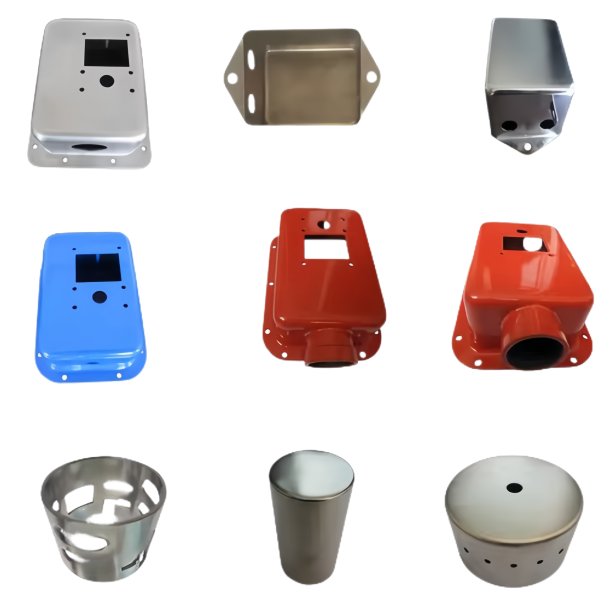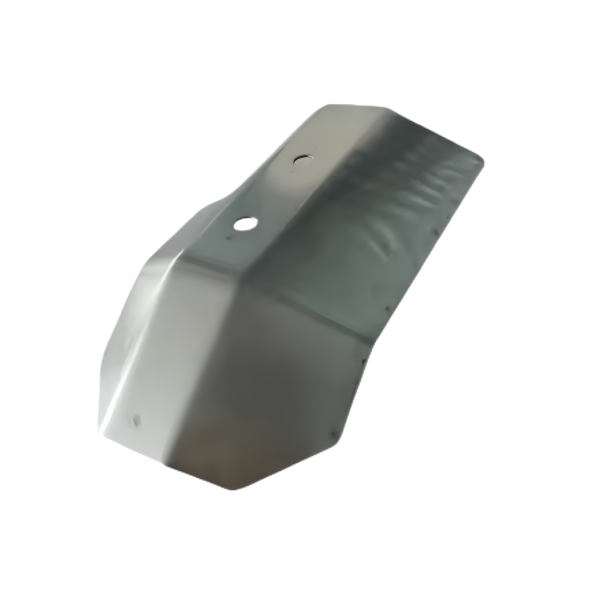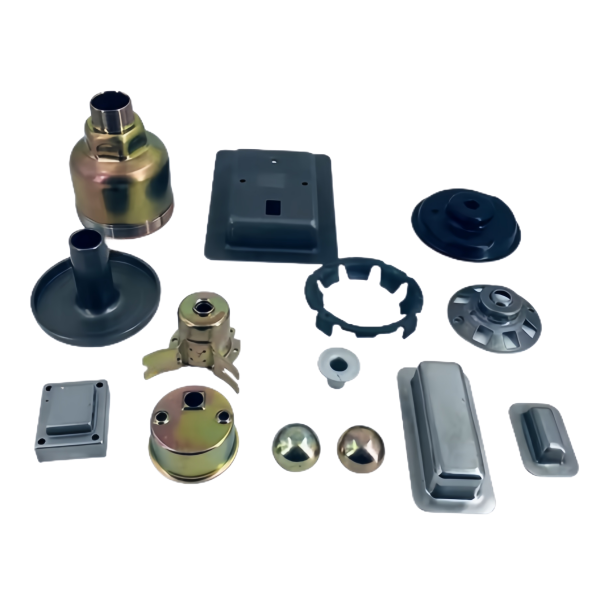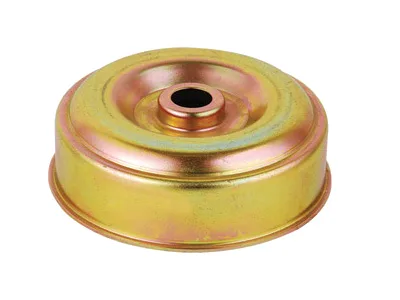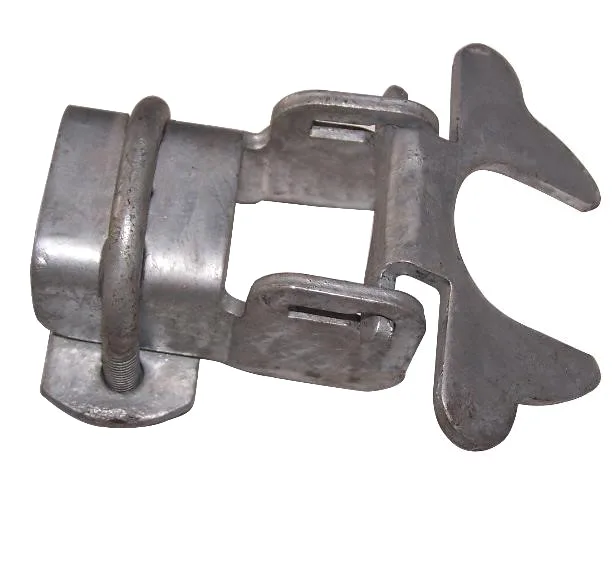
A curved mounting bracket has a direction, and curves are directional by nature
A steel stamped curved mounting bracket is a bracket that is not flat. That single fact changes how it must be designed, because a curve in sheet metal has a direction and everything about the part’s behaviour depends on that direction. A bracket that curves to follow a tank can only be mounted one way round, and a bracket that curves to clear an obstacle has to be curved in a specific direction relative to the load. Most of the ways these parts go wrong come from treating the curve as a stylistic choice rather than as a directional structural feature.
We coil-feed stamp these, deburred and finished to the print, with in-process checks between stages, on 5-250 T mechanical presses running progressive and compound dies, with first articles and batch samples checked on the CMM. Tolerance runs +/-0.05 mm to +/-0.1 mm across the part, with finer bands confirmed from capability data before quoting. Carbon steel, 304 and 316 stainless steel, aluminium and brass are all held in stock, with material substitutes proposed only with your written approval. Surface treatment is matched to the duty – plating, coating or polishing – with alternatives quoted with the quotation and samples approved in writing. This page is about the four things a curve determines, and about the cutouts that usually come with it.
A curve is not a bend, and the difference is structural
A bend is an angle in one plane: the metal is bent about a straight line and the part goes from flat to angled. A curve is different in three ways that matter:
- A curve has a direction of curvature, and a part can only be mounted one way. A bracket that curves to follow a cylindrical surface will not fit a flat surface, and a bracket that curves away from a clearance will only clear on one side. The drawing has to establish the orientation unambiguously, and on a part that looks nearly symmetric this is a genuine risk of being assembled backwards.
- A curve stiffens in one direction and not the other. A curved section is far stiffer in the plane of its curvature than a flat section of the same material – it behaves like a shallow arch. That is often why a curved bracket exists: the curve gives stiffness without adding material. But the corresponding weakness is in the direction perpendicular to the curve’s plane, where the section is a simple flat strip with no arch action at all.
- A curved part cannot lie flat, and so it cannot be measured flat, machined flat, or stored flat. A part with a curve has a defined three-dimensional shape, and any operation that assumes a flat part – a fixture, a straight edge, a lapping surface, a stacking surface – has to accommodate it.
How a curve is made, and what the process decides
A curve in a stamped part is made by bending the material through a radius, and the process has real consequences:
- A tight curve radius needs a generous inside radius. Bending a sheet through a small radius stretches the outer fibre, and on a hard or thick material that will crack. A radius of one material thickness is the minimum for formability; two to three thicknesses gives a much more stable curve and a better fatigue life.
- Springback along a curve is harder to control than at a single bend. At a single bend the springback is one angle. Along a curve, the material’s springback accumulates along the curve’s length, so a long gentle curve and a short tight curve with the same total angle can have quite different final shapes. The compensation has to be designed for the specific curve, and this is one of the places where a bracket designed on a flat sheet and then curved behaves differently from the drawing.
- Two curves in opposite directions in the same part are the hardest case. A bracket that curves in one plane and then curves back is a genuine spatial shape, and the tooling has to form it in a defined sequence because the material’s condition after the first curve affects what the second can do.
- Whether the curve is rolled, press-brake-formed, or drawn in the die. A progressive die forming a curve in the strip is fast and repeatable but the curve’s shape is a tooling dimension. A rolled curve is a slower, separate operation but it produces a more continuous curve and a gentler radius. Which is right depends on the curve’s radius, its length, and the volume.
Cutouts, which are always the second half of the design
A curved bracket with cutouts is the standard combination, because a curved bracket is often being used to save space or to clear something, and the cutouts are usually saving material or providing further clearance. The two interact, and there are four rules that decide where a cutout can go on a curved part:
- Never put a cutout in the plane of maximum curvature’s compression. A curve is in compression on its inside and in tension on its outside. A cutout on the inside of a curve is removing material from an already-stressed and already-shortened region, and a cutout on the outside is removing material from a region where the tension is highest. Both are poor, and the outside is the worse of the two because that is where the stress is.
- Keep cutouts away from the curve’s transition points. Where a curve begins or ends – where it blends into a flat – the material changes direction and the stress changes character. A cutout there is a stress concentration at a stress transition, which is the worst combination.
- Radiused corners on every cutout. On a curved, cyclically-loaded bracket the cutout’s corner is a fatigue crack initiation site, and a square corner makes it much worse. There is no reason to specify a square corner.
- Mind the web between cutouts, especially on a curve. Two cutouts separated by a narrow web on a curved bracket will fail at the web first, and the curvature makes the web’s load path less obvious than it looks in a flat pattern.
Assembly, and the fact that a curved part can go in backwards
On a flat bracket, assembly orientation is usually obvious or it does not matter. On a curved bracket it frequently matters a great deal, and the drawing and the assembly process both have to address it:
- Keying, or a feature that prevents mis-assembly. Where a curved bracket could physically be fitted the wrong way round, and the consequence is a bracket under load, this is a design requirement. An asymmetric hole pattern, a different hole size on one side, or a tab that only fits one way are all standard solutions.
- Marking. On a part where orientation matters and the part is symmetric-looking, a laser mark is a cheap insurance policy.
- The fastener access on a curve. A curved bracket’s mounting face may be flat while the rest of the part curves away, or the curve may be in the mounting region – in which case the fastener’s bearing surface is curved and the washer will bear on its edge. Where a curved bracket is bolted flat, there has to be a flat land, and that land is a design feature.
The curve decides the grade on this bracket, before the environment does
Carbon steel, 304 and 316 stainless steel, aluminium and brass are all held in stock, with material substitutes proposed only with your written approval. On a curved bracket the material choice is driven by the forming of the curve and by the environment:
- SPCC or DC01 carbon steel is the default and forms a curve easily. DC01’s tighter property specification is worth having where the curve’s shape has to be consistent across a batch, because a curved part’s shape is sensitive to the material’s condition.
- 304 or 316 stainless steel where corrosion resistance dominates. Stainless Steel is harder to curve – it springs back more, it work-hardens fast, and it will crack at a tight radius where mild steel would not. The tooling has to be specified for it and the curve’s radius has to be more generous. 316 for salt and marine environments.
- Aluminium where mass matters. It forms a curve readily and its springback is lower, but its stiffness is a third of steel’s – so a curved bracket in aluminium has much less arch action, and the advantage of the curve is largely lost. Where the curve exists for stiffness, aluminium costs more material to achieve the same result.
- Brass where a specific reason applies, and it curves well.
A coating reaches the inside of a curve less well than the outside
Surface treatment is matched to the duty, with alternatives quoted with the quotation and samples approved in writing. Three points on a curved part:
- Coverage on the curve’s inside. A coating reaches the inside of a curve less well than the outside on a sprayed or rack process, and a curved bracket’s inside is often where a cutout’s edge is and where a fastener goes. This is the same crevice problem as any formed geometry, and it is worse on a curve because the whole inside is a relatively inaccessible surface.
- Coating on the mounting land. If the bracket is bolted flat, the land is usually masked, and a coating there would change the flatness and the friction.
- Coating on the cutouts’ edges, where the coating is thinnest and the edge is most exposed. On a curved, cyclically-loaded bracket in a severe environment this is where corrosion will start.
A curve has a direction and can be installed backwards
Eight things, and the first three are what a curved part needs that a flat one does not:
- The curve defined by radius, arc length or chord, and centre, rather than by a picture. A curved feature on a drawing that is described qualitatively cannot be manufactured or inspected.
- The curve’s orientation relative to the rest of the part, stated unambiguously, because a part that is nearly symmetric can be assembled the wrong way round.
- Whether the part can be mis-assembled, and what prevents it – keying, asymmetric features, or a marking requirement.
- Any flat land for a fastener, with its flatness, if the mounting region is curved.
- Every cutout’s position relative to the curve – inside, outside, or at a transition – and its corner radii.
- Tolerance on the curve, and whether it is a profile, a radius, or a positional control. A profile tolerance on a curved feature is the most usable form for a complex curve.
- Material grade and temper, confirmed in writing, since a curved part’s shape depends on the material’s condition.
- Which surfaces are masked, and whether dimensions apply before or after finish.
Does the bracket need to be curved?
Does the bracket need to be curved, or would a flat bracket with a formed feature do the same job? A curve is worth having when the part has to follow a cylindrical surface, when it has to clear an obstacle, or when the curve provides real arch stiffness. It is not worth having when the curve is cosmetic or when it was chosen to look more considered than a flat part. The reason matters: a curve that exists for clearance or for a cylindrical mount has a tight functional tolerance, while a curve that exists for appearance can be specified loosely. Establishing which of the two it is at enquiry is what decides whether the curve needs to be a profile-controlled dimension or a general form, and it is a much better outcome than specifying a tight curve on a part that did not need one.
This part belongs to our Custom Metal Stamping Parts range. The custom metal stamping parts pages collect the process notes, common materials and inspection points behind every product in the family.
Specifications
| Item | Steel Stamped Curved Mounting Bracket with Cutouts |
|---|---|
| Brand | AUNOV |
| Designing | Drawings are reviewed for feasibility, and the agreed version is what production runs against. |
| Tooling | Dies are made and maintained in house, which keeps tooling lead time and cost under control. |
| Samples | Sample parts are measured and reported before submission, so the sample is retained as the master, and the signed sample is kept for future reorders. |
| Materials | Carbon steel, 304 / 316 stainless steel, aluminium and brass are all held in stock; material substitutes are proposed only with your written approval. |
| Surface finish | Surface treatment matched to the duty: plating, coating or polishing; alternatives quoted with the quotation, samples approved in writing. |
| Processing | Coil-fed stamping, deburred and finished to the print; in-process checks sit between stages, not only at the end. |
| Equipment | Press shop with 5-250 T mechanical presses and dedicated dies, with in-house toolmaking to keep dies and fixtures maintained. |
| Tolerance | +/-0.05 mm to +/-0.1 mm across the part; finer bands confirmed from capability data before quoting. |
| Delivery terms | FOB Ningbo or Shanghai, payment by T/T, L/C at sight or D/P; sea or air freight is quoted to your door. |