
CAPABILITY · FINISHING
Secondary Operations & Finishing
CNC trimming and turning, laser welding, plating and anodising, assembly and export packing — finished parts, not half-finished blanks.
From Drawn Blank to Finished Print
A drawn blank is rarely the finished part. Our CNC cells turn, mill, drill and trim drawn shells to final print — sealing faces, threads, cross-holes and chamfers machined in the same shop that drew the shell. Parts that need joining go to our laser welding and riveting stations; assemblies that need hardware go through our automatic tapping and assembly lines.
Protected to the Port, Finished to the Print
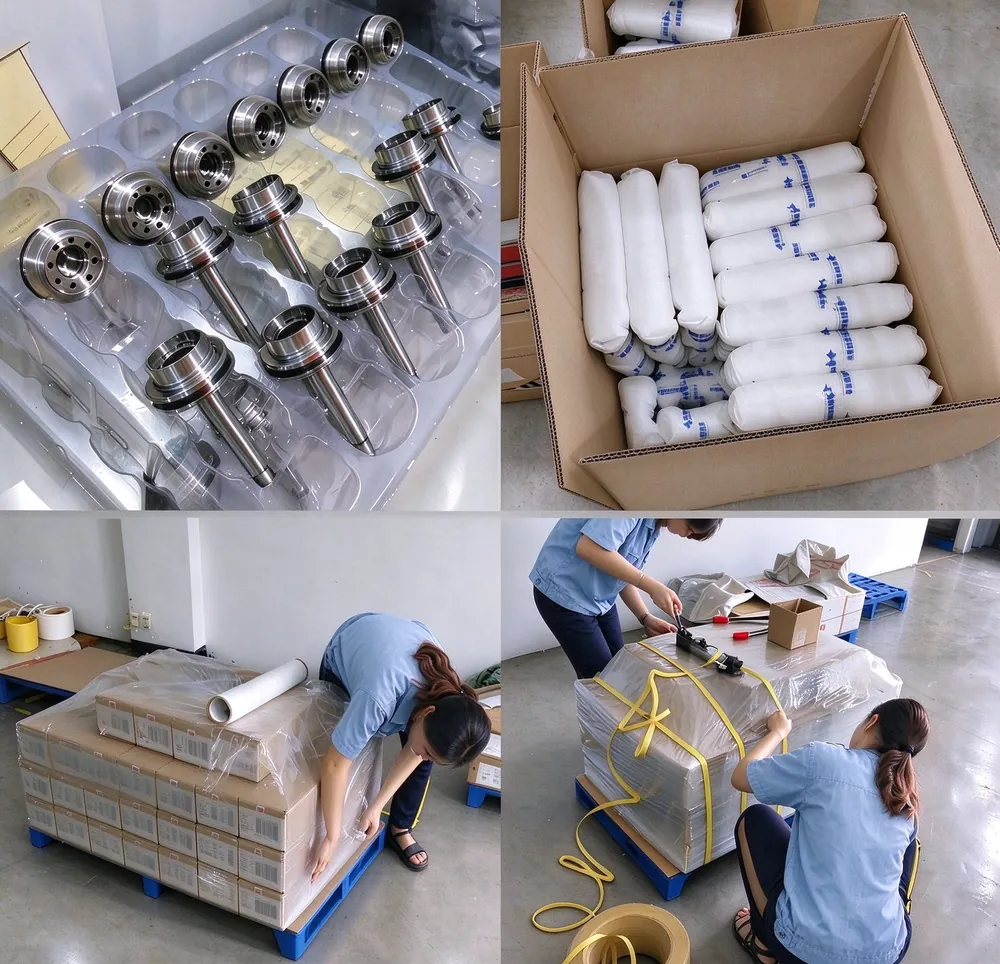
Surface treatment is where drawn parts meet their environment. We manage electroplating (zinc, nickel, tin), anodising, polishing, phosphating and blackening — with salt-spray verification on our own floor rather than trusting a certificate blindly. Coating and corrosion test methods are standardised by ASTM. Export packing is part of the same discipline: VCI paper, foam separators and cartons engineered for sea freight, so a mirror-polished shell looks the same in Ohio as it did in Hangzhou.
Secondary Operations We Run
A drawn shell is rarely the finished part. What happens after the press is often what turns a formed shape into something you can assemble, and doing it under one roof is usually what keeps a programme on schedule.
- Trimming and piercing. The uneven top edge is trimmed to length, and holes or slots are pierced in dedicated stations.
- Threading and tapping. Formed threads suit thin walls; cut threads suit thicker sections where a standard tap is specified.
- CNC machining. Turning and milling handle the surfaces that need tighter tolerances than forming can hold.
- Welding and brazing. Where a part has to be joined to a flange, bracket or tube, the joint is made and finished in the same cell.
- Deburring and polishing. Trim edges on drawn parts are sharp by default; deburring, tumbling and polishing make them safe to handle.
- Plating, anodising and coating. Zinc, nickel, chrome and powder coat protect steel; anodising protects and colours aluminium.
Which Operations Add Cost — and Which Do Not
Not every extra step costs the same. Operations that can be carried out in the press line — coining a step, piercing a hole, forming a flange — add almost nothing, because the part is already in the tool. Operations that need a second setup — machining, welding, plating — add handling, fixtures and queue time, and those show up on the quote.
The practical rule is to ask which features genuinely need a separate operation. A diameter that only has to fit a mating part usually does; a flat that only has to look tidy usually does not. Our painted steel deep drawn enclosure box with flanges is a good example of a part where the flange is formed rather than machined, and the coating is the only true secondary step.
Designing Parts for Efficient Finishing
Finishing problems usually trace back to geometry decided much earlier. Three checks prevent most of them:
- Leave access for the tool. An internal surface that must be machined needs clearance for the cutter.
- Think about how the part is held. A part that cannot be clamped without distortion will not hold tolerance in a second setup.
- Specify the finish where it matters. “Plate all over” is expensive; “plate the external surfaces” is usually enough and much cheaper.
Where machining is unavoidable after forming, the hybrid route — draw the shell, machine only what matters — is normally the best balance of cost and precision. See deep drawn vs machined vs welded housings for that comparison, and our deep drawing process page for the forming side, and our stamping and forming production for stamped and press-formed parts.
Sequencing and Handling Between Operations
The order of operations matters as much as the operations themselves. Trimming before machining gives the machinist a clean datum; plating before assembly avoids coating the threads; and deburring before inspection stops a burr being mistaken for a dimensional problem. Getting the sequence wrong is a common cause of rework that nobody has priced.
Handling is the other hidden cost. Every time a batch is moved, counted, boxed and re-presented, there is an opportunity for damage and delay. Where a part needs several operations, planning them as one continuous route through the workshop — rather than as separate jobs — is usually cheaper and more predictable than optimising each step in isolation.
For buyers, the practical question to ask is not “can you do this operation” but “in what order, and how many times will the part be handled”. The answer tells you more about the likely cost and lead time than any individual capability claim.
Packaging, Kitting and Shipment
The last operation is packing, and it is where finished parts are most often damaged. Small drawn parts nest and scuff in a loose carton; large polished shells mark against each other without separation. Deciding the packing method at quotation stage — layered trays, partitioned bags, or kitting into assembly sets — costs a little and prevents the whole complaint category.
Say what you need on the drawing or the order: separation method, count method, labelling, and whether parts ship as individual components or kitted sets. It is a small line item that removes a recurring source of friction.
Frequently Asked Questions
What are secondary operations in deep drawing?
Secondary operations are the steps carried out after the part leaves the press: trimming, piercing, threading, CNC machining, welding, deburring, polishing, plating and coating. They turn a formed shell into a finished, assembly-ready component.
Can secondary operations be avoided?
Often partly. Features that can be coined, pierced or flanged inside the draw line add almost no cost, while features needing a separate setup add handling and fixtures. Reviewing which features truly need a second operation is the fastest way to reduce finishing cost.
Do you machine deep drawn parts after forming?
Yes. Where a tolerance is tighter than forming can hold, the shell is drawn first and then machined only on the surfaces that need it. That hybrid route is usually cheaper than machining the whole part from solid.
Which finishes can be applied to drawn parts?
Zinc, nickel, chrome and powder coating for steel; anodising in clear or coloured forms for aluminium; passivation and electropolishing for stainless steel; and lacquer for brass and copper to prevent tarnishing.
Does adding a finish change the dimensions?
Yes. Plating and coating add thickness to the surface, so parts that must mate after coating need the coating build-up allowed for in the drawing. Specify which dimensions are measured before and after finishing.
Continue through the capability tour: quality control and material selection.
Talk To Our Engineers
Send your drawing to [email protected] — material advice, tooling plan and a per-piece price within 24 hours.