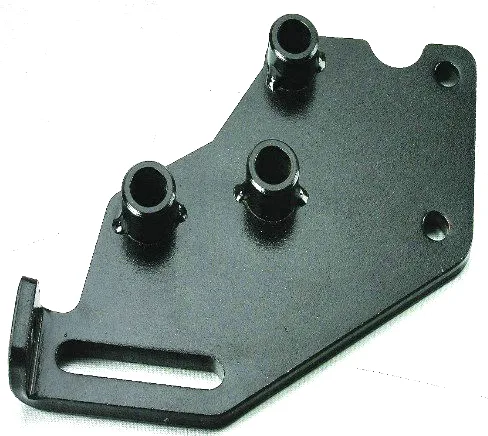
A threaded boss is a thread cut into sheet metal, and sheet metal does not hold threads well
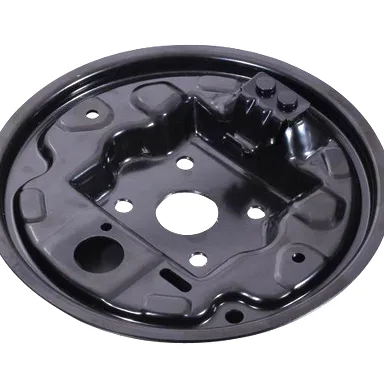
A black stamped bracket plate with threaded bosses looks like a flat plate with a few raised bumps on it, and the bumps exist to carry screws. That is the whole idea, and it is sound – but the engineering of it is entirely about the fact that a screw in sheet metal is a bad idea, and the boss exists to make it less bad. The limits of what a stamped boss can carry determine the design, and knowing where they are prevents a whole family of failures.
We progressive-die stamp these, trimmed and formed in one pass, with first articles verifying the whole flow before the run is released, on a press shop with 5-250 T mechanical presses and dedicated dies, CNC turning centres for secondary operations, and CMM inspection. Formed features to +/-0.05 mm and overall length to +/-0.1 mm, with critical dimensions carrying CMM data with the shipment. Stock covers carbon steel in SPCC and DC01 grades, 304 and 316 stainless steel, aluminium and brass, with material substitutes proposed only with your written approval. Zinc, nickel or chrome plating, anodising, passivation or e-coat are available, and the agreed finish travels with the part number. This page is about the boss, the thread, and the three ways to do it better.
Why a screw in sheet metal strips
A thread in sheet metal is a thread in a short piece of material with no strength behind it. The failure is a simple shear of the surrounding material, and it happens the first time the screw is tightened properly. Three things make it worse, and all three are common:
- Too few threads engaged. A typical rule is at least one diameter of thread length for a serviceable connection and one and a half to two diameters for a permanent one. In sheet, an M3 screw in 1.2 mm sheet gives well under a diameter, and it will strip.
- The screw is tightened harder than the design intended. Assembly-line torque settings vary, and a screw tightened to its full recommended torque in a thin boss will strip on the first unit and be fine on the rest.
- Repeated assembly and disassembly. Each cycle damages the thread’s flanks, and a sheet boss degrades much faster than a machined one.
Boss geometry: what makes it work
A stamped boss is a drawn or formed protrusion with a hole in it, and its ability to carry a screw depends on four things:
| Wall thickness around the hole | The single most important variable. Thread strength in a boss scales roughly with the material’s thickness cubed, so 1.0 mm versus 1.6 mm is a very large difference. This has to be a stated dimension, and it is frequently left as an implication of the boss’s outer diameter. |
|---|---|
| Engagement length | The boss’s height, which sets how much thread is available. A boss tall enough to carry the required engagement is the whole reason it exists. |
| Entry chamfer or countersink | A screw’s first thread has to start somewhere. Without a lead-in, the screw’s first thread lands on the boss’s top edge and cuts it rather than threading into it – and the first failure will always be there. This is a small, cheap, and frequently missing detail. |
| Material around the hole, not just the hole | The boss must be supported by the plate around it. A tall thin boss on a thin plate deforms when the screw is tightened, because the plate itself is what the boss is bending. |
Three better ways, in order of preference
Where the design allows, each of these beats a sheet-metal thread:
- A pressed-in or welded-in metal insert. A brass or steel insert with a proper thread gives full thread strength, and it is the standard answer for a plastic enclosure and a perfectly good one for a stamped bracket. The insert needs to be retained – pressed in with an interference, or welded – and either way it is a specified feature.
- A self-tapping screw into a thicker region. Where the bracket has a thicker section anyway, a self-tapping or self-forming screw into that section avoids a thread entirely. This works well on aluminium and on thicker steel sections.
- A rivnut or a clinch nut. A threaded insert that is installed from the accessible side, giving full thread strength with no boss at all. The cost is that it needs space to install from and a slightly larger hole.
The design question to settle at review is which of the four applies here, and the honest answer is often that the boss exists because the layout does not leave room for an insert – which is a legitimate reason, but it should be a decision rather than a default.
In-die tapping, and the process decision
Where a sheet-metal thread is genuinely the answer, there are two routes, and they differ in more than cost:
- In-die tapping forms the thread in the same press stroke that forms the boss, by passing the sheet through a tapping ring as it is drawn. It is fast and it is nearly free at volume, and it has a hard limit: the thread is formed by displacement, so it is a formed thread, not a cut one. It is a coarse, rounded thread with a reduced minor diameter, and it is not accurate, and it is not repeatable in the sense that a cut thread is. It also cannot be re-tapped or re-drilled without work.
- Machined or cold-formed thread in a secondary operation on a CNC turning centre, or a separate tapping operation. This gives a proper cut thread, can be gauged, and costs more. On a part where the thread carries real load and the assembly is done more than once, it is the right route.
The tolerance structure on this part – formed features at +/-0.05 mm – tells you which of these is likely in play, because an in-die formed thread cannot hold a tight band and a machined one can. Where a thread is on a functional requirement, the drawing should say how the thread is made, because a customer who assumes a cut thread and receives a formed one will be unhappy.
Black finish, and what it does to a threaded boss
The black finish on this part interacts with the bosses specifically, and there are three consequences worth stating:
- Plating on a thread changes its fit. A plated thread is larger than an unplated one, and on a screw that has to go in repeatedly this matters. Threads on bosses should be masked, or specified as post-plate, and on a formed in-die thread the plating will partially fill the form and can make it very difficult to start.
- The coating is thinnest on the boss’s top edge and its corners, which is exactly where a screw’s first thread lands. So a painted or plated boss has a wear point right where the assembly force is applied, and it will look worn early.
- Masking a boss is a per-part operation and it is not trivial on a small part – a plug, a tape operation, or a rack. If a large proportion of the part’s bosses are masked, that operation belongs in the cost and the schedule rather than being discovered as an overrun.
The bracket around the bosses
The bosses do not exist in isolation, and the plate matters as much as the bosses:
- Plate thickness under each boss determines how much the plate stretches when the screw tightens, and a plate that is too thin will dish visibly around the boss.
- Distance between bosses, where two screws go into a plate, must be far enough apart that their stressed zones do not overlap – otherwise tightening one relaxes the other. On a bracket with a row of bosses, this is a real and often overlooked requirement.
- The plate’s flatness at the boss, because a dished surface under a boss’s head gives uneven bearing and uneven torque.
- Whether the boss is on a formed feature or on a flat, because a boss on a bent region is much harder to form and much weaker than one on a flat area.
Materials, and where stainless steel changes things
Stock covers carbon steel in SPCC and DC01 grades, 304 and 316 stainless steel, aluminium and brass, with substitutes proposed only with your written approval. On a threaded boss the choice has a specific consequence:
- Stainless Steel threads gall. A stainless steel boss with a stainless steel screw will gall on assembly and be very difficult to disassemble. This needs a defined friction treatment – a nylon patch, a dry film, or a plating on the thread – and it belongs on the drawing rather than being discovered at the assembly bench.
- Stainless Steel is harder to form, so an in-die formed thread in stainless steel has lower formability and a higher risk of cracking at the boss’s root.
- Aluminium is easy to form and easy to strip, so an aluminium boss needs a thicker wall than a steel one for the same thread, or a self-tapping screw into the material rather than a pre-threaded boss.
- Carbon steel is the forgiving case, and it is why most stamped bosses with in-die threads are steel.
The four that decide whether a boss works
Seven things, and the first four are the ones that make the difference between a boss that works and one that strips:
- Thread size, pitch and class, and how the thread is made – formed in-die, machined, or an insert.
- Wall thickness around the thread, as an explicit dimension, since it is what carries the load.
- Engagement length, and the minimum number of threads required for the load.
- Entry chamfer or countersink on the boss, which is small, cheap, and the difference between a first-attempt assembly and a first-attempt failure.
- The load on the screw, – clamp force, and whether it is a one-time assembly or a repeated service joint. A repeated joint should not be a formed thread.
- Whether the thread is masked from the finish, and whether its dimension is before or after plating.
- Material, and if stainless steel, the galling treatment.
And the review question worth asking, which is the same one every time: has anyone checked whether this boss needs to be a boss at all. A pressed-in insert costs a fraction of what a field failure costs, it gives full thread strength, it removes the forming difficulty from the die, and it eliminates the plating and galling problems in one move. It is worth putting that option on the table at review rather than after the first assembly-line problem.
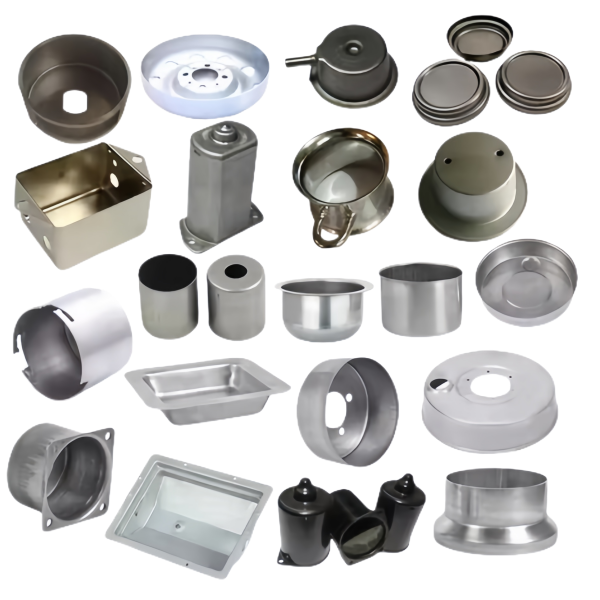
This part belongs to our Custom Metal Stamping Parts range. The custom metal stamping parts pages collect the process notes, common materials and inspection points behind every product in the family.
Specifications
| Item | Deep Drawing Sheet Metal |
|---|---|
| Brand | AUNOV |
| Designing | Your drawing sets the part – DFM notes are returned before any tooling is cut; the same drawing is used for every repeat order. |
| Tooling | Dies, fixtures and gauges are made in our own toolroom, so die cost stays transparent, and maintenance is tracked against the part number. |
| Samples | Approval is in writing, and the signed sample is kept as the reference for repeats. |
| Materials | Stock covers carbon steel (SPCC / DC01), 304 / 316 stainless steel, aluminium and brass; material substitutes are proposed only with your written approval. |
| Surface finish | Zinc, nickel or chrome plating, anodising, passivation or e-coat; the agreed finish travels with the part number. |
| Processing | Progressive die stamping, trimmed and formed in one pass; first articles verify the whole flow before the run is released. |
| Equipment | Press shop with 5-250 T mechanical presses and dedicated dies, with CNC turning centres for secondary operations and CMM inspection. |
| Tolerance | +/-0.05 mm on formed features, +/-0.1 mm on overall length; critical dimensions carry CMM data with the shipment. |
| Delivery terms | FOB, CIF or DDP per Incoterms 2020, T/T or L/C, with D/P accepted on repeat business; call-off schedules are supported. |