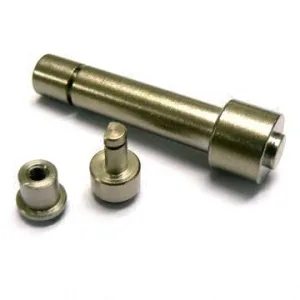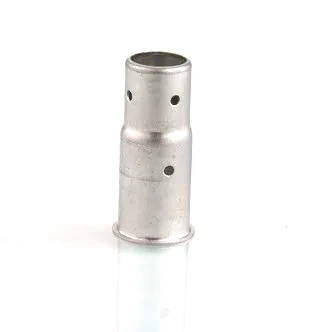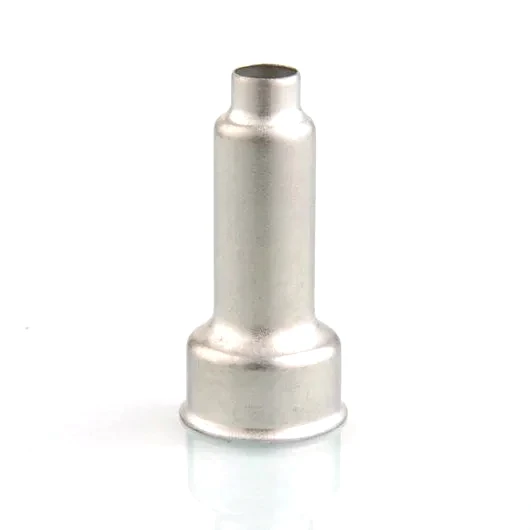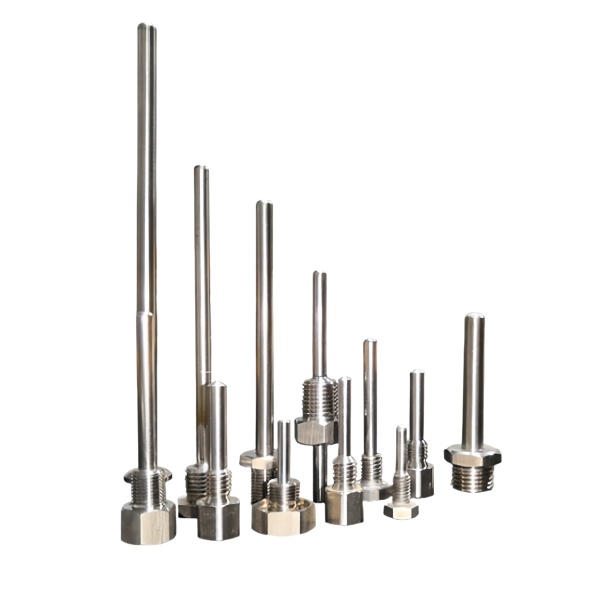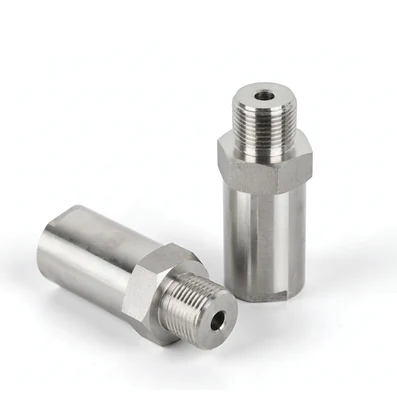
An IP67 rating is a promise about water and dust, and on a machined sensor housing it is a structural promise rather than a material one. IP67 says: dust-tight, and protected against temporary immersion in water up to one metre for thirty minutes. Nothing on that sentence is achieved by choosing the right alloy. It is achieved by geometry – by the housing having no opening that water can enter through, and by every joint in it being a joint rather than a gap.
Blanking, drawing and piercing in sequence, then machining of sealing faces, at +/-0.01 mm on thread pitch diameters and +/-0.05 mm on the drawn body. So the tight band is on the thread – and on an IP67 housing the thread is not the main event. The main event is every opening the design happens to have.
What IP67 actually requires, and where it fails
- Dust-tight means no opening that lets dust in. On a sensor housing that has a vent – a pressure-equalisation vent, a membrane – the membrane has to be dust-locking and not merely water-repellent, and that is a specific component with a specific rating of its own.
- And temporary immersion means the whole housing is under water, not a splash. So any opening that would let water in under a splash – a cable entry, a vent, a mounting hole that penetrates – will let water in under immersion. IP67 does not allow a pressure-equalisation vent that breathes in water.
- Which means the design has to choose: is this housing vented or is it sealed? A vented housing and a sealed housing are different products, and an IP67 vented housing uses a membrane that lets air through and water out of – a one-way valve in a silicone or a PTFE membrane, rated for the immersion.
- And the failure mode when a design is wrong is not a leak. It is water inside, trapped, and not drying. A housing that passed IP67 and then collected water from condensation will corrode internally, and the external rating will still be stamped on it.
Every opening is a design decision
On a sensor housing the openings are almost always there for a reason, and each one has to be brought into the rating rather than exempted from it.
- The cable or lead entry. The hardest one, because a cable has to move and a seal that permits movement permits water. The three standard answers: a gland that compresses a seal onto the cable’s jacket, a moulded boot that is part of the assembly and carries the flex, or a potted entry where the cable is embedded in a compound. Each has a different IP rating and a different failure mode.
- The pressure-equalisation vent. On a housing that breathes, the vent is a component and it is rated. On a fully potted housing there is no vent because nothing can move.
- The mounting holes. If a bolt passes through the housing into the inside, that bolt’s clearance is an opening. The solution is a sealing washer, a potted fastener, or a blind hole – and it must be decided on the drawing, because the assembly is somebody else’s job.
- The sensor port. Where the element or the process connection enters, that is the wettest opening on the part and it is usually a separate seal – an O-ring, a face seal, or a welded closure.
So the drawing question is: list every opening on this housing, and state the sealing method for each. That list is the IP rating.
The joint, which is where IP ratings are usually lost
A housing with a lid has a parting line, and that line is the weakest point in the whole rating. Three things have to be true at it.
- The mating faces have to be flat and parallel. This is why the tight band on this part is not only the thread – the sealing face’s flatness is at least as important, and it is measured against a stated datum with a stated support condition.
- The joint has to be sealed, and the seal’s compression has to be controlled. A gasket in a groove with a defined compression; a bonded seal; or a welded or brazed closure with no joint at all. Where the joint is bolted rather than sealed – a cover held by screws with no gasket – then the rating depends on the bolts’ preload keeping the faces together, and that is a design calculation rather than a tolerance.
- And the parting line has to drain or not trap. A horizontal parting line on a submerged housing will hold water in it, and water held against a metal surface in a crevice is where corrosion starts. This is a design feature – a drain hole, a sloped face, a parting line placed where it cannot trap – and it is invisible on a drawing unless somebody thinks about it.
Material, and the two questions that are not corrosion
Standard stock: carbon steel, 304 and 316 stainless steel, aluminium, brass, with special grades sourced to the drawing when volumes justify. On this part the material is chosen by the process, and then two other requirements arrive.
- Galvanic corrosion inside the housing. A housing that is IP67 on the outside and drains water inside will have two dissimilar metals in the presence of that water – the housing and its fasteners, or the housing and an internal shield – and the internal couple is not protected by any coating on the outside. On a marine or a road-salt environment this is the mechanism that ends the part’s life.
- And the surface finish, which on an exterior is not cosmetic. A coated housing in a wet environment will be chipped at the mounting faces and at the grip area, and every chip is a corrosion site. So on a part with an IP rating the finish’s adhesion test is a functional requirement and the wear areas need to be identified rather than assumed.
Tolerance, and which dimensions carry the rating
+/-0.01 mm on thread pitch diameters and +/-0.05 mm on the drawn body, with GD&T per drawing and PPAP-style reports on request. On this part the flagged dimensions are the ones that either seal or locate, and the thread’s tight band is on its own account rather than for the rating.
- Sealing face: flatness and perpendicularity, against a named datum, in a stated support condition. This is the dimension that carries the joint.
- Any gland or seal groove: its depth and width, because the seal’s compression is set by the groove and a groove that is half a millimetre deep produces a seal that is not a seal.
- Thread: class and pitch diameter, gauged, and the sealing method stated – thread, face, or gasket.
- Bore concentricity to the sealing face, where the part is located by a spigot rather than by its bolts.
- And the requirements that are not dimensions: the list of every opening with its sealing method, the vent’s rating if there is one, and the drain strategy for any horizontal parting line. Those three are the IP rating, and none of them is a tolerance.
An IP rating is verified by the functional half of the plan
Every stage logged against the part number, with secondary operations on CNC turning centres and inspection on the CMM. On an IP-rated housing the inspection plan has two distinct halves and the second one is what actually verifies the rating.
- Dimensional: the sealing faces, the gland geometry, the thread, the concentricity – as above.
- Functional: an IP67 test on a sample, by immersion and by dust test. This is the only inspection that verifies the rating, and it is a test of the assembly rather than of the part – which is why it is worth specifying who performs it.
- Finish thickness and adhesion on the first article, with the masked areas verified – and on this part the masked areas are the sealing face, the gland, the thread, and any datum.
- And the parting line’s condition, verified: no burr, no step, nothing that would trap water or that would hold a gasket outside its groove.
Vented or sealed, and does anyone ever open it?
Is this housing vented, and is it ever going to be opened? Two questions, and they decide most of the rating. A vented housing needs a pressure-equalisation membrane rated for the immersion and it cannot be fully potted; a sealed housing can be potted and it is simpler. And a housing that is opened in service – to replace an element, to reach a terminal, to adjust something – has a rating that applies only when it is closed, which is a different product from one that is never opened and whose rating applies permanently. There is a third question that is worth asking on an IP-rated sensor housing because it is the one that produces returns: what is the actual mounting orientation, and is the housing ever mounted upside down or on its side? Because a housing rated for immersion will have water in it whatever the rating says, and where that water collects depends on the orientation and on the internal geometry – and internal water that cannot drain is what corrodes the inside of a part whose outside still looks new. So the rating tells you it can survive immersion. It does not tell you it can survive immersion repeatedly, and those are different requirements.
Sensor Housings is the range this part sits under; the overview page pulls together the tooling logic, finishing options and tolerance notes that apply across the family.
Specifications
| Item | Sensor Housing CNC Machining Stainless Steel Aluminum IP67 Rated |
|---|---|
| Brand | AUNOV |
| Designing | Driven by your drawing or a physical sample – unusual walls, threads or tolerances are feasibility-checked first; the agreed version governs every later batch. |
| Tooling | Die design and toolmaking stay in house, so die cost stays transparent, and the charge is refundable against agreed volumes. |
| Samples | Sample approval is documented: dimensions, finish and material recorded for later comparison. |
| Materials | Standard stock: carbon steel (SPCC / DC01), 304 / 316 stainless steel, aluminium, brass; special grades are sourced to the drawing when volumes justify. |
| Surface finish | Zinc, nickel or chrome plating, anodising, passivation or e-coat; masking and laser marking available where needed. |
| Processing | Blanking, drawing and piercing in sequence, then machining of sealing faces; every stage is logged against your part number. |
| Equipment | Hydraulic presses for drawing, with CNC turning for finishing; secondary ops run on CNC turning centres, inspection on the CMM. |
| Tolerance | +/-0.01 mm on thread pitch diameters, +/-0.05 mm on drawn body; GD&T per drawing, PPAP-style reports on request. |
| Delivery terms | FOB, with DDP offered for EU and US addresses, T/T with deposit and L/C for larger runs; call-off schedules are supported. |