
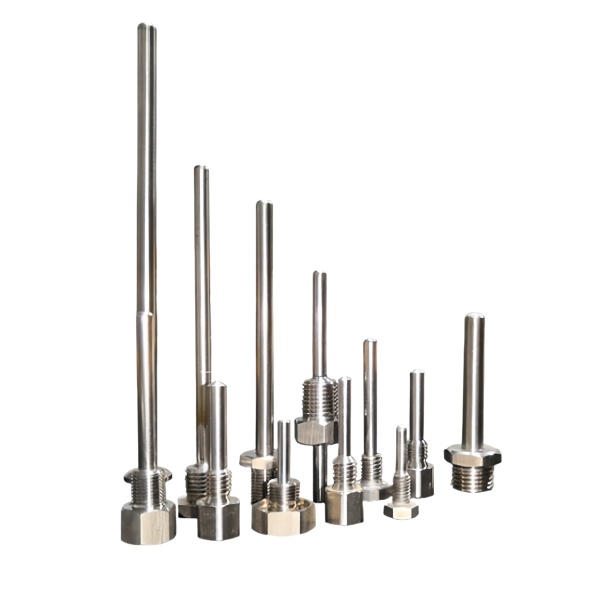
A mixed length order is bought as one part number, but it is used as several different instruments. This set of stainless steel thermowell probes is the same probe drawn in a range of lengths, so a single purchase covers every immersion depth the installation needs – and the set only earns its keep if the lengths behave as one family rather than as unrelated parts that happen to look alike.
What a mixed length order has to deliver
Each length in the set exists because some point in the process has to be reached that the other lengths cannot reach. A short probe sits close to the port; a long one puts the tip into the moving stream. The buyer is therefore not ordering spare parts of one size – they are ordering a range of measurement positions, and every length has to land its tip in the region that length was chosen for. A probe that misses its depth by a few millimetres is not a shorter probe, it is a wrong probe for that position.
The features that must not move when the length does
Because the set is drawn as one design, anything that is not the length has to be identical from the shortest member to the longest: the same tip form, the same thread, the same bore, the same material and the same finish. If the thread pitch drifts on one length, or the tip radius quietly changes on another, the instruments downstream can no longer be swapped between positions and the set has failed at the one job it was bought for. We hold the shared features as a single specification and let the length be the only variable.
Straightness on the longest member sets the limit for the set
Length is what makes these probes difficult, and the longest member is where the difficulty shows. A slender stem that is easy to keep true at 60 mm will bow at 200 mm, and a bowed probe either will not pass the port and its guide, or it passes and then sits with its tip off the centreline where the flow is weaker. Straightness is therefore specified per length rather than for the set as a whole, and it is held by supporting the stem through manufacture and packing instead of being straightened afterwards.
Deeper immersion means a slower and different reading
The lengths are identical in construction but not in behaviour. Heat reaching the tip of a long probe has travelled further along the wall, and the tip of a long probe usually sits in a different part of the flow than a short one – often where the temperature genuinely differs, not just where it is measured later. Two lengths in the same set can therefore report different values in the same vessel without either being wrong. We tell buyers this at quotation stage so the length is selected for the measured position rather than for convenience.
How a mixed length set is checked before it ships
Each length is inspected against the shared specification and against its own target depth, so a set that is internally consistent can be demonstrated rather than assumed.
First articles and retention samples are kept per length for the programme, so a reorder is built to the same verified family rather than to a remembered one. On a set whose value is interchangeable consistency across a range of immersions, that is what keeps the second batch behaving like the first.
Parts like this one sit under the Sensor Housings range, whose overview page gathers the tooling logic, finishing options and tolerance notes shared across the family.
Where this part is used
Assorted-length thermowell probes cover multi-point measurement in one vessel or duct, where a single order has to supply several immersion depths against the same port standard. They are common in tanks and mixers, in HVAC duct arrays, and in OEM programmes that standardise one probe family across a product range and order it in a length schedule.
The commercial attraction is a shared port and a shared tool family with a length list attached. The technical risk is the opposite: a length change that quietly moves the part into a different tonnage or a different press, which shows up as straightness problems on the longest item.
What we need to quote it
Send the length list with the quantity per length, and confirm the port standard is shared across the set. Tell us whether the lengths may be grouped into one die family or whether the longest and shortest need separate tools, and whether the shortest items can run on the same line as the longest without a press change.
Specifications
| Item | Stainless Steel Thermowell Probes Assorted Lengths |
|---|---|
| Brand | AUNOV |
| Designing | Send the drawing, or a sample we can measure, a manufacturability review comes back with the quotation. |
| Tooling | Dies designed and built in our own toolroom, with your part number on the tool record. |
| Samples | First-off samples of the probe are sent with dimensional data plus material certs. |
| Materials | 304 / 316 stainless steel is the primary stock for this part, alongside carbon steel (SPCC / DC01), aluminium, brass and copper, with the final grade confirmed at the drawing review. |
| Surface finish | Plating, e-coat, powder coating, anodising or passivation as the drawing calls out, selected against the drawing requirement. |
| Processing | Deep drawing in stages, in-line annealing where needed, pierced and machined on the same floor. |
| Equipment | 5-250 T mechanical presses plus 250-500 T hydraulic presses, CNC turning and milling cells, a climate-controlled CMM room. |
| Tolerance | Tolerances to +/-0.1 mm as drawn, +/-0.03 mm on machined features. |
| Delivery terms | FOB as standard, DDP available for EU and US destinations, T/T or L/C, with D/P for repeat business, call-off scheduling supported. |
Related Products


Frequently Asked Questions
Why is a mixed length order one part number but several instruments?
This set is the same probe drawn in a range of lengths, so a single purchase covers every immersion depth the installation needs. It only earns its keep if the lengths behave as one family rather than as unrelated parts that happen to look alike. Assorted-length probes cover multi-point measurement in one vessel or duct against the same port standard.
What must stay identical when only the length changes?
Because the set is drawn as one design, anything that is not the length has to be identical from the shortest member to the longest: the same tip form, the same thread, the same bore, the same material and the same finish. If the thread pitch drifts on one length, or the tip radius quietly changes on another, the instruments can no longer be swapped between positions. The set has then failed at the one job it was bought for.
Why does straightness on the longest member set the limit?
A slender stem that is easy to keep true at 60 mm will bow at 200 mm, and a bowed probe either will not pass the port and its guide, or passes and then sits off the centreline where the flow is weaker. Straightness on the longest member therefore sets the limit for the whole set. It is checked before a mixed length order ships.
Why does deeper immersion give a slower and different reading?
Length is not a neutral dimension on a thermowell, because a deeper member changes both the conduction path and the response. A probe bought as one part number is used as several instruments, and the reading each gives depends on where its tip sits. Send the immersion depth each position needs so the set is drawn to behave as a family.
Request a Quote for This Part
Send a drawing or sketch — get material advice, tooling cost and a per-piece price within 24 hours (working days).