
CAPABILITY · MATERIALS
Material Selection & Sourcing
The right alloy, the right temper, the right mill — verified before it reaches the press.
Alloys, Tempers and Thicknesses
Deep drawing punishes the wrong material choice. Formability, springback, finish and corrosion resistance all hang on the alloy and temper, so we help customers select material as part of the quote — not after the first batch of cracks. We stock and draw the grades below in thicknesses from 0.15 mm to 3.0 mm, in quarter-hard to full-hard tempers as the part demands.
All stocked grades are supplied to recognized standards — stainless steel to ASTM A240 / JIS G 4305, cold-rolled low-carbon steel to EN 10130 / JIS G 3141, aluminum to ASTM B209 / JIS H 4000, and copper alloys to ASTM B152 / JIS H 3100.
Mill Certificates and Incoming Checks
Every coil arrives with its mill certificate — grade, temper, thickness and heat number — and every lot is re-verified in-house before it is released to the press shop. Thickness is measured across the coil, mechanical properties are sampled against the certificate, and material identity is recorded so that any finished part can be traced back to its heat.
Because we buy in volume and draw daily across these grades, our mills give us consistent quality and honest lead times — and when a customer needs a specific mill brand or a RoHS / REACH declaration, it is part of the standard paperwork, not a special favour.
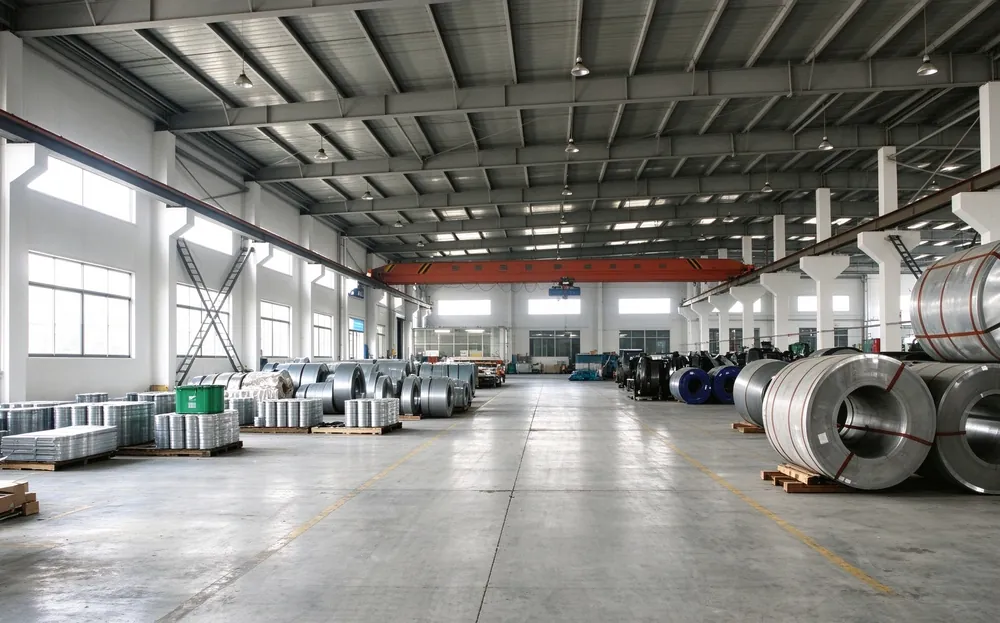
Materials We Source and Draw
A deep drawing project succeeds or fails on the strip of metal you start with. Two coils carrying the same grade number can behave differently on the press, because drawability depends on grain structure and inclusion content as much as on chemistry. We buy to a drawing specification rather than a generic sheet specification, and we name the standard, the temper and the surface finish on every order.
- Austenitic stainless steel 304 and 304L. The default for drawn shells, housings and cups. Work hardens quickly, so multi stage draws usually need an intermediate anneal.
- Austenitic stainless steel 316L. Specified for chloride exposure or for welding into a corrosive service line. Molybdenum raises strength and shortens the run between anneals.
- Ferritic stainless steel 430 and 439. Cheaper than the 300 series and magnetic, which matters for solenoid bodies. Suits simple axisymmetric shapes rather than severe reductions.
- Low carbon steel DC04, DC05, SPCC and SAE 1008 to 1010. High elongation, low tool wear, and the cheapest route to a painted or plated housing.
- Aluminium 1050, 1060, 1100 and 3003. High elongation grades used for enclosures, reflector shells and heat sink cups where weight and conductivity matter.
- Copper C110 and C122, brass C260 and C268. Drawn for valve tubes, terminals and contacts. Copper needs soft temper and clean lubrication to avoid surface pickup.
Surface finish is part of the specification. For stainless steel we start from 2B or BA depending on whether the part will be polished, passivated or left as drawn. A 2B finish holds lubricant and hides minor die marks; BA is brighter but shows every tooling scratch. Where a customer needs a mirror finish on a stainless steel deep drawn cup, we plan the starting finish and the polishing sequence together, because uneven polishing can thin the wall below the specified minimum.
We also advise against over specifying. A part that will be plated or powder coated does not need a premium surface, and one that never sees a corrosive environment rarely needs 316L. Downgrading from austenitic stainless steel to a ferritic grade or to aluminium often saves more than any tooling change, and our guide to material selection for deep drawing sets out the trade offs.
Thickness, Temper and Coil Width
Thickness is the first number we check against the drawing. Our production range runs from about 0.15 mm to 3.0 mm, with most deep drawn work between 0.3 mm and 1.5 mm. Below 0.3 mm the blank wrinkles easily and the tool needs tighter clearances. Above 2.0 mm press tonnage and die section sizes climb fast, and machining or welding is often the cheaper route.
Temper matters as much as thickness. Deep drawing grades are supplied annealed or dead soft, with elongation above 40 percent for austenitic stainless steel and above 30 percent for aluminium 3003. Quarter hard and half hard tempers give higher finished strength but lose elongation, and suit only shallow draws or parts that are formed first and then used as a structural shell.
- Thickness tolerance held to the governing standard, normally plus or minus 0.02 mm under 1.0 mm, checked at three points across the coil width.
- Grain size checked on critical jobs. Coarse grain above about ASTM 7 gives orange peel on stainless steel after forming; very fine grain raises forming loads.
- Coil width and slitting matched to blank diameter so we buy the narrowest coil the nesting allows. Better nesting is a direct saving on every part.
- Earing measured on the first coil of each new heat. Earing height sets the flange trim allowance.
Blank diameter is calculated from surface area and then corrected by trial. Blanks are sheared or laser cut depending on volume and edge quality, then deburred, because a burr on the blank edge starts a crack in the first reduction. For thicker material and for aluminium enclosures with rounded corners, we also check blank flatness, since coil set that has not been levelled will not feed consistently through the blankholder.
Certification and Traceability
Every coil arrives with a mill test certificate to EN 10204, type 3.1 for most work and type 2.2 where a customer accepts a declaration without actual test results. The certificate carries the heat number, the cast analysis, the mechanical results for that heat and the dimensional check. We do not accept conformity only documents for pressure containing parts.
Traceability runs from the coil to the finished box. Each coil gets an internal lot number on arrival, that number travels on the job card through slitting, blanking, drawing and packing, and it appears on every carton label. A complaint raised twelve months later can be traced back to the coil, the heat, the press and the shift.
- Mill certificates retained for ten years, or longer where the customer contract requires it.
- RoHS and REACH declarations issued at alloy level rather than part level.
- Conflict minerals reporting on request, with country of origin taken from the mill certificate.
- PPAP level 3 submissions supported for automotive programmes, including dimensional reports and a process flow.
Where a specification is unusual we source it rather than substitute it. We have bought dual certified stainless steel, controlled oxygen copper and restricted iron aluminium, all with certificates covering the extra requirement. Substitutions happen only with written approval, and the quotation states which grade the price is based on. The limiting draw ratio chart for each material is what tells us, before any tool is cut, how many reductions a given shell will need.
Frequently Asked Questions
Which material is best for a deep drawn part?
There is no single best material, only the best fit for the geometry and the service environment. Low carbon steel and aluminium 3003 give the deepest single stage reductions, while austenitic stainless steel 304 gives corrosion resistance at the cost of more frequent intermediate annealing. We start from the operating environment and then check whether the required depth is reachable with that alloy.
Can you supply stainless steel with a specific surface finish?
Yes. Stainless steel is normally supplied in 2B or BA, and we can also source No. 4 brushed, bright annealed and pre polished material. We agree the finish before the coil is ordered, because it affects both price and how the surface behaves during forming.
What thickness range can you draw?
We draw from about 0.15 mm to 3.0 mm, with most production work between 0.3 mm and 1.5 mm. Thinner material needs tighter tooling clearances and closer blankholder control, and thicker material needs substantially higher press tonnage.
Do you provide material certificates with every shipment?
Yes. Every shipment can be supplied with the mill certificate for the coil used, referenced to the lot number printed on the carton label. A summarized certificate of conformance can be issued instead where that is what the customer needs.
Can you source a grade outside your standard list?
Yes, we buy against specification rather than only from stock. Lead time is longer because the mill has to schedule the heat, and there is a minimum coil weight, so we tell you the quantity at which a special grade becomes practical.
Continue through the capability tour: the deep drawing process and secondary operations & finishing.
Talk To Our Engineers
Send your drawing to [email protected] — material advice, tooling plan and a per-piece price within 24 hours.