
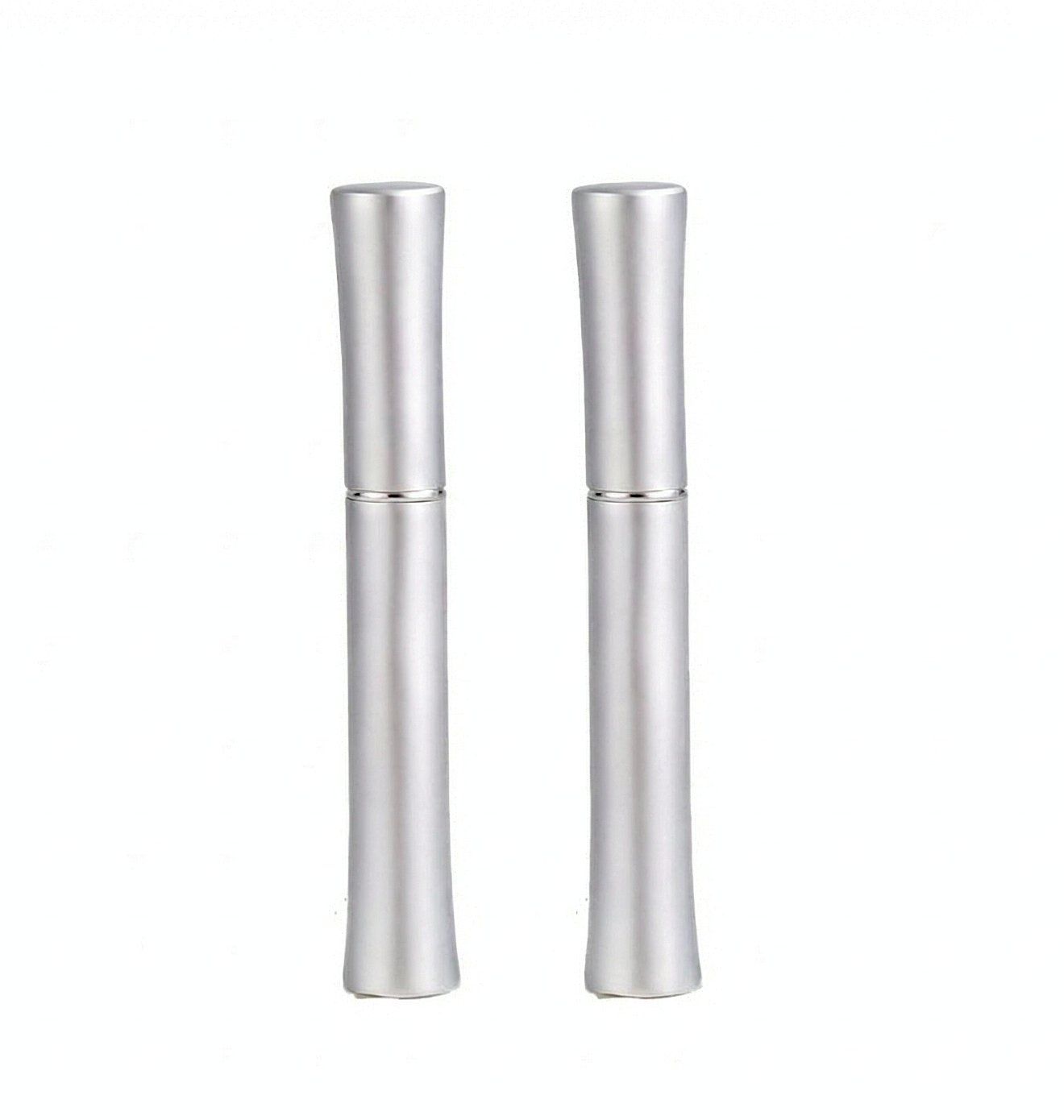
A mascara tube is a pressure vessel nobody pressure-tests
An aluminium mascara tube has to do two jobs that pull against each other. It has to hold a cosmetic fluid – which means it must not leak, must not corrode, and must not let anything from the metal into the product. And it has to look and feel like a luxury object in a customer’s hand – which means a smooth, bright, even finish across a surface that is frequently handled and frequently visible. Almost every technical decision on this part is a consequence of those two jobs meeting.
We blank from coil and draw progressively, with coining on the final station where the print calls for it, on mechanical presses from 5 to 250 T and hydraulics from 250-500 T with in-line annealing available. Turned secondary features are held to +/-0.03 mm and as-drawn walls to +/-0.1 mm, with first articles and batch samples checked on the CMM. This page covers the aluminium choices, the surface requirements that cosmetics demand, and the drawing details that decide whether the tube looks good.
Which aluminium, and why the answer is 1050 or 3003 more often than 6061
We work in 1050, 3003, 5052 and 6061 across 0.5-3.0 mm stock, with temper matched to the forming depth or machining route of this tube. They are not interchangeable, and the difference shows up in the two places that matter on a cosmetic part.
| 1050 (pure aluminium) | The most ductile and the best surface finish of the group – it takes a bright drawn or polished surface readily. Lowest strength. This is the standard choice for a tube where appearance is the primary requirement and the wall is thin. |
|---|---|
| 3003 (with manganese) | Slightly stronger than 1050 with good formability and a good surface. The usual selection where a little extra strength is needed for a stepped or shouldered tube, and the most widely used alloy in cosmetic packaging. |
| 5052 (with magnesium) | Considerably stronger with good corrosion resistance. Harder to draw to a fine surface and more likely to show tooling marks, so it is chosen where stiffness or a specific corrosion duty matters more than a mirror finish. |
| 6061 (with magnesium and silicon) | The machinability alloy. Chosen where the tube has significant CNC finishing, threads, or machined features rather than where it is purely drawn. Its draw formability is the poorest of the four. |
For a mascara tube the usual answer is 1050 or 3003 in a drawn temper. Higher-strength alloys resist a cosmetic formula’s surfactants and solvents less well and take a less even surface, and on a part this visible the finish is worth more than the strength.
Anodising is the natural finish, and it has its own rules
Anodising is the standard finish on aluminium cosmetic tubes, and the options are:
- Type II sulphuric anodising – the workhorse. Produces a hard, clear, corrosion-resistant layer with excellent dyeability, which is how coloured mascara tubes are made. Thickness typically 5-25 microns.
- Type III hard anodising – thicker and harder, with a slightly different surface character. Used where abrasion resistance is a requirement, but it darkens the surface and can look different on a decorative part.
- Electropolishing before anodising – the sequence that produces the best appearance. The electropolish removes fine drawing lines and gives a mirror base, and the anodising then hardens that surface. Where appearance is the point, this is the combination.
Three anodising details belong on the drawing:
- Masking. Any surface that must stay metallic, any mating thread, and any ground or datum face must be masked. A thread that is anodised changes size and can seize against its mating part, and a masking operation has to be specified rather than assumed.
- The appearance standard. “Bright” is not a specification. A cosmetic part needs an agreed reference sample, because anodising has a natural colour variation between batches and a reference sample is the only way to define the acceptable range. We quote alternatives with samples approved in writing.
- Coating not included in dimensions. Anodising grows outward on the surface, so every external dimension increases. Whether the drawing dimensions are before or after finishing must be stated.
Zinc, nickel or chrome plating and e-coat are also available and quoted where the print calls for them, but on aluminium they are less usual for cosmetic work because the plating has to be sealed and the appearance is harder to make consistent. Passivation is the route where the aluminium must stay bright and uncoated.
The drawn wall is the whole product
A mascara tube is a thin-walled drawn cylinder, and thin-walled is where the draw is hardest. At 0.5-0.8 mm on a tube of cosmetic diameter, the wall is not thick enough to hide anything – a draw line, a scratch, a thinning ridge or an out-of-round section is visible through the wall from the outside and cannot be polished out without going through it.
What that means in practice:
- Roundness is a cosmetic requirement. A tube that is out of round changes the highlight running along its length, and on a metallic finish the change is obvious. Roundness has to be controlled as a real dimension, and it is checked in a fixture rather than with a micrometer across one diameter.
- The inner and outer surfaces are coupled. On a drawn tube, any imperfection inside is often visible outside through the highlight. Tool wear that has worn the punch shows on the inside surface of the tube, and it is visible.
- Drawing direction and temper matter. Drawn tube has a longitudinal grain from the drawing process, and any later forming or a deep emboss will crack along it. The temper is chosen to match the forming depth rather than to match the alloy nominally.
- Scratches are cumulative. In-process handling between coil, blanking, drawing, annealing, finishing and packing is where a cosmetic tube is actually lost. A tube with a good finish that is scratched in the drum is a reject, and this is a process-control problem rather than a drawing problem.
Geometry details that matter more than they look
The functional features on a cosmetic tube are small, and each one has a tolerance that is tighter than the general wall tolerance:
- The neck and thread. Where a pump or an applicator assembly screws on, the thread has to be cut to a controlled pitch and diameter. Turned secondary features at +/-0.03 mm cover this, and the thread is cut on a CNC turning centre rather than formed in the draw – a formed thread cannot hold a usable profile on a thin wall.
- The crimp or rolled seam. Most mascara tubes are closed by rolling the tail over. The crimp needs a defined thickness band so the seal holds and the tube does not split at the crimp. This is a common and often overlooked failure.
- The shoulder or step. Where the tube has a transition between diameters, that step is where the draw is most difficult and where the wall is thinnest. The step is also a stress concentration when the tube is squeezed, so the radius matters.
- The base. If the tube stands on its own, the base needs a flat enough seating surface to look stable and to take a label. A drawn base is usually coined to control it.
Cosmetic compatibility is a real specification
The tube’s inner surface is in contact with the formula for its entire shelf life, and that contact is regulated in most markets. In practice this means three requirements, and all three need to be written down:
- No direct contact with an unsuitable surface. Anodising is inert and widely used for this reason, but the anodising layer itself is slightly porous and a formula containing aggressive solvents can affect it. Where the formula is known, it is worth having it reviewed against the finish before tooling.
- No corrosion product or lubricant residue. Drawing lubricant and any residual metal must be removed before the tube is filled. For a cosmetic part this is a cleaning specification with a verification method, not an assumption.
- Traceability of the material. The alloy and temper need to be recorded so a claim can be answered later. Material certificates with the heat number are the mechanism, and they are cheap to require at the start and impossible to create retrospectively.
Drawing, review and repeat orders
Your drawing sets the part, and samples are reverse-measured into a controlled drawing – the same drawing is then used for every repeat order. Any sample deviation is corrected before the first production batch is released, which on a cosmetic part means the appearance reference sample is agreed before the run rather than inspected after it.
Dies, fixtures and gauges are made in our own toolroom, so no tooling step is outsourced, and the charge is refundable against agreed volumes. Batch records are filed so a repeat order starts from approved data – on a cosmetic tube that matters, because the appearance and the wall thickness of a repeat order are supposed to match the original, and the only way to guarantee that is to run from the same approved data.
The three questions that most improve a mascara tube drawing: which finish is required and whether an appearance reference is agreed, what goes inside the tube and whether the finish is verified against it, and which surface the customer sees – because that surface should be the one that sets the material, the temper and the inspection method.
The design decisions behind a part like this — draw ratio, wall thinning, radii and trim — are worked through with numbers in our deep drawn covers guide, and the Precision Deep Drawn Parts pages collect the rest of the family.
Specifications
| Item | Aluminum Mascara Tube |
|---|---|
| Brand | AUNOV |
| Designing | Your drawing sets the part – samples are reverse-measured into a controlled drawing; the same drawing is used for every repeat order. |
| Tooling | Dies, fixtures and gauges are made in our own toolroom, so no tooling step is outsourced, and the charge is refundable against agreed volumes. |
| Samples | Any sample deviation is corrected before the first production batch is released. |
| Materials | 1050 / 3003 / 5052 / 6061 aluminium, 0.5-3.0 mm stock – temper matched to the forming depth or machining route of this tube. |
| Surface finish | Zinc, nickel or chrome plating, anodising, passivation or e-coat; alternatives quoted with the quotation, samples approved in writing. |
| Processing | Coil blanking and progressive drawing, coining on the final station where the print calls for it; batch records are filed so a repeat order starts from approved data. |
| Equipment | Mechanical presses from 5 to 250 T and hydraulic presses 250-500 T, with in-line annealing furnaces; first articles and batch samples are checked on the CMM. |
| Tolerance | +/-0.03 mm on turned secondary features, +/-0.1 mm on as-drawn walls; GD&T per drawing, PPAP-style reports on request. |
| Delivery terms | FOB Ningbo or Shanghai, payment by T/T or L/C, quoted in USD or EUR; price breaks tie to annual volume. |
Frequently Asked Questions
Which aluminium alloy should we specify for a drawn mascara tube?
1050 and 3003 are the usual answers, not 6061. Drawing down to a tube wall needs material that flows without tearing, and both grades do that while taking a bright even anodise. 6061 is chosen for strength it cannot keep through a deep draw, and its alloying content shows up as colour variation in the finish.
How does a one-piece drawn tube avoid leaking cosmetic product?
The usual leak path on a tube is a side seam or a weld, and a body drawn from a single circular blank has neither, so the remaining questions are about closure fit and finish rather than about sealing a joint. Most cosmetic programmes do not pressure-test the tube, which is why any pressure hold has to go into the inspection plan rather than being assumed.
What are the anodising rules for a tube that touches cosmetic product?
Anodising is the natural finish here, but it carries three rules of its own. The coating has to be sealed, the colour has to hold across batch after batch on a part customers compare side by side, and any coining done at the final station changes how the surface takes the finish. Cosmetic compatibility is a specification, not a finishing detail.
What tolerances can you hold on a mascara tube?
Turned secondary features are held to +/-0.03 mm and as-drawn walls to +/-0.1 mm, with first articles and batch samples checked on the CMM. The typical minimum order is 1,000 pieces with a 24-hour quotation.
Related Products


Request a Quote for This Part
Send a drawing or sketch — get material advice, tooling cost and a per-piece price within 24 hours (working days).