
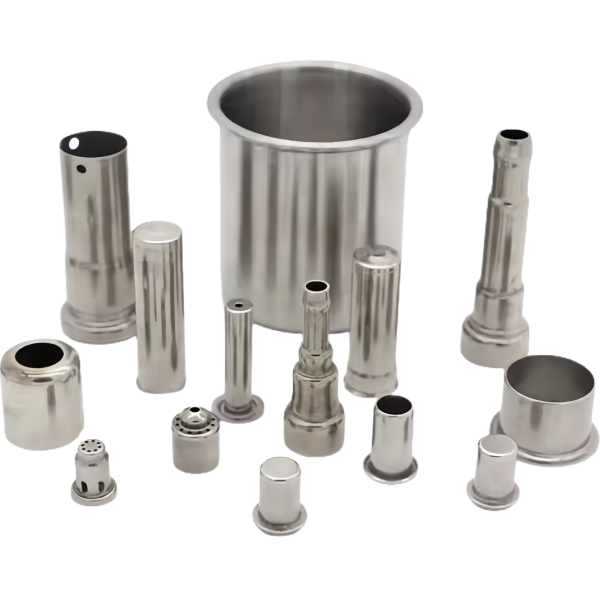
Stainless steel deep drawn cups and tube shells are seamless austenitic (304 or 316) forms produced by progressive drawing from a single sheet blank: cups with a closed bottom and a controlled depth, and tube shells drawn long and open to accept an internal element. The Stainless Steel Deep Drawn Cups and Tube Shells family holds two austenitic stainless steel forms on one release: cups with a closed bottom and a controlled depth, and tube shells that are drawn long and open to accept something inside. Both are made from 304 or 316, and both are governed by the same central difficulty – austenitic stainless steel work-hardens fast, draws with a lot of force, and gives very little warning before it tears. Managing that means deciding the number of draws and the anneal points before the first blank is cut, because on stainless steel you cannot recover a part that has been pushed too far in one hit. This page covers the draw strategy, the anneal discipline and the passivation that finishes these parts.
Austenitic stainless steel hardens fast, so the draw count is decided first
304 and 316 are chosen for corrosion resistance, not for formability, and they punish any attempt to take a deep part in too few operations. As the blank is drawn, its flow strength climbs with the strain, so a second or third draw into the same metal needs noticeably more force and starts to tear at the punch radius well before a mild-steel part would. The engineering decision on this family is therefore the stage reduction – how much diameter we take per draw – and we set it conservatively at quotation.
- We hold stage reduction well inside what mild steel would allow, because stainless steel has a narrower safe window between the blank wrinkling and the wall tearing.
- Draw radii are generous on stainless steel; a tight punch radius is the single most common cause of a fracture on these parts.
- Lubrication is a forming-lubricant decision, not an afterthought, because stainless steel galls and the wrong lubricant both raises force and scars the surface.
Annealing between draws is scheduled, not improvised
Because work hardening is the limiting factor, the interstage anneal is not optional on a deep stainless steel part – it is the operation that makes the second and third draws possible. The subtlety is that annealing is also the operation most likely to be skipped or shortened under schedule pressure, and a stainless steel part drawn on a rushed anneal schedule fails later and less visibly. We schedule anneals into the route card with a defined cycle so the metal reaches the pot at a known state every time.
- Annealing restores ductility so the next draw can take its reduction without cracking; we specify the anneal against the strain the part has actually seen, not a blanket cycle.
- After annealing, stainless steel forms a light oxide scale that has to be removed by pickling or a controlled descale before the next draw, because scale left in the die both raises force and marks the surface.
- Tube shells that are drawn long get the same discipline; a long shell is just more draws and more anneal points, and the schedule reflects that.
Cups and tube shells fail at opposite ends of the draw
Although they share material and press, the two shapes in this family fail differently and are inspected for different things. A cup fails at its bottom – the punch radius and the base thickness – because that is where the deepest strain concentrates. A tube shell fails along its wall and at its ends, because a long open shell has to stay straight and parallel over its whole length or nothing will slide into it.
- Cups: bottom thickness and the punch-radius region are the critical measurements; a base that is too thin is a burst waiting for internal pressure.
- Tube shells: straightness, wall uniformity along the length and end squareness are the critical measurements, because the shell has to accept an internal element over its full depth.
- Both: wall thinning is predicted and spot-checked, because stainless steel’s high flow strength means it thins more readily than the mild-steel equivalent.
Passivation is the last forming operation that matters
Stainless Steel resists corrosion because of its chromium content, but drawing, annealing and handling all leave free iron and scale on the surface, and that free iron is what rusts. Passivation removes the loosely attached free iron and lets the passive chromium oxide layer re-form, but it does not deposit a coating and it cannot fix a surface that was contaminated by the wrong tool or a carbon-steel fixture. We treat passivation as a controlled chemical step with its own verification.
- We segregate stainless steel from carbon-steel tooling and fixtures throughout, because cross-contamination is the most common cause of a “stainless steel” part that rusts in the field.
- Passivation is verified per lot – by a copper-sulfate or water-immersion test as the spec requires – rather than assumed from the bath.
- The customer’s corrosion requirement drives the passivation spec; we confirm whether the part only needs free-iron removal or a formal passivation with a recorded test.
How we verify stainless steel cups and tube shells
The verification plan splits by shape but shares the material and surface checks:
- Cups: inside diameter, depth and bottom thickness measured per the control plan, with the punch-radius region inspected for the start of any fracture.
- Tube shells: inside diameter at several depths, straightness over length, wall thickness at sampled points, and end squareness.
- Wall uniformity confirmed by section on the first article and by micrometer on production samples, tracing the thinning through the draw stages.
- Material certificate per lot confirming 304 or 316 as ordered, with the mill heat traceable to the release.
- Passivation record with the applicable test result attached, proving free iron was removed and the passive layer reformed.
- Fit check on the first article: the internal element the cup or shell is built around is inserted, confirming depth, diameter and straightness work together.
First articles and retention samples are kept for the programme, and the anneal and passivation records travel with them, so a repeat run of these stainless steel parts is made the same way and to the same verified condition – which, on a material this sensitive to process, is the only way to get the same corrosion performance twice.
The engineering calls behind a part like this — draw ratio, wall thinning, radii and trim — each get worked examples in our deep drawn covers guide; the Precision Deep Drawn Parts pages gather the rest of the family.
Specifications
| Item | Stainless Steel Deep Drawn Cups and Tube Shells |
|---|---|
| Brand | AUNOV |
| Designing | Share your print, or send a part to be measured, a manufacturability review comes back with the quotation. |
| Tooling | Every die designed and built in our toolroom, held and maintained under your part number. |
| Samples | Sample parts arrive with a dimensional report plus material certs. |
| Materials | Stock for this part leads with 304 / 316 stainless steel, alongside carbon steel (SPCC / DC01), aluminium, brass and copper, per the drawing. |
| Surface finish | Surface treatment per the drawing: plating, e-coat, powder coating, anodising, passivation, selected against the drawing requirement. |
| Processing | Staged deep drawing, with in-line annealing where the draw ratio requires, then pierced and machined in house. |
| Equipment | Our press floor runs 5-250 T mechanical and 250-500 T hydraulic presses, CNC turning centres, climate-controlled CMM room. |
| Tolerance | Tolerances to +/-0.1 mm as drawn, +/-0.03 mm after machining. |
| Delivery terms | Prices FOB, with DDP for EU and US on request, payment T/T or L/C, D/P for repeat accounts, scheduled call-offs welcome. |
Related Products


Frequently Asked Questions
Why does stainless steel need more draws than mild steel?
Austenitic 304 and 316 work-harden as they are drawn, so each stage needs more force and tears at the punch radius well before mild steel would. We set stage reduction conservatively and keep draw radii generous, because a tight punch radius is the most common cause of a fracture on these parts.
What does annealing between draws do for stainless steel cups and shells?
It restores ductility so the next draw can take its reduction without cracking, and it leaves a light oxide scale that we remove by pickling before the next draw. The anneal is scheduled into the route card with a defined cycle, not improvised under schedule pressure.
How do cups and tube shells fail differently?
A cup fails at its bottom – the punch radius and base thickness – where the deepest strain concentrates. A tube shell fails along its wall and at its ends, so straightness and wall uniformity along the full length are the critical checks before anything slides inside.
Why is passivation the final critical step?
Drawing, annealing and handling leave free iron on the surface, and free iron is what rusts. Passivation removes it and lets the chromium oxide layer re-form; it does not deposit a coating and cannot fix a surface contaminated by the wrong tool or a carbon-steel fixture.
Which stainless steel grade should I specify for a drawn cup or shell?
304 is the default for corrosion resistance; 316 where the service is more aggressive. Both are drawn from a sheet blank, and the choice is about the environment the part lives in, not the geometry.
Request a Quote for This Part
Send a drawing or sketch — get material advice, tooling cost and a per-piece price within 24 hours (working days).