
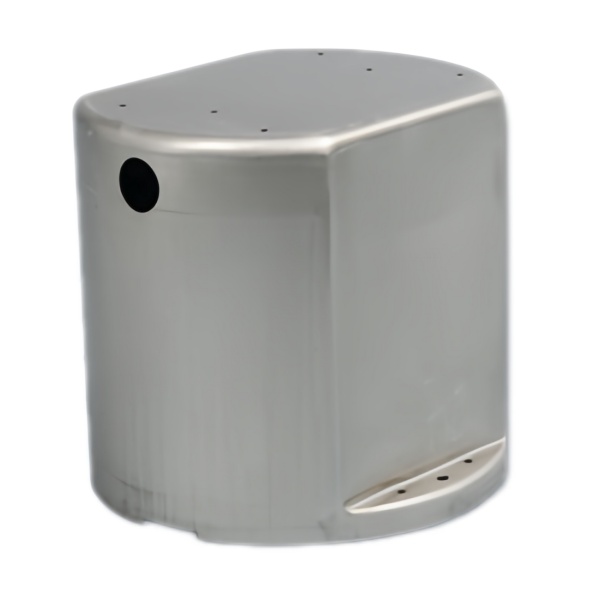
Rounded corners are a stress decision, not a styling decision
An aluminium deep drawn enclosure with rounded corners is easier to draw than a square one, and that is not a coincidence of taste. A rounded corner lets the aluminium flow evenly as the shell forms, so the material does not have to travel the long, uneven path that a square corner forces, and the wall thickness stays more uniform. The rounded corner is therefore a manufacturing and a stress decision: it reduces the wrinkle-and-thin risk at the corner and it removes the stress concentrator that a sharp internal corner would be on a box that gets dropped, bolted and vibrated. We treat the corner radius as a structural input, not a look.
We draw these on mechanical presses in aluminium, holding the envelope to roughly +/-0.1 mm and any machined face to +/-0.03 mm. The wall is usually in the 1.0 to 1.5 mm band where the alloy’s work-hardening window is manageable, and the rounded corners are what let us hold that window without cracking.
We record the draw and the finish together against your part number, so the enclosure you approve is the enclosure you reorder, corner radius and coating growth included. The open-face flatness and slot-free rim that we proved first time are held on every later batch, which keeps the lid seating the same way year after year instead of slowly relaxing as a process left to itself tends to.
The rim of a rounded-corner aluminium enclosure is where the lid lives, and the corner radius that helps the draw also helps the lid seat by keeping the rim even. A square box fights a warped rim at the corners; a rounded one gives a continuous seat, and we hold that rim flat so the gasket or shield has contact all the way round rather than starving at a corner.
Powder versus anodize on this box is a thickness decision as much as a look. Powder adds a far thicker film and hides more, but it also changes every post-coat dimension more; anodize is thinner and harder-wearing on edges. We quote both where the duty is unclear, so the lid fit and the appearance are decided together rather than the coat being bolted on after the dimensions are fixed.
The wall thickness on a rounded enclosure is set by the shielding and the drop requirement more than by the draw. A thicker wall shields better and survives a fall, but draws with more springback; a thinner wall is lighter and cheaper but needs a gasket or finger stock to do the shielding job. We state which job the wall is doing so the right one is specified.
Drawing aluminium into an enclosure: the work-hardening window
Aluminium hardens as it is drawn, and an enclosure is a deeper draw than a dish, so the window between “flows nicely” and “cracks at the corner” is the thing we manage. We plan reductions that stay inside the alloy’s formability, anneal between stages where needed, and keep the blank holder pressure set so the wall feeds without wrinkling. On a rounded-corner box this is more forgiving than on a square one, but it is still a planned process, not a single hit.
- The 1.0 to 1.5 mm wall is the sweet spot for this size: thick enough to draw without fracturing, thin enough to stay light and cheap.
- Earing at the rim appears from grain direction, and we orient the blank or trim the flange so the open face stays usable.
- Corner thinning is measured, not assumed, because a rounded corner that thinned too far is a corner that dents in service.
- Annealing between draws is scheduled where the depth demands it, so the alloy gets another chance to flow.
EMI and RFI shielding starts at the seam, and the corner helps the lid seat
An aluminium enclosure is often chosen because aluminium is conductive and a well-seated lid makes a continuous shield against electromagnetic and radio-frequency interference. The shield is only as good as the seam: a lid that rocks on a warped rim leaves a gap that leaks exactly the frequencies the enclosure was meant to block. The rounded corner helps here because it keeps the rim even and lets the lid seat all the way round, so the gasket or the conductive finger stock has continuous contact instead of a starved corner.
We therefore hold the open-face flatness as a functional tolerance on a shielding enclosure, and we keep the rim true through the draw and any restrike. Where the spec calls for a conductive finish or a gasket, we make sure the mating face is clean aluminium or properly prepared, because an anodized or painted seam is an insulator and a shield breaker unless that is designed around.
We also confirm the shielding requirement up front, because a box specified for EMI but finished with an insulating anodize or powder on the seam will not shield no matter how good the draw is. Where the spec needs a continuous conductive path we leave the mating face bare or prepare it, and we treat the lid-seat flatness as the shielding tolerance it actually is rather than as a cosmetic note.
Anodize or powder on an aluminium box, and the growth to design around
The finish on an aluminium enclosure is a dimensional decision as much as a cosmetic one. Anodizing grows the part by its oxide thickness on every face; powder coating adds a far thicker film. Both change a sliding lid, a locating step or a panel cutout if those dimensions are specified at bare size. We advise stating the finish class and the post-coat dimension on the features that matter, and we measure the finished box at the condition the customer receives.
- Clear anodize for light protection and a clean look, with the seal step confirmed so it does not stain.
- Hard anodize where the box sees wear or abrasion on its faces.
- Powder coat for outdoor or appearance-critical enclosures, with film thickness held so the lid still fits.
- Masking is used where a face must stay conductive or bondable, because the finish would otherwise defeat that function.
Flatness of the open face, because the lid is only as good as the rim
The open face of an enclosure is the reference the lid closes on, and a rim that is out of flat means a lid that rocks, a gasket that is pinched on one side and starved on the other, and a seam that leaks air, water or signal. We keep the rim as the drawn reference plane, flatten or restrike it, and measure its flatness directly rather than inferring it. Where the lid truly needs a precise seat we machine a register after forming, and we tell you which approach the drawing should call for.
Springback is the enemy here, and on aluminium it is predictable enough to compensate. We lock the over-form that worked on the first article so repeats stay flat, and we resist the temptation to specify the whole rim to a machining flatness that the forming process cannot natively hold without adding a restrike or a machine step that costs more than the function needs.
How we verify an aluminium enclosure
An enclosure is verified as a shielding and sealing component, because that is what the box is for. The routine:
- First-article CMM report on the envelope, corner radii and any machined face, at the stated condition.
- Open-face flatness measurement, on a surface plate or CMM, because the lid depends on the rim.
- Finish thickness check against the anodize or powder class written on the drawing, confirmed post-coat.
- Corner thinning measurement, to confirm the draw did not leave a weak wall at the radius.
- Seam readiness check, confirming the mating face is clean or prepared for the gasket or shield spec.
- Material certificate confirming the aluminium grade and temper the forming plan assumed.
The enclosure ships with its dimensional report and certificate under your part number, and the draw and finish settings are archived so the next order repeats the same process rather than relearning the corner radius.
Send the enclosure drawing with the finish class and the post-coat dimensions on the lid seat stated, and we return a manufacturability review with the quotation and a first article proving the open-face flatness. State the shielding requirement up front so the seam finish is chosen to conduct rather than to insulate.
Draw ratio, wall thinning, radii and trim — the design decisions behind a part like this are worked through with numbers in our deep drawn covers guide, and the Precision Deep Drawn Parts pages collect the rest of the family.
Specifications
| Item | Aluminum Deep Drawn Enclosure with Rounded Corners |
|---|---|
| Brand | AUNOV |
| Designing | Send the drawing, or a sample we can measure, the quotation comes back with a manufacturability review attached. |
| Tooling | Dies engineered and produced in our own toolroom, with your part number on the tool record. |
| Samples | First-article samples ship with a dimensional report plus material certs. |
| Materials | Aluminium leads the stock list for this part, alongside carbon steel (SPCC / DC01), 304 / 316 stainless steel, brass and copper, per the drawing. |
| Surface finish | Surface treatment per the drawing: plating, e-coat, powder coating, anodising, passivation, per your print. |
| Processing | Deep drawing in stages, in-line annealing where needed, then pierced and machined in house. |
| Equipment | Mechanical presses 5-250 T and hydraulic presses 250-500 T, CNC turning centres, plus a climate-controlled CMM room. |
| Tolerance | Drawn tolerances held to +/-0.1 mm, +/-0.03 mm after machining. |
| Delivery terms | FOB as standard, DDP available for EU and US destinations, T/T or L/C, with D/P for repeat business, call-off scheduling supported. |
Related Products


Frequently Asked Questions
Why are rounded corners easier to draw than square ones?
A rounded corner lets the aluminium flow evenly so it does not travel the long uneven path a square corner forces, keeping wall thickness more uniform and removing a stress concentrator.
What wall thickness is typical for this enclosure?
Usually 1.0 to 1.5 mm, the band where the alloy’s work-hardening window is manageable and the rounded corners let it be held without cracking.
How is the envelope held?
The envelope is held to roughly +/-0.1 mm with any machined face to +/-0.03 mm, drawn on mechanical presses in aluminium.
Are the corners a structural decision?
Yes – the corner radius is treated as a structural input that reduces wrinkle-and-thin risk and removes the sharp internal corner a dropped or bolted box would otherwise concentrate stress on.
Request a Quote for This Part
Send a drawing or sketch — get material advice, tooling cost and a per-piece price within 24 hours (working days).