
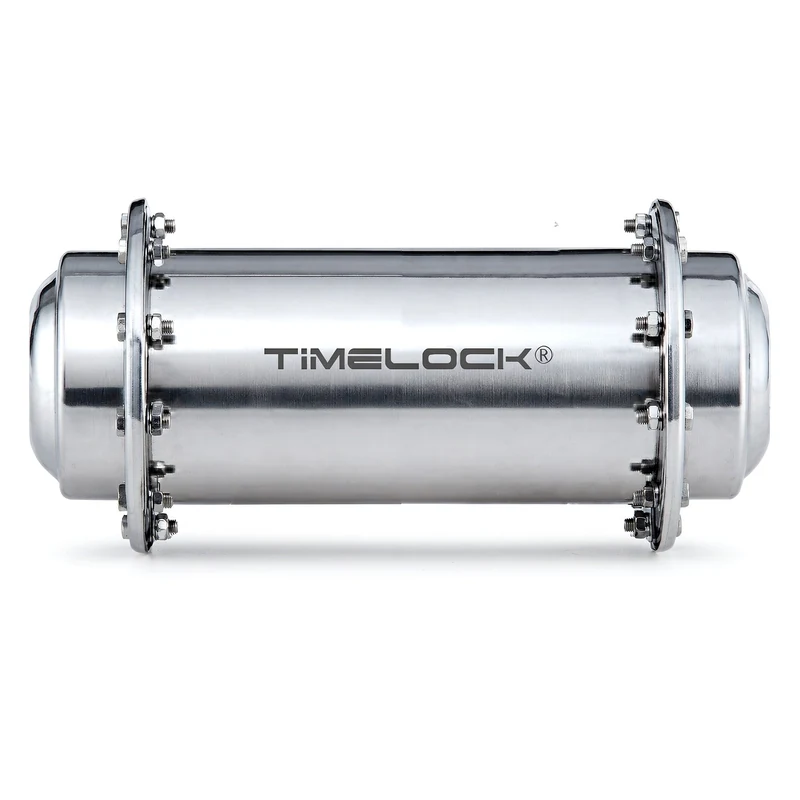
Every graduation season produces the same quiet problem: a shoebox of letters, a folder of photographs, and a promise to open them “someday” – kept in a cupboard that leaks, fades, and gets thrown out during the next move. The Stainless Steel Durable Lock Container for Future Graduation Gift exists to keep that promise properly. It is a mirror-polished SUS 304 cylinder drawn in one piece, sealed by twin bolted clamp rings, rated to survive more than 200 years in the ground, and handsome enough to sit on a mantelpiece for the decades before burial.
It is a gift that behaves differently from everything else at the ceremony. The graduate receiving one is not being given an object so much as an appointment: a sealed date, decades ahead, with the people who stood there on that day. This page is for the schools, families, and classes planning that appointment – and for anyone who wants the container to last as long as the intention behind it.
The tradition, and why it keeps returning
The graduation time capsule has survived a century of changing customs because it solves something no diploma can: it lets a group of people speak to their future selves while everyone is still together. Classmates scatter within months of a ceremony; a capsule is the one project that requires them to collaborate at the exact moment they are about to stop seeing each other every day.
What has changed is how badly the early attempts aged. Sealed cardboard disintegrated. Galvanised pails rusted through at the seams. Plastic turned brittle and split. The containers that did survive a generation were almost always metal, almost always seamless, and almost always buried deeper than nostalgia alone would suggest – which is precisely the specification of a drawn stainless steel vessel.
Why stainless steel outlasts every other gift box
The comparison is worth spelling out, because the container is the whole gift:
- Against wood. Timber swells and shrinks with every wet season, feeds insects and fungi, and glues fail long before the reopening date. A capsule needs no climate and no maintenance schedule.
- Against plastic. Polymers embrittle under years of ultraviolet light and temperature cycling, and buried plastic is a favourite food of nothing – but a fine pathway for water. Plastic also dates itself visually; a polished steel cylinder looks the same in fifty years as on graduation day.
- Against galvanised or plated steel. A zinc coating is a consumable: it sacrifices itself and, once gone, the base steel rusts from every scratch. SUS 304 is the alloy itself all the way through – scratched, it re-passivates and keeps protecting.
- Against “we’ll just keep it indoors”. Moves happen. Boxes get opened early and re-sealed badly. A lock container that is beautiful enough to display and tough enough to bury survives both plans, including the plan changes.
The material is the same industrial-grade sheet specified for buried infrastructure: yield strength at or above 205 MPa, tensile strength at or above 520 MPa, elongation at or above 40%, and a 1.2 mm wall that resists dents when a box is dropped during a move or a backfill shovel catches an edge. Rated service temperature reaches 1200 °C, which is a fact most gift wrapping cannot claim.
Choosing a size: what classes actually put inside
There are ten sizes in the family, in three bores – 100 mm, 115 mm, and 130 mm – with lengths from 260 mm to 1100 mm and weights from 1.0 to 4.2 kg. The bore, not the length, decides what fits without crushing:
| 100 mm bore | Letters, cards, a class photograph, small medals, a rolled ribbon or two. The 260 and 340 mm sizes are the personal-gift sizes; the 450 mm takes a full document roll for a whole form class. |
|---|---|
| 115 mm bore | The school-archive bore. Newsletters, a school tie or patch, cassettes-era media, USB drives in an envelope, small trophies, and the class roster. The 840 and 1100 mm lengths accept rolled T-shirts and banners. |
| 130 mm bore | Flat and boxed items without rolling: portfolios, yearbooks, framed photographs, and group contributions from a large cohort. |
One practical rule from schools that have done this well: agree on the reopening date first, then let the contents list grow to fit the capsule – not the other way round. A date that lands on a reunion anniversary gives the class a reason to gather, and the capsule a reason to exist.
How to run the sealing ceremony
The container keeps the contents; the ceremony keeps the people. The sequences that work share the same bones:
- Fix two dates in writing – the sealing date and the opening date – and put both on the message card inside and on the burial card in the archive. Vague intentions are how capsules get opened “around the ten-year mark” and then never.
- Give every contributor a format. A letter to the future reader, an object with one sentence of explanation, or a signed photograph. Uniform formats pack better and read better decades later.
- Wear the gloves provided. Fingerprints and sweat etch paper and metals over decades; the cotton gloves in the box are not ceremony theatre, they are conservation.
- Photograph the contents laid out before sealing, and keep that photograph outside the capsule. The inventory image is what future archivists will thank you for.
- Seal with the hex key in front of everyone. The bolted clamp rings close in minutes and are deliberately visible – the act of tightening the ring circle is the ritual itself, and children asked to “do one bolt each” remember it.
- Decide display or burial on the same day. Either mount it with the supplied brackets where the cohort will walk past it, or bury it with the record-keeping described below. The one wrong answer is a capsule that drifts into a cupboard.
Display it, or bury it – and how to record either
Because the closure is bolted rather than welded, the same capsule supports both plans across its life. On display – a lobby shelf, a library wall on its brackets – it becomes a physical countdown that every cohort inherits, and it can be opened at anniversaries, added to, and re-sealed without tools beyond the wrenches supplied.
Burial asks for a little more bookkeeping, and the box already contains the tools for it. The burial card records what was sealed, by whom, when, and the exact reopening date; it belongs in a copy held by the school office or the family archive, not only in the ground. Bury roughly a metre down, on clean sand or fine gravel that drains, away from future building lines and tree roots, and photograph the capsule in the hole before backfilling – that photograph, kept with the burial card, defeats every filing system failure a century can offer.
Then there is the ceremony nobody budgets for: the reopening. Ten bolts, one wrench, and a gasket that has waited patiently for decades. Capsules of this construction are opened, refilled with the next generation’s letters, re-torqued, and buried again – which is how a graduation gift turns into a school institution.
What comes in the box
Each container ships ready for either plan: the capsule itself, a pair of mounting brackets and a full fastener set for wall mounting, a hex key and an open-end wrench for the clamp rings, a polishing cloth for keeping the mirror finish honest, cotton gloves for loading the contents, and two cards – the burial card for the archive record and the message card for the future reader. Nothing extra needs to be purchased before the ceremony.
For the forming and corrosion engineering behind the vessel, see the anti-corrosion waterproof time capsule page, which covers the sealing system and burial chemistry in depth; the Precision Deep Drawn Parts pages collect the rest of the family.
Specifications
| Item | Stainless Steel Durable Lock Container for Future Graduation Gift. |
|---|---|
| Brand | AUNOV |
| Material | SUS 304 industrial stainless steel, mirror finish, 1.2 mm drawn shell. |
| Sizes | Ten sizes from 260 to 1100 mm long; bores 100, 115 and 130 mm. |
| Weight | 1.0 to 4.2 kg depending on size. |
| Closure | Twin bolted clamp rings with silicone seals; opens and re-seals for repeated ceremonies. |
| Durability | Waterproof to 10 MPa and engineered for more than 200 years underground. |
| Temperature | Shell rated for service up to 1200 °C. |
| Supplied with | Mounting brackets, fastener set, hex key, open-end wrench, polishing cloth, gloves, burial card and message card. |
| Marking | Laser marking of school names, cohort years and closing/opening dates is available against your layout. |
| Designing | Custom lengths, engraving and finish changes are quoted against your drawing. |
| Tooling | Our toolroom covers die design, wire-cut EDM and maintenance, so a die can be re-cut against the approved drawing, and the charge is refundable against agreed volumes. |
| Samples | Prototype and pre-production samples are provided against the drawing, and production starts only after your written sign-off. |
| Delivery terms | CIF or DDP, with FOB available, payment by T/T, L/C at sight or D/P; call-off schedules are supported. |
Frequently Asked Questions
What makes this different from an ordinary keepsake box?
The container is stainless steel and closes with its own lock, so what it is protecting is not dependent on glue, cardboard or a cupboard that stays dry. The point of the material choice is that the box survives long enough for the promise inside it to actually be kept.
How do I choose a size?
Work backwards from what you want to put in, because the contents decide it rather than the other way round. Letters, photographs and small keepsakes each fill a different volume once they are actually stacked, so it is worth laying them out before choosing rather than discovering the fit on the day.
Is there a right way to run the sealing?
The tradition works best when the contents are settled and the closure is treated as the moment it becomes a time capsule rather than a container again. Whether that means witnesses, a date written down, or simply agreeing when it gets opened is up to whoever is assembling it.
Display it or bury it?
Both work, and the choice mostly changes how you record where it is. Something displayed is seen and remembered; something buried is protected but relies on whoever eventually looks for it knowing where to look. Writing the location down is what makes either version workable years later.
Related Products


Request a Quote for This Part
Send a drawing or sketch — get material advice, tooling cost and a per-piece price within 24 hours (working days).