
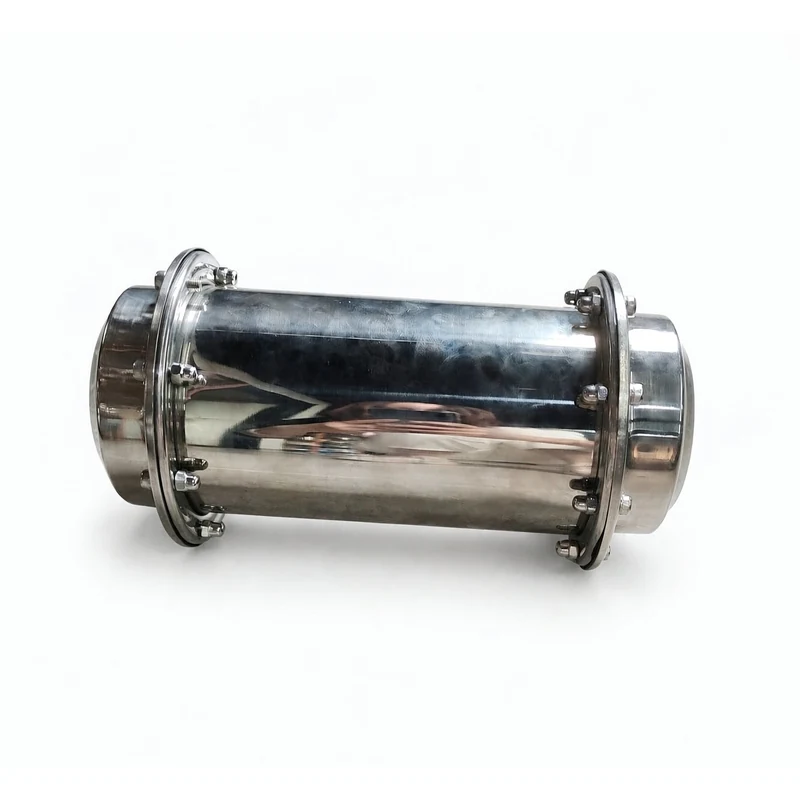
A time capsule has one job that almost no other container has: keep water, air, and soil chemistry away from its contents for a length of time measured in generations, then open cleanly when the date arrives. The Stainless Steel Anti-Corrosion Waterproof Time Capsule is built around that single requirement. The shell is drawn in one piece from SUS 304 industrial-grade stainless steel, mirror polished inside and out, closed by bolted clamp-ring seals at both ends, and rated for a decade-counting service life of more than 200 years underground.
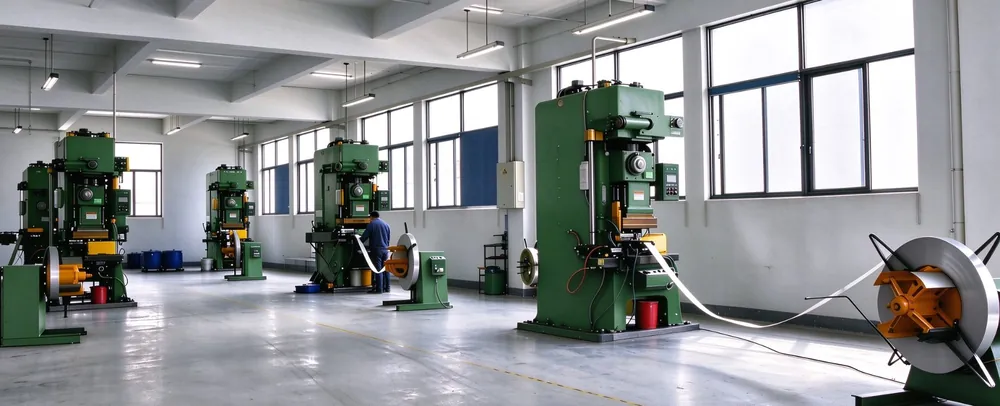
We draw the body and the domed end caps on our own presses from 1.2 mm SUS 304 sheet, so the capsule that reaches you is a seamless vessel – no welded longitudinal seam, no folded corners, no place where two materials meet and disagree. This page is written for the people who have to defend that promise for a century: facility managers, municipal project owners, school boards, and anyone choosing a capsule that will outlive everyone in the room.
A sealed cylinder is only as good as its weakest joint
Most containers fail at a joint. A soldered seam creeps. A folded lip wicks moisture by capillary action. A plastic gasket ages into powder. Deep drawing removes the two worst offenders before the capsule is even finished:
- The shell has no longitudinal seam. A drawn cylinder is one continuous piece of metal. There is no weld bead to corrode preferentially, no heat-affected zone with a different microstructure, and no folded lip to wick water along the wall. Soil moisture pressing on the outside has no path to follow.
- The domed ends are formed, not attached. Each end cap starts as flat 304 sheet and is drawn into a dome in the same shop, on the same presses, from the same certified coil. The dome is not a disc welded onto a tube – it is a continuous surface with the same thickness discipline as the wall, which is what lets a shallow dome resist external pressure so effectively.
- The only joints are engineered ones. Water cannot get past metal that was never cut, so the design concentrates every leak path into the two closures, where it can be controlled with a gasket, a clamp ring, and a torque pattern.
That concentration is deliberate. It is far easier to make two bolted flanges reliably watertight than to make an entire welded vessel reliably watertight, because a bolted joint can be opened, inspected, re-sealed, and torque-checked – which is exactly what a reusable capsule needs.
Inside the clamp-ring seal: 10 MPa, and openable again
Each end of the capsule closes on the same principle: a silicone gasket sits in a groove between the dome flange and a separate clamp ring, and a circle of hex bolts pulls the ring down against the flange with even, measurable force. Three things follow from that construction:
- The pressure rating comes from the gasket compression, not from luck. Even bolt spacing means even gasket squeeze, and even squeeze is what lets the seal hold 10 MPa – roughly the water pressure a capsule would feel 1,000 metres below the surface. No burial scenario on Earth produces that head, which is the point: the rating is a safety factor, not a boundary.
- The capsule opens and closes again. Because nothing is welded, cut, or destroyed in opening, a capsule can be re-sealed and re-buried. Schools open theirs at anniversaries and add a new layer. Councils inspect a capsule after a decade and rebury it with fresh desiccant. A single purchase covers several ceremonies instead of one.
- Maintenance is a torque wrench, not a workshop. The fasteners are standard hex bolts and the tooling ships in the box. Re-torquing a clamp ring before a long burial takes minutes and needs no special equipment.
The silicone gasket itself is chosen for the same century-long brief as the steel: it stays flexible across decades of temperature swings, it does not rot, and it resists the acids and alkalis that ordinary rubber seals swell or dissolve in.
What actually attacks a buried capsule – and why 304 answers it
Burial is a chemistry problem before it is a strength problem. The soil around a capsule is a moving cocktail of moisture, dissolved salts, air pockets, and microbial life, and the attacks worth engineering against are these:
- Chlorides. Road-salt runoff, coastal groundwater, and fertilised soil all carry chloride ions, which are the most common trigger of pitting corrosion in stainless steel. SUS 304’s chromium-nickel composition handles typical soil chloride levels for decades; in extreme coastal or de-icing-salt exposure, drainage and backfill choices (below) do the rest.
- Loss of passivation. Stainless steel resists corrosion because its chromium forms a self-repairing oxide film a few nanometres thick. Scratches in the film re-passivate on contact with oxygen – which is why a scratched, mirror-polished capsule buried for a century still behaves like a scratched one buried last week. The mirror finish itself helps: a smooth surface gives dirt and moisture less to cling to.
- Differential aeration cells. Where oxygen-rich soil touches one patch of metal and oxygen-poor clay touches another, small corrosion cells can form. The defence is not a thicker wall but a uniform environment – which is why the installation notes below insist on clean, free-draining backfill around the whole capsule rather than native clay packed against one side.
- Microbial attack. Some soil bacteria consume sulphates and produce acids. 304 is not immune to aggressive biological environments, but paired with neutral, well-drained backfill it is the standard choice for buried water infrastructure for exactly this reason – and a time capsule faces far milder conditions than a water main.
The material data behind the shell is the standard annealed 304 datasheet, and we publish it because it is the basis of every corrosion and strength claim on this page: yield strength at or above 205 MPa, tensile strength at or above 520 MPa, elongation at or above 40%, hardness at or below 90 HRB, and a service temperature rating up to 1200 °C. The 1.2 mm wall is not the thinnest that could hold a shape – it is the thickness that keeps the dome and barrel rigid against handling, backfill load, and ground movement over decades.
Ten sizes, three bores, one closure system
The family is a single system scaled in length, so every size shares the same seal hardware, the same gasket, and the same wrenches. Bores come in 100 mm, 115 mm, and 130 mm:
| 100 mm bore | Lengths 260, 340 and 450 mm; unit weights 1.0, 1.2 and 1.4 kg. The two shorter sizes are the natural desktop and shelf capsules; the 450 mm holds a document roll or a class letter set. |
|---|---|
| 115 mm bore | Lengths 520, 580, 680, 840 and 1100 mm; unit weights 2.0 to 4.0 kg. The workhorse bore – the 840 and 1100 mm sizes accept rolled banners, fabric items, and bulk class contributions. |
| 130 mm bore | Lengths 680 and 1100 mm; unit weights 3.0 and 4.2 kg. The largest bore fits A4 portfolios flat-side and boxed objects without rolling. |
Because the closure system is common across the range, a school that buys a 340 mm capsule for one cohort and an 840 mm capsule for the next can treat the accessories, spare gaskets, and installation hardware as one inventory line.
Installing it so it is still there in a century
A rated capsule can still be failed by a careless hole. The burial practice that matches the engineering is straightforward:
- Choose the spot for the century, not the season. Above the local water table, away from future construction zones, tree roots, and utility corridors. A spot that will not be landscaped or excavated is worth more than a spot that is convenient this year.
- Dig deep enough to be boring. Roughly a metre of cover places the capsule below frost heave and garden disturbance. Deeper is fine; shallower invites a spade.
- Bed it on and backfill it with clean, free-draining material. Sand or fine gravel around the whole capsule keeps the environment uniform and drains water away, instead of letting clay grip one side and pond on the other.
- Record the position twice. Once in a document that lives in an archive, and once physically at the site. Every capsule ships with a burial card for exactly this record; a photograph of the closed capsule in the hole, before backfill, is the second copy that survives every filing system.
- Or skip the ground entirely. The same family mounts on walls with the supplied brackets, which is how many lobbies, libraries, and corridors prefer to keep a capsule visible – opened and re-sealed at anniversaries instead of dug up.
Where they are used
The anti-corrosion capsule is the choice when the contents are irreplaceable and the reopening date is fixed:
- Municipal and institutional archives – cornerstone and centennial capsules sealed into buildings, bridges, and public works, with the reopening written into the city’s own records.
- Corporate and campus time capsules – founding documents, product samples, and staff messages sealed at openings and anniversaries, kept on display in reception between ceremonies.
- School and university legacies – class capsules handed from cohort to cohort, opened at reunions, and re-sealed with the next generation’s additions.
- Private and family estates – landowners marking a milestone with a capsule intended for grandchildren rather than for the next tenant.
Our deep drawn covers guide explains the forming decisions behind domed closures like these, and the Precision Deep Drawn Parts pages collect the rest of the drawn family.
Specifications
| Item | Stainless Steel Anti-Corrosion Waterproof Time Capsule. |
|---|---|
| Brand | AUNOV |
| Material | SUS 304 industrial-grade stainless steel, mirror polished inside and out. |
| Wall thickness | 1.2 mm drawn shell; domed ends formed from the same certified coil. |
| Mechanical data | Yield strength at or above 205 MPa, tensile strength at or above 520 MPa, elongation at or above 40%, hardness at or below 90 HRB. |
| Sealing | Bolted clamp-ring closures with silicone gaskets at both ends; rated 10 MPa, roughly the pressure at 1,000 m water depth. |
| Reusability | Opens and re-seals repeatedly for inspection, anniversaries, and added contents. |
| Temperature | Shell rated for service up to 1200 °C. |
| Buried life | Engineered for more than 200 years underground. |
| Sizes | Ten sizes; bores 100, 115 and 130 mm; lengths 260 to 1100 mm; unit weight 1.0 to 4.2 kg. |
| In the box | Capsule, fastener set, hex key, open-end wrench, polishing cloth, gloves, burial card and message card. |
| Designing | Custom bores, lengths, laser marking of names and dates, and finish changes are quoted against your drawing. |
| Tooling | Our toolroom covers die design, wire-cut EDM and maintenance, so a die can be re-cut against the approved drawing, and the charge is refundable against agreed volumes. |
| Samples | Prototype and pre-production samples are provided against the drawing, and production starts only after your written sign-off. |
| Delivery terms | CIF or DDP, with FOB available, payment by T/T, L/C at sight or D/P; call-off schedules are supported. |
Frequently Asked Questions
Is the capsule body welded?
No, and that is deliberate. The body is drawn in one piece from 1.2 mm SUS 304 industrial-grade stainless steel, so what reaches you is a seamless vessel with no welded longitudinal seam, no folded corners and no place where two materials meet and disagree. The joint is the part that fails first on a buried container, so removing it matters more than it sounds.
How does it seal, and can it be opened again?
Each end closes with a bolted clamp-ring seal, which differs from a welded or adhesive closure in being designed to come apart cleanly when the date arrives. A capsule that cannot be opened without destroying the contents has failed at the one job that is unique to it.
Why SUS 304 for this duty?
The enemies are water, air and soil chemistry acting continuously for generations, and 304 answers that combination. It earns its keep here because it is paired with a body that has no crevice and no weld line for corrosion to start in.
How long will it last, and what does installation have to do with it?
The capsule is rated for a service life measured in generations buried underground, and reaching that depends heavily on how it goes in. Orientation, drainage around the burial and the backfill it sits in decide whether the rating is met, which is why we write installation guidance for whoever will be answering for it later.
Related Products


Request a Quote for This Part
Send a drawing or sketch — get material advice, tooling cost and a per-piece price within 24 hours (working days).