
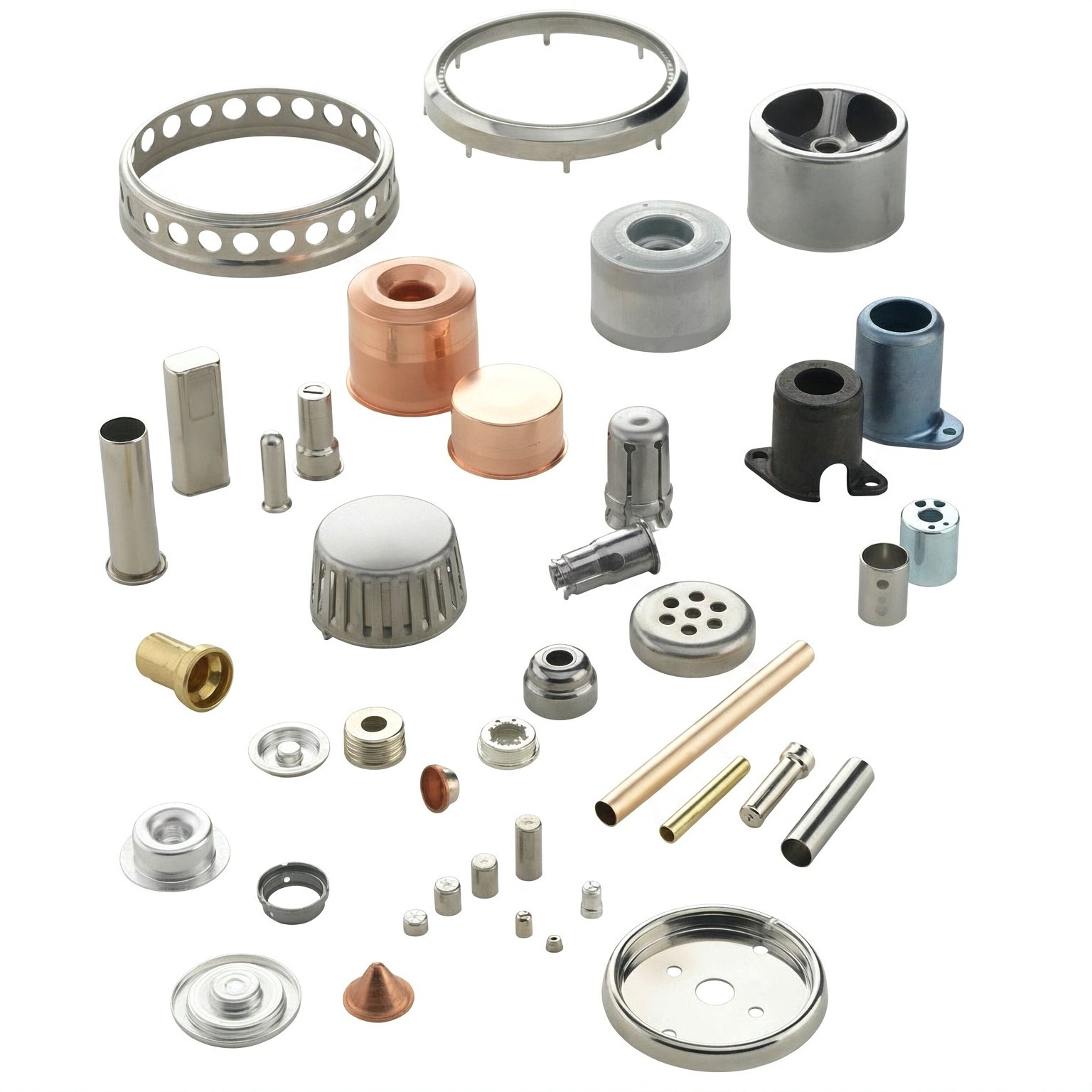
These are small parts, and small is the whole difficulty. A deviation that would be invisible on a 200 mm cover is a large fraction of the feature on an 8 mm retainer, which means the measurement plan has to be tighter than the part looks and the packaging has to keep the shapes apart once they are made.
At this scale the tolerance is a bigger fraction of the part
The controlling issue on a small drawn part is proportion. An error of 0.05 mm is negligible on a large cover and is several percent of the wall on a small cup, so the inspection budget goes further here than the part count suggests. It also means setup errors are less forgiving: there is less material to absorb a misjudged blank or a die that has not settled, and the scrap risk on a short small-parts run is genuinely higher than on a large one.
Retainers are spring parts, and the hardness band has to be stated
The most common specification gap in this family is a retainer drawing that calls up spring steel without a hardness range. Too hard and the ring cracks on installation; too soft and it relaxes in service and stops retaining. We ask for the band and the duty, and where a retainer carries a safety load we add a set-resistance check rather than relying on the temper the material arrived in.
Wall and edge are where the inspection goes
For the cups and rings, the two features worth measuring are the wall thickness at the base and the condition of the trimmed edge. Both are cheap to catch on a first article and expensive to discover in a returned batch, and both are reported as named measurements rather than as a general pass. A ring edge that burrs toward its seat will assemble and then fail; a cup wall that thinned at the base will hold its shape and then crack.
The order is kitted, not boxed
A mixed small-parts lot is packed as a set and every compartment is labelled with its own part number, so goods-in can verify the mix without tipping everything out. That matters more at this size than at any other, because three small drawn shapes look alike in a bag. It also means a later order for one shape is a pull from a recorded process rather than a new quotation.
How the route is chosen at this size
Volume drives the route more than geometry does: a cup that draws in one hit is cheap per piece but carries a die cost that only pays back across thousands, while a ring that is blanked and formed has almost no tooling and a higher piece cost. Where volume is uncertain we quote both routes so the crossover is visible instead of assumed.
Each shape keeps its own die and its own recorded settings, so a reorder of the retainer alone reproduces the approved process. On small parts that is what keeps a second batch measuring like the first.
This part belongs to our Deep Drawn Parts range, where the process notes and tolerance practice behind the whole family are collected.
Where this part is used
Small drawn cups, rings and retainers under about 20 mm go into electrical contact assemblies, instrument pivots, bearing cups and retaining hardware. The retainer half of the family is the demanding one, because a retainer is a spring part: it has to flex into a groove and hold, which makes the hardness band a functional requirement rather than a metallurgical note.
These parts are usually ordered as a kit rather than as a single part number, and the kit is where the inspection plan has to be designed. A deviation that would be invisible on a 200 mm cover is a large fraction of the feature on an 8 mm ring.
What we need to quote it
Send the hardness band the retainers have to meet, the dimensions that are functional rather than informational, and the kitting list with quantities per item. Tell us whether cups and rings in the same order may share a drawing revision, and whether the kit is inspected per item or per family — that answer changes the sampling plan we quote.
Specifications
| Item | Assorted Small Deep Drawn Cups Rings and Retainers |
|---|---|
| Brand | AUNOV |
| Designing | Send the drawing, or a ring sample we can measure, DFM feedback is returned with the quote. |
| Tooling | Every die designed and built in our toolroom, held and maintained under your part number. |
| Samples | Samples for approval come with a dimensional report and material certificate. |
| Materials | Carbon steel (SPCC / DC01), 304 / 316 stainless steel, aluminium, brass and copper, with the final grade confirmed at the drawing review. |
| Surface finish | Finish options: plating, e-coat, powder coating, anodising or passivation, per the drawing. |
| Processing | Multi-stage drawing, annealed in line where wall thinning calls for it, pierced and machined on the same floor. |
| Equipment | Mechanical presses 5-250 T and hydraulic presses 250-500 T, CNC turning and milling cells, a climate-controlled CMM room. |
| Tolerance | Drawn tolerances held to +/-0.1 mm, machined features held to +/-0.03 mm. |
| Delivery terms | FOB is standard; DDP offered for EU and US, payment T/T or L/C, D/P for repeat accounts, scheduled call-offs welcome. |
Frequently Asked Questions
Why is tolerance a different problem at this scale?
The same deviation is a much larger fraction of the feature. Something negligible on a large cover is a substantial part of an 8 mm retainer, so carrying general tolerances down from bigger work produces parts that measure within band and still misbehave. At this size the tolerance has to be reasoned from the feature rather than borrowed.
Why do retainers need a hardness band stated on the drawing?
They are springs, so what matters is where they sit in a range. Too hard and they crack rather than flex; too soft and they take a permanent set and stop retaining. Naming a material does not convey that, whereas a specified hardness band does, and it is the difference between working and not.
Where should inspection concentrate on small drawn parts?
On wall and edge, which is where failures originate. Wall condition decides whether a retainer survives installation, and edge condition decides whether anything seats or snags. Appearance gets most of the attention it receives because it is easy to see, not because it predicts anything.
Why are these supplied kitted rather than boxed?
Loose small parts generate their own problems. Pieces go missing, variants mix, and nobody can tell whether a kit is complete until it is being assembled. Kitting and counting per set cost little and remove complaints that otherwise look like quality failures.
Related Products



Request a Quote for This Part
Send a drawing or sketch — get material advice, tooling cost and a per-piece price within 24 hours (working days).