
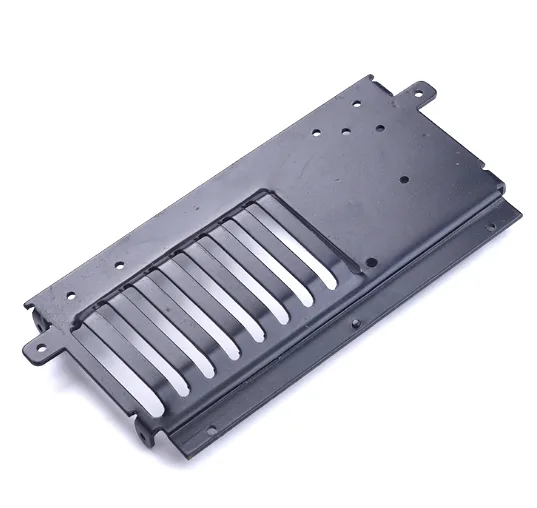
A deep drawn square cover is the hardest common cover geometry to draw well — and the reason it usually ends up on custom tooling. On a round shell, metal flows inward evenly from every direction. On a square one, the corners pull metal from two directions at once while the straight sides pull from one, so corner stock wants to wrinkle while side stock wants to tear. Getting both right in the same stroke is die design work, and it is why we build square cover dies in our own toolroom, on wire-cut EDM, to your print.
Why square corners are the whole game
Every question a square cover print raises comes back to the corners:
- Minimum corner radius. A drawn inside corner needs roughly 4× the sheet thickness to flow without splitting; below that, the corner radius belongs on a machined boss after forming, not in the draw. This is the single most common redline we return with a quotation.
- Corner thinning vs side wrinkling. The corner wall thins where the metal makes the tightest turn; the flat sides wrinkle where the blank holder pressure is least effective. Blank holder pressure and draw beads are tuned per corner, not per part — on a well-built die the settings are recorded so lot 2 reproduces lot 1.
- Flatness of the mounting face. The flange that bolts down tends to bow toward the corners after springback. We compensate in the die and check flatness on the CMM at first article — it is the dimension most often missed when a cover is bought on price alone.
If your print has sharper corners than the draw can hold, the usual good answer is a hybrid: draw the shell, then machine or coin the critical corner features. The quotation will say so explicitly, with the cost of each route.
What “custom tooling” means on this page
There is no catalogue square cover — every one on this page was someone’s print first. The tooling route works like this:
- Feasibility at quotation. Your 2D/3D drawing is checked for draw ratio, corner radii and tolerance bands before a price is issued — non-standard features are flagged there, not discovered later.
- Die design and build in-house. Die design, wire-cut EDM cutting and die maintenance all happen in our toolroom. That keeps the die charge as a visible, separate quotation line and keeps first-article timing measured from the tooling start date.
- Progressive or single-stage, chosen deliberately. Shallow square covers in thinner sheet often suit a progressive die — blank, draw and trim in one strip. Deeper or thicker shells go single-stage with a redraw. The trade-off is made at quotation and written down, so you know what the tooling buys.
- Die life and maintenance by stroke count. Maintenance is triggered by a schedule, not by failures, which is how piece 10,000 stays inside the same tolerance band as the first article.
The tool & die design page covers the toolroom in more detail.
Materials and finishes
Stock that square covers run in:
- Carbon steel (SPCC / DC01) — the default; zinc plating or powder coat for corrosion protection, e-coat where corners need uniform coverage.
- 304 / 316 stainless steel — washdown and outdoor duty; 316 where chlorides are present. Corner thinning is watched more closely on stainless steel because work-hardening is faster.
- Aluminium — when weight matters; anodised after forming.
- Brass — where EMI shielding or appearance drives the choice.
Material substitutes are proposed only with your written approval, and the finish on the drawing — plating, coating, anodising or passivation — is checked for thickness and adhesion on the first article.
Tolerances we hold on square covers
| Dimension | Standard band | Note |
|---|---|---|
| General form | ±0.05 – ±0.10 mm | Finer bands confirmed from capability data before quoting |
| Flange flatness | Per print, verified on CMM | The dimension springback attacks first |
| Hole pattern | Per print | Pierced after forming through position fixtures |
| Wall thickness | Held to print | Corner thinning kept within process limits recorded in the die file |
If the numbers you need sit outside these bands, say so at RFQ — the answer will be a capability check, not a hopeful yes.
Where square drawn covers are used
Typical homes for this geometry: control and junction box lids (see junction box enclosure with socket panel), battery and instrument covers, motor-mounted electronics lids, and stepped covers that mate to a gasket face — see stepped cover with side hole and black painted steel square cover for worked examples. Round and rectangular shells are covered on the parent page, precision deep drawn parts.
Quality and traceability
Production runs under an ISO 9001 certified system. Incoming material is verified against mill certificates; the CMM measures the first article dimension by dimension; every run is inspected against the first-article report. The square-cover first-article report carries flange flatness and cavity depth. Functional testing — torque, leak or pressure — can be written into the plan, and results travel with the batch paperwork. Repeat orders are measured against the approved sample, so neither material nor finish drifts between lots; grade changes have to be agreed in writing first.
Sampling and volume
First-article samples ship with a dimensional report and material certificate, so the part is proven before it is made in volume — and mass production is gated on that approval. Small orders are welcome: prove the cover, then scale. Repeat orders are a repeat of an approved process, not a new project; each shipment stays traceable to the signed first article.
Requesting a quote
Send the 2D drawing (PDF or DWG) and a 3D model if available (STEP), with material, finish, annual volume and any test requirements. The reply confirms material options, corner-radius feasibility, tolerances and the tooling cost as its own line — through the quote request page. If your part might not need a draw die at all, ask — for low volumes, custom metal stamping or a laser-and-form route can be the cheaper first step.
Questions we get about square covers
Can you hold a sharp outside corner on a square cover?
The inside draw radius has a material limit (about 4× sheet thickness); sharp features outside the drawn form can be machined or coined after forming. Prints come back with a redline before tooling when a corner would split — that review is part of the quotation.
Will the mounting flange stay flat?
Flatness is die-compensated and verified on the CMM at first article. It is the dimension springback attacks first on square shells, so it is inspected explicitly, not assumed.
How much does custom tooling cost relative to the parts?
Die cost is quoted as its own line, and per-unit price falls as volume amortises it. At quotation you see both numbers separately, so the volume at which tooling pays for itself is a calculation, not a guess.
Can existing covers be matched without drawings?
Yes — send the sample. It is measured, a die is quoted, and a first article with a dimensional report is supplied for your approval before production. Material and finish follow the sample unless you approve a substitute in writing.
| Item | Deep Drawn Square Cover – Custom Tooling |
|---|---|
| Brand | AUNOV |
| Designing | Made to your 2D/3D drawings — non-standard features are feasibility-checked at quotation stage. |
| Tooling | In-house die design, wire-cut EDM and maintenance; die charge is its own quotation line; first-article timing measured from tooling start. |
| Samples | First article ships with dimensional report and material certificate; mass production gated on approval. |
| Materials | Carbon steel (SPCC / DC01), 304 / 316 stainless steel, aluminium, brass; substitutes only with written approval. |
| Surface finish | Plating, coating, anodising or passivation per drawing; thickness and adhesion checked on the first article. |
| Processing | Coil blanking and progressive drawing (or single-stage with redraw), coining on the final station where the print calls for it. |
| Equipment | Mechanical presses 5–250 T and hydraulic presses 250–500 T, in-line annealing furnaces, in-house toolmaking. |
| Tolerance | ±0.05 mm to ±0.10 mm across the part; wall thickness held to print; finer bands confirmed from capability data before quoting. |
| Delivery terms | CIF or DDP, FOB available; T/T with deposit, L/C for larger runs; sea or air freight quoted to your door. |
Also known as: deep drawn stamping parts for square covers — same part, same tooling, only the drawing reference differs.
Related Products
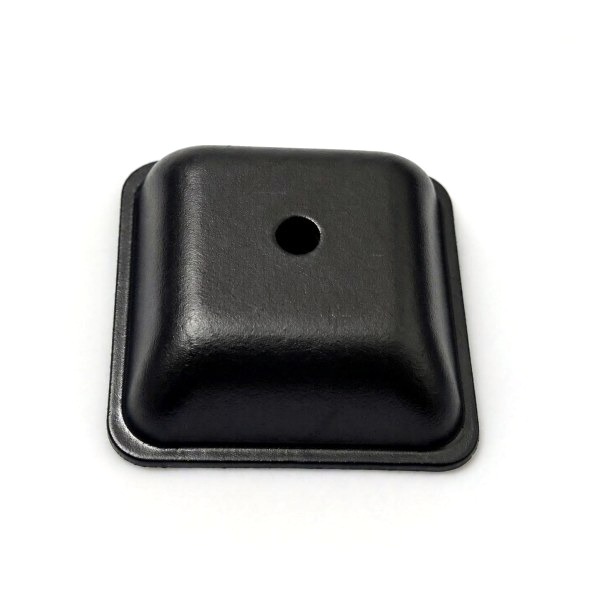


Request a Quote for This Part
Send a drawing or sketch — get material advice, tooling cost and a per-piece price within 24 hours (working days).