

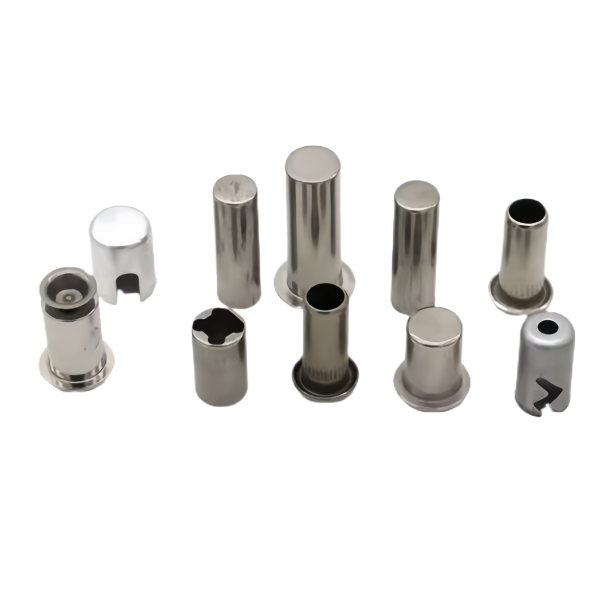
Deep drawn cans, caps and sleeves are three form families that come off the same presses and the same toolroom, separated by what the drawing asks the shell to do: a can closes one end and contains, a cap closes over, a sleeve stays open and guides. All three are quoted and built to customer print, drawn on presses from 5 to 500 T, and supplied as OEM parts to equipment makers — including deep drawn enclosure bodies bought as the customer’s own housing.
The three forms, and where each wins
Buyers often send one drawing that could be any of the three; naming the form correctly at RFQ saves a round of questions:
| Form | Defining feature | Typical duty | Worked examples on this site |
|---|---|---|---|
| Can | Closed bottom, open top — a container | Holding, shielding, containing fluids or electronics | deep drawn can, cylinder can, stainless steel battery can |
| Cap | Shallow draw that closes over an opening | Covers, end caps, sensor caps | aluminium cap, custom sizes, deep drawn cap |
| Sleeve | Open shell, wall does the work | Guiding, bearing seats, valve bodies | stainless steel drawn tube, valve tubes & sleeves |
The boundary is not cosmetic — it decides the die. A cap in a single stage may be a progressive-die part; a deep can needs redraws with interstage annealing; a long sleeve lives or dies on wall uniformity along its length.
OEM enclosure supply, not catalogue parts
A recurring request on this family: the customer’s own housing, drawn as a can or enclosure body and shipped as their part number. That supply model runs differently from catalogue selling, and the differences are in the paperwork as much as the metal:
- Your drawing is the controlled master. Revisions are versioned; a repeat order builds from the same drawing revision you approved, not from a newer guess.
- The part ships unbranded or marked to your scheme — laser marking, stamping or labels as the print requires.
- Deviation reporting before shipment. Each shipment is verified against the master sample before it leaves the shop; a deviation is reported before dispatch rather than found on your assembly line.
- Volume-flexible supply. Scheduled releases against a frame quantity, or batch orders — the route cards follow each batch either way, so the next run starts from the data that already worked.
Wall thickness: the dimension that decides cost
On cans and sleeves, wall thickness is where forming skill shows and where money is made or lost:
- Drawing thins the wall at the top radius by design. A well-run draw keeps that thinning inside roughly 10–15%; beyond it, the wall bulges under load or splits at the radius. Die radii, blank-holder pressure and lubrication are tuned per part — blank size and lubrication are logged per run, not improvised.
- Ironing can hold a tighter wall. Where the print wants a uniform thin wall on a deep shell, an ironing pass sizes the wall after drawing — the standard route for long sleeves.
- First article carries wall data. Wall thickness is measured and recorded on the first-article report, so the thinnest section in your part is a number on file, not a feeling.
Materials and finishes
Stock for this family: SPCC / DC01 carbon steel, 304 / 316 stainless steel, aluminium, brass, copper and bronze — the grade is matched to the duty and fixed in the drawing review. Finishing follows the service environment: zinc / nickel / chrome plating, e-coat, powder coating, anodising for aluminium, passivation for stainless steel, polishing where the surface is the product. The agreed finish travels with the part number, so repeat orders never reopen the question. Material selection reasoning per grade is in the deep drawn covers design guide; sourcing detail is on material selection & sourcing.
Tolerances and inspection
| Parameter | Standard | Note |
|---|---|---|
| Drawn diameters | ±0.05 mm | Tighter bands confirmed against the drawing before quoting |
| Wall thickness | Held to print | Thinning data on the first-article report |
| GD&T | Per drawing | PPAP-style reports on request |
| Sealing surfaces | Measured at first article | Flange flatness and seal-face finish where the print calls them |
Production runs under an ISO 9001 certified quality system: stock arrivals are checked against mill certificates, first-article geometry is confirmed on the CMM, and production batches follow the agreed sampling plan. Where the assembly calls for torque, leak or pressure proof, the test is built into the quality plan with certificates in the shipment file — the system detail is on the quality control page.
Tooling, samples and volumes
Dies, fixtures and gauges are made in our own toolroom — the die charge appears as its own quotation line, and first-article timing is measured from the tooling start date. Drawing-driven parts can be quoted from the print alone; sample-driven parts are reverse-measured into a controlled drawing first, so the sample you send stops being a sample and becomes a drawing. First-article samples ship with a dimensional report and material certificate; later batches are gauged back to the signed sample. Unusual walls, threads or tolerances are feasibility-checked before the price is issued — see tool & die design.
Applications
This family serves equipment across the site: sensor and instrument housings (see sensor housings), motor shells and covers (see automotive motor components), fluid and valve hardware (see deep drawn tubes & sleeves), and general industrial assemblies bought to drawing. If the part you have in mind is mostly a closure rather than a container, the covers range starts on the deep drawn cover page.
Requesting a quotation
Send the drawing (2D PDF/DWG plus STEP if available) or the sample, with material, finish, annual volume and any test requirements. The reply confirms grade options, wall-thickness feasibility, tolerance bands and the tooling cost as its own line — through the quote request page.
Frequently asked questions
Can you supply enclosure bodies as our own OEM part?
Yes — that is the normal model for this family. Your drawing is the controlled master, parts ship marked to your scheme, and every shipment is verified against the master sample before dispatch.
How deep can a can be drawn before it needs a redraw?
Roughly up to a 2:1 ratio of diameter to depth in one draw depending on grade; deeper shells are redrawn in stages with interstage annealing. Aluminium and brass draw deep more readily than 300-series stainless steel.
Can wall thickness be specified independently of the starting sheet?
Within limits: ironing can size a drawn wall down to a defined value on deep shells. The feasibility check at quotation will confirm what your geometry and grade allow.
What documents ship with the parts?
Dimensional report and material certificate with the first article; batch paperwork with each shipment; PPAP-style reports and leak/pressure certificates where the plan calls for them.
| Item | Deep Drawn Cans, Caps and Sleeves |
|---|---|
| Brand | AUNOV |
| Designing | Driven by your drawing or a physical sample — unusual walls, threads or tolerances are feasibility-checked first; the same drawing revision is used for every repeat order. |
| Tooling | Dies, fixtures and gauges made in our own toolroom; die charge as its own quotation line; first-article timing measured from tooling start. |
| Samples | First-article samples ship with dimensional report and material certificate; later batches gauged back to the signed sample. |
| Materials | Carbon steel (SPCC / DC01), 304 / 316 stainless steel, aluminium, brass, copper, bronze — grade matched to duty and fixed in the drawing review. |
| Surface finish | Plating (zinc / nickel / chrome), e-coat, powder coating, anodising, passivation, polishing — per drawing, stable between batches. |
| Processing | Coil blanking, progressive or single-stage drawing with interstage annealing, ironing where the wall calls for it, trim and pierce in following dies. |
| Equipment | Mechanical presses 5–250 T plus 250–500 T hydraulics with in-line annealing; secondary ops on CNC turning centres; inspection on the CMM. |
| Tolerance | ±0.05 mm on drawn diameters, tighter bands confirmed against the drawing; GD&T per drawing, PPAP-style reports on request. |
| Delivery terms | FOB, with DDP offered for EU and US addresses; T/T with deposit, L/C for larger runs; repeat orders reuse the approved first article. |
Also known as: deep drawn cans and caps for OEM equipment — same forming family, only the drawing reference differs.
Related Products


Request a Quote for This Part
Send a drawing or sketch — get material advice, tooling cost and a per-piece price within 24 hours (working days).