
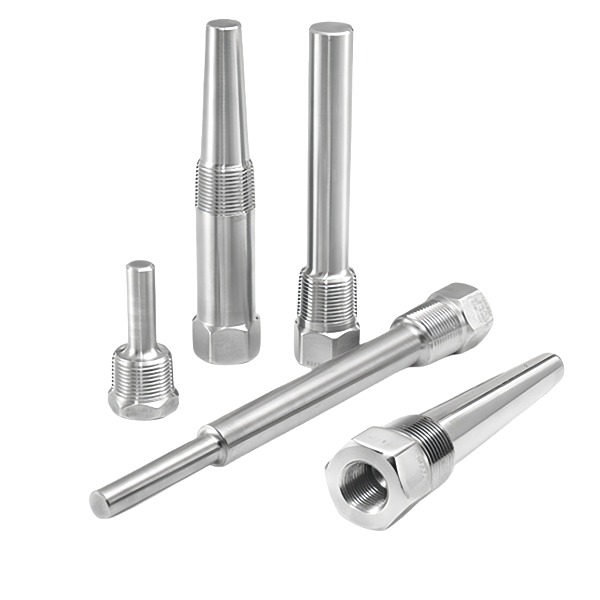
This probe tube ends in a taper, and the taper exists because the tube has to be pushed into something. A blunt tube displaces the material it enters and needs force to do it; a tapered one parts it. That single difference decides whether a probe goes into a product cleanly or tears it.
Penetration is a geometry problem, not a force problem
The response from a probe is always improved by getting more of it into the medium, but pushing a wider tube in damages what it is measuring and takes more force to do it. A taper resolves this: the tip opens a path the larger diameter behind it then follows, so the tube reaches full immersion without displacing the volume a blunt end would. In food product, in granular material and in soil, that is the difference between a reading and a destroyed sample.
The taper has to be formed, not ground
A tapered tip on a drawn tube is produced in the forming, which keeps the wall continuous over the nose and leaves no seam for product to collect in. That matters more than it sounds: a tip that is made by closing a tube and then shaping the end leaves the closure at the point of the taper, which is both the weakest part of the tube and the part with the most contact with whatever is being probed.
Wall and tip thickness still set the response
A pointed tip is thin at its point, and that thinness is what makes it fast – the sensor behind it is close to the medium and the heat path is short. The risk is the opposite one: a tip formed too thin will not survive being pushed into anything, and in food service a tip that dents or bends is a foreign-body hazard. The tip thickness is set between those two limits and held, which is why it is an inspected dimension rather than a consequence of the forming.
Cleanability: the reason these are seamless
Probes that go into food or pharmaceutical product have to come out clean, and a smooth seamless body with no crevices is what makes that possible. The stepped body is what allows it to be gripped and sealed in a fitting while the slim tip does the measuring. There is nowhere for product to lodge between the tip and the body, and the finish is specified so the surface releases rather than holds.
How a tapered tip is checked before it ships
The taper form, the tip thickness and the transition into the body are measured together, and the surface is checked for the condition the application’s cleaning depends on.
First articles and retention samples are kept for the programme, so a reorder is formed to the same taper and the same tip thickness. On a probe that has to enter the medium without damaging it, that is what keeps the second batch behaving like the first.
You will find this part in our Sensor Housings range. Process notes, common materials and inspection points for every product in the family are collected across the sensor housings pages.
Where this part is used
Stepped probe tubes with tapered tips are used wherever a probe has to be pushed into a medium rather than screwed into a port. Food and meat probes, dairy and laboratory probes, soil and compost probes, and medical entry probes all rely on the same idea: a blunt tube displaces the material it enters and needs force, while a tapered one parts it and goes in with far less.
Stainless steel is the default because these tubes are cleaned, often chemically, and because the tip has to stay sharp through that cleaning. The taper is formed rather than ground, which keeps the wall continuous and the tube seamless.
What we need to quote it
Send the taper angle and tip diameter, the immersion depth, and whether the tube is filled or sealed downstream. State the cleanability requirement — if the tube has to be food-contact or chemically cleaned, that decides the surface finish we hold and whether we electropolish. A sample of the current probe is the fastest way to set the response target.
Specifications
| Item | Stainless Steel Stepped Probe Tubes with Tapered Tips |
|---|---|
| Brand | AUNOV |
| Designing | Send us your 2D drawing, or mail a sample for measurement, our engineers reply with a manufacturability assessment and pricing. |
| Tooling | Every die designed and built in our toolroom, with your part number on the tool record. |
| Samples | Sample parts arrive with a full dimensional report and material certification. |
| Materials | 304 / 316 stainless steel leads the stock list for this part, alongside carbon steel (SPCC / DC01), aluminium, brass and copper, and the grade is fixed at the drawing review. |
| Surface finish | Plating, e-coat, powder coating, anodising or passivation as the drawing calls out, per your print. |
| Processing | Deep drawing in stages, in-line annealing where needed, then pierced and machined in house. |
| Equipment | Mechanical presses 5-250 T and hydraulic presses 250-500 T, CNC turning centres and a climate-controlled CMM room. |
| Tolerance | Drawn tolerances held to +/-0.1 mm, +/-0.03 mm after machining. |
| Delivery terms | FOB as standard, DDP available for EU and US destinations, payment T/T or L/C, D/P for repeat accounts, call-off schedules and blanket orders supported. |
Related Products


Frequently Asked Questions
Why does the tip taper?
A blunt tube displaces what it enters and needs force; a tapered tip parts the material so the larger diameter behind it follows without destroying the sample.
Where is this taper used?
In food product, granular material and soil, where a blunt end would destroy the sample rather than read it.
How is the taper held?
The taper is finished on the critical faces with the tube drawn first, so the tip opens the path the full diameter then follows at controlled immersion.
Which stainless steel grades are used?
304 and 316, drawn then finished on the tip, with the grade chosen for the process the probe enters.
Request a Quote for This Part
Send a drawing or sketch — get material advice, tooling cost and a per-piece price within 24 hours (working days).