
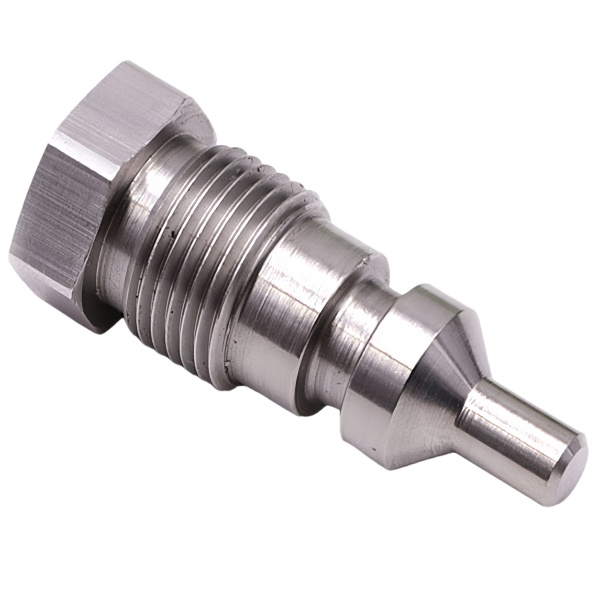
The Stainless Steel Threaded Thermowell Bulb Fitting is a thermowell whose sensing end is not a plain closed tube but an enlarged bulb – a locally thicker or wider section that houses more of the sensing element and puts more metal in contact with the process. The bulb is there to improve thermal response and strength at the tip, and the threaded section at the top screws the whole assembly into the port. Two things define the part: forming the bulb without leaving it thin or off-centre, and getting the thread to seal and retain at the port while the bulb does its thermal job. This page covers the bulb geometry, the thread and the stainless steel that ties them together.
The bulb is a response and strength feature, and it is formed locally
A bulb at the sensing end puts more metal, and more contact area, right where the measurement happens, which speeds the thermal response and thickens the tip against pressure and erosion. But the bulb is a local enlargement on what is otherwise a tube, and forming it – by expanding, by a secondary draw or by swaging – works the metal at exactly the point that was already the most stretched part of the original tube. A bulb that is formed carelessly is thin at its pole or off-centre, and either defect undoes the response and strength the bulb was added to provide.
- Bulb wall thickness at its widest point is measured, because that is where the forming thinned the metal the most.
- Bulb concentricity to the tube axis is checked, since an off-centre bulb seats the sensor crooked and responds unevenly around its circumference.
- The transition from tube to bulb is controlled for a smooth blend, because a sharp step there is both a stress riser and a place the sensor can catch.
Threaded into the port: the thread is the pressure boundary
The threaded section is what holds the thermowell in the port and, very often, what seals it. On a threaded thermowell the seal is either on the thread flanks – a taper thread that wedges tight – or on a separate face or land that the thread clamps down. Which one it is changes the thread spec entirely, because a retaining thread and a sealing thread are not interchangeable. We confirm at review which seal the design relies on, because a thermowell that is threaded to retain but expected to seal is a slow leak.
- Thread form and class are chosen for the seal type, with taper threads verified to their gauge where the seal is on the flanks.
- Engagement is enough to hold against internal pressure trying to push the well out, which is the load a ported thermowell actually sees.
- The shoulder or face the thread bottoms against is checked for squareness, so the well seats fully and the seal land closes evenly.
Austenitic stainless steel: forming the bulb and cutting the thread together
The whole part is stainless steel, and that material choice governs both of its features. Forming the bulb in 304 or 316 fights the same work-hardening that makes every stainless steel draw hard – the bulb is formed from already-worked tube and needs either a gentle process or an anneal to avoid cracking at the pole. Cutting the thread fights galling, because austenitic stainless steel threads galls and builds up if the tool and the speed are wrong. The bulb and the thread are made in the same material but they are two different battles.
- Bulb forming is staged or followed by an anneal where the local strain is high, so the pole does not crack after the metal has work-hardened.
- Thread cutting uses parameters and lubricant that stay under stainless steel’s galling threshold, and the crest is inspected for the torn or built-up edge that stainless steel produces when it does gall.
- Passivation after all forming and cutting removes the free iron that both operations leave behind, and is verified per lot rather than assumed.
The thermal path from bulb to sensor has to stay short
Everything about the bulb is in service of getting heat to the sensor quickly, and that thermal path runs from the process, through the bulb wall, to the sensor seated inside. Any feature that lengthens or degrades that path – a thick air gap, a rough seating surface, a bulb that is thick in the wrong place – slows the response even though the part looks correct. We hold the internal seating geometry with the thermal path in mind, not just as a bore dimension.
- Internal bore finish at the sensing section is controlled so the sensor contacts the wall rather than sitting in a gap.
- Sensor seating depth inside the bulb is verified, because a sensor seated short of the bulb’s thermal centre responds slower than the design assumes.
- Wall thickness is balanced – thick enough for pressure and response at the bulb, but not so thick that it slows the sensor down.
How we verify a threaded thermowell bulb fitting
Verification checks the bulb, the thread and the internal thermal path, because the fitting only performs if all three are right.
- Bulb: maximum diameter, wall thickness at the pole, and concentricity to the tube axis measured on the first article.
- Bulb-to-tube transition inspected for a smooth blend and for the absence of cracking at the pole.
- Thread: form and class gauged to the seal type, with the crest inspected for galling or build-up and the seating shoulder checked for squareness.
- Internal bore and seating: diameter, finish and sensor-seating depth verified against the thermal-path requirement.
- Material and passivation records per lot, confirming the stainless steel grade and that free iron was removed after forming and threading.
- Fit and pressure check on the first article: the fitting threaded into a gauge port and pressure-tested, with the sensor inserted to confirm seating before the run.
First articles and retention samples are kept for the programme, so a repeat run of the bulb fitting is formed, threaded and passivated to the same verified baseline. On a part whose bulb, thread and internal seating all have to work together for the sensor to respond quickly and the port to hold pressure, that baseline is what keeps a second batch performing like the first.
Sensor Housings is the range this part sits under; the overview page pulls together the tooling logic, finishing options and tolerance notes that apply across the family.
Specifications
| Item | Stainless Steel Threaded Thermowell Bulb Fitting |
|---|---|
| Brand | AUNOV |
| Designing | A drawing file or a physical sample starts the review, you get a DFM review together with the quotation. |
| Tooling | Tooling designed and cut in house, held and maintained under your part number. |
| Samples | First-off samples are sent with a full dimensional report and mill certificate. |
| Materials | 304 / 316 stainless steel leads the stock list for this part, alongside carbon steel (SPCC / DC01), aluminium, brass and copper, per the drawing. |
| Surface finish | Zinc, nickel or chrome plating, e-coat, powder coat, anodising or passivation, as called out on your print. |
| Processing | Progressive deep draw stages with in-line annealing as the draw ratio demands, then pierced and machined in house. |
| Equipment | Our press floor runs 5-250 T mechanical and 250-500 T hydraulic presses, in-house CNC cells and a temperature-controlled inspection room. |
| Tolerance | Drawn tolerances held to +/-0.1 mm, machined features held to +/-0.03 mm. |
| Delivery terms | Standard terms FOB, DDP offered to EU and US, payment T/T or L/C, D/P for repeat accounts, blanket orders and call-offs supported. |
Related Products


Frequently Asked Questions
Why add a bulb to the sensing end?
The bulb puts more metal and contact area at the measurement point, speeding thermal response and thickening the tip against pressure and erosion.
How is the bulb formed without weakness?
It is formed by expanding, a secondary draw or swaging, but worked at the already-stretched point of the tube, so it must be formed without going thin at the pole or off-centre.
What does the thread do?
The threaded section screws the assembly into the port and has to seal and retain while the bulb does its thermal job.
Which stainless steel grade is used?
304 or 316 depending on the process, drawn then finished so the bulb and thread hold together under pressure.
Request a Quote for This Part
Send a drawing or sketch — get material advice, tooling cost and a per-piece price within 24 hours (working days).