
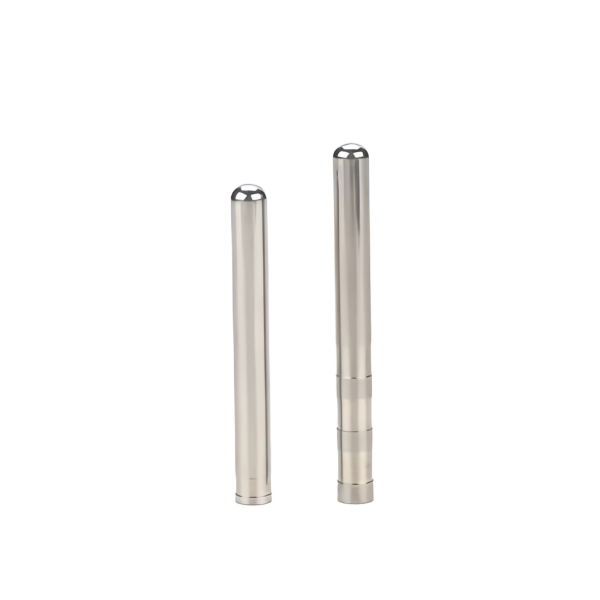
A one-end-closed thermowell tube has to be closed at the far end, and there is more than one way to do it. The three routes – closing the end in the die as part of the drawn shell, drawing the tube and welding a cap on, or spinning the end closed – produce parts that look identical on a drawing and behave differently in service. Which one we propose depends on the wall, the pressure and the environment.
Closing the end in the die, as part of the shell
The seamless route draws the tube and forms the closed end from the same piece of metal, so there is no joint at the end at all. It is the option to prefer where the tube sees pressure, cyclic temperature, or a corrosive medium, because the absence of a joint removes the place those failures start. It costs more in tooling and it constrains the geometry: very deep tubes with small diameters may exceed what a single draw can reach, and unusually thick walls resist being formed into a closed end without an intermediate step.
Welding a cap on a drawn tube
The cap route separates the two problems: draw the tube to its bore and wall, then close it with a machined or drawn cap welded in place. It handles wall thicknesses and depth-to-diameter ratios that the one-piece route will not, and it is often the economical choice for large sizes. The weld becomes the feature to specify and to inspect, and it sits at the hottest, most cycled end of the part – so the joint preparation, the penetration and the post-weld condition are what decide whether the tube lasts.
Spinning the end closed
Spinning closes the end by working the metal over a form rather than removing or adding anything. It suits moderate pressures and larger diameters, and it handles a tapered or radiused end profile without a dedicated closing die. The practical limit is that a spun closure relies on the quality of the worked metal at the tip, and thin walls can thin further at the nose exactly where the material has the least margin.
Tip thickness sets the response, whatever the route
Whichever way the end is closed, the tip is a thermal component. The heat has to cross it to reach the sensor seated inside, so a heavy tip makes a slow probe and a thin one makes a fast one – and the two routes do not leave the same thickness. We hold the tip thickness to the response the application needs rather than to whatever the forming process happens to leave, and we say so at quotation because it can rule a route in or out.
How a closed end is verified
The closure is inspected for soundness and for the tip thickness the thermal response depends on, and the method matches the route: a seamless end has no joint to prove but does have a formed thickness to hold, while a welded or spun closure is checked at the joint or the worked nose.
First articles and retention samples are kept for the programme, so a reorder is closed the same way and to the same tip thickness. On a tube whose far end is the difficult end, that is what keeps the second batch responding like the first.
This part belongs to our Sensor Housings range. The sensor housings pages collect the process notes, common materials and inspection points behind every product in the family.
Where this part is used
One-end-closed thermowell tubes close at the process end and stay open at the instrument end, which is the standard arrangement where a sensor has to be replaceable without breaking into the line. Process piping and vessels are the usual home, along with HVAC plant and water systems where the well is screwed into a port and the sensor is withdrawn from outside.
Closing one end of a tube that also has to hold a thread at the other is two forming operations in sequence, and the closed end has to stay thick enough to be a pressure boundary while staying thin enough to respond.
What we need to quote it
Send the process medium and its temperature, the port thread at the open end, and the closed-end thickness target. Tell us whether the sensor is replaced under pressure, and if so what the withdrawal procedure is — that decides whether we leave a clearance or a seal land at the closed end.
Specifications
| Item | Stainless Steel One-End-Closed Thermowell Tubes |
|---|---|
| Brand | AUNOV |
| Designing | Share your print, or send a part to be measured, a manufacturability review comes back with the quotation. |
| Tooling | Our own toolroom designs and builds every die, each die held against your part number. |
| Samples | Sample parts arrive with a full dimensional report and material certification. |
| Materials | 304 / 316 stainless steel is the primary stock for this part, alongside carbon steel (SPCC / DC01), aluminium, brass and copper, with the final grade confirmed at the drawing review. |
| Surface finish | Zinc, nickel or chrome plating, e-coat, powder coat, anodising or passivation, each selected against the drawing requirement. |
| Processing | Deep drawing in stages, in-line annealing where needed, then pierced and machined in house. |
| Equipment | Our press floor runs 5-250 T mechanical and 250-500 T hydraulic presses, CNC turning and milling cells, a climate-controlled CMM room. |
| Tolerance | +/-0.1 mm on as-drawn features, +/-0.03 mm on machined features. |
| Delivery terms | FOB is standard; DDP offered for EU and US, T/T and L/C; D/P on repeat accounts, call-off schedules and blanket orders supported. |
Frequently Asked Questions
What are the three ways to close the far end, and what separates them?
Closing it in the die, which leaves one continuous piece of metal with the tip thickness set by drawing. Welding a cap on, which allows a heavier tip than drawing would leave but introduces a joint. And spinning the end closed, which suits particular diameters and profiles. The three differ in strength, tip thickness control and what has to be inspected.
Which route gives the fastest reading?
Whichever leaves the thinnest sound tip, because response follows thermal mass at the sensing point. Drawing can be thin but is constrained by what the material survived reaching there. A welded cap is predictable but usually thicker. Choosing the route is therefore choosing where the response and the margin sit.
When does the welded cap become the wrong answer?
Whenever the joint becomes the least sound part of the assembly. In aggressive media, under thermal cycling, or where the specification restricts welds in the pressure path, a joint that is metallurgically fine is still a location that has to be qualified. In those cases closing it in the die removes a question rather than saving money.
How is a closed end proved if it cannot be allowed to fail?
By combining two kinds of evidence. Destructive sectioning on samples establishes what is actually being achieved at the tip – wall, soundness, absence of fold – because that cannot be measured from outside. Non-destructive checks then confirm the rest of the batch resembles what was sectioned, rather than standing in for it.
Related Products


Request a Quote for This Part
Send a drawing or sketch — get material advice, tooling cost and a per-piece price within 24 hours (working days).