
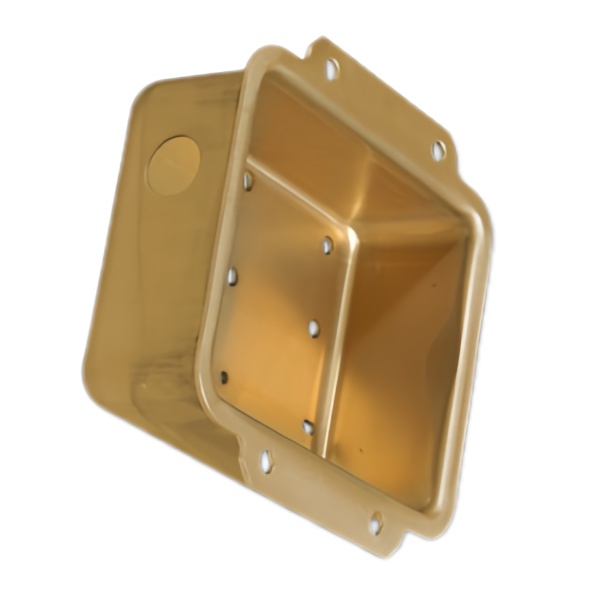
An enclosure box lives at its seams and flanges, not at its walls
A painted deep drawn steel enclosure box is judged by the places where it meets the world: the flange it bolts through, the seam where a lid closes, and the face a cable or a panel meets. The walls are the easy part; a deep draw makes four straight-ish walls and a bottom in one hit. The hard part is making the open flange true, because a painted box that is perfect on its faces but warped at the rim will not seal, will not sit square in its cutout, and will show its paint unevenly exactly where people look. We plan the draw and the paint together, because the paint is a tolerance the flange has to respect.
We draw these on mechanical presses in carbon steel, holding the envelope to roughly +/-0.1 mm and any machined seat to +/-0.03 mm, then apply a paint system suited to the duty. The flanges are formed and flattened as part of the draw, and the painting is sequenced so the coating thickness is known before the lid and panel dimensions are set.
We log the draw and the paint system together against your part number, so the box you approve first time is the box you receive on reorder, film thickness and all. The flange flatness and bolt-hole pattern that we proved on the first article are held on every later batch, which is why a painted enclosure programme can run for years without the lid slowly drifting out of fit as the process “settles”.
The flange radius is the paint’s weakest point and the box’s strongest need. A sharp flange edge pulls the paint thin and chips on handling, while a generous radius lets the coat cover and protects the edge that the box is handled by. We size the flange radius from the paint system, not just from the look, and we record it so repeats hold the same edge protection.
A painted enclosure that must keep an IP rating depends on the lid-seat flatness more than on the coat. Paint builds on the rim, and if the rim was not flat before painting it is a wavy seat after, with the gasket pinched on the highs. We hold the rim flat first and treat the paint as a known addition, so the lid closes on a true plane and the rating holds.
Colour and gloss matching across a long production run is a control we put in the quotation. A box that matches its neighbour this month but not next is a visible failure on an installed panel. We keep a reference sample with the order and we check against it, because the paint system is only as good as its repeatability.
Painting a drawn box: how the system stacks against the steel
A painted finish on a steel enclosure is a stack of layers, typically pretreatment, primer and topcoat, and each layer adds thickness and each layer has an adhesion requirement. The pretreatment, usually a phosphate or conversion coat, is what lets the paint grip the steel through years of temperature and humidity, and skipping or rushing it is the classic reason a painted box chips at the first knock. We specify the system against the environment the box lives in, from an indoor powder through to an outdoor-rated coat with UV stability.
- Pretreatment first. Without a proper conversion layer the topcoat is a sticker, not a finish, and it fails at edges where the box gets handled.
- Film thickness is a tolerance. Too thin and the steel shows and corrodes; too thick and the coat sags, cracks at the flange, and interferes with the lid. We measure it, we do not guess it.
- Edge coverage is the weak point. A drawn box has sharp flange edges where paint is thinnest, and we design the radius so the coat can actually cover rather than pull back.
- Cure is part of the spec. An under-cured coat stays soft and marks; an over-cured one goes brittle. We hold the cure window the chemistry demands.
The flange is a mounting and sealing plane, and its flatness beats its cosmetics
The flange of an enclosure box is where it is bolted, gasketed or inset, so its flatness and its hole pattern matter more than its paint shine. We keep the flange as the drawn reference plane and we flatten or restrike it so it stays true after springback, then we paint it knowing the coating will add a few microns across that plane. Where the box must seal, we machine a register or a gasket step after painting only if the tolerance demands it, because machining through paint reopens a corrosion path that has to be dealt with.
We also decide with you whether the painted box is rated for indoor or outdoor duty before the first part is drawn, because the pretreatment and the topcoat system are different and cannot be swapped at the end. An outdoor-rated system costs more and cures differently, but it is what keeps the steel from rusting at the flange edge where paint is thinnest, and that edge is exactly where a box fails if the system is wrong.
The bolt pattern on the flange is a position feature, not an outline. We hold the holes to a tighter band than the cosmetic shell and we confirm they line up with the intended lid or back panel, because a box whose holes drift is a box that cannot be assembled no matter how good the walls look.
Corner radii on a rectangular draw, and why a tight radius buys a wrinkle
A rectangular enclosure is four corners, and each corner is where material has to travel farther than along the straight wall. Tight corner radii tempt a designer because they look neat, but on a deep draw they force the material to pile up and wrinkle, or to thin and crack, unless the reduction is gentle. We open the corner radius just enough to let the steel flow, and we record the value that worked on the first article so repeats use the same die settings.
- The wall straightness follows the corner. A corner that wrinkled on the first pull leaves a wave in the adjacent wall that no amount of paint hides.
- Draw beads control the flow. We use holder pressure and beads to meter material into the corner so it fills without puckering.
- Bottom corner radius and wall radius are different features and both need a value on the drawing; a single “square” note cannot describe them.
Paint film thickness as a tolerance the mating cover must know about
Because the paint adds measurable thickness to every exposed face, the lid or cover that closes on this box has to be designed for the coated dimension, not the bare steel dimension. A lid drawn to bare size will bind or gap once the box is painted, and the mismatch shows as an uneven seam. We state the film thickness on the drawing and we advise the lid designer to dimension to the finished, painted condition so the two halves agree.
This is also where colour and gloss get agreed. “Painted” covers a vast range, and on a visible enclosure the agreed reference sample is what prevents a box that is technically compliant but visually wrong next to its neighbours. We keep that reference with the order so repeats match the first article rather than drifting toward a generic interpretation of the colour name.
How we verify a painted enclosure box
A painted box is verified as a finished assembly component, coating and all. The routine:
- First-article CMM report on the envelope, flange and any machined seat, at the condition stated on the drawing.
- Coating thickness measurement across walls and flange, confirmed against the specified film build.
- Adhesion test on the cured paint, because grip through the pretreatment is what the service life depends on.
- Flange flatness and bolt-hole position, checked so the box seats and lines up with its lid or panel.
- Corner and wall inspection for wrinkle or thinning, against the recorded draw settings.
- Appearance sign-off against the agreed colour and gloss reference, where the box is visible.
The box ships with its dimensional report and material certificate under your part number, and the draw and paint settings are archived so the next order repeats the same process rather than relearning the flange.
Send the box drawing with the paint system, the flange flatness and the bolt pattern stated, and we return a manufacturability review with the quotation and a first article proving the coated dimension. State the duty, indoor or outdoor, because that chooses the pretreatment and topcoat the box will live or die by.
The engineering calls behind a part like this — draw ratio, wall thinning, radii and trim — each get worked examples in our deep drawn covers guide; the Precision Deep Drawn Parts pages gather the rest of the family.
Specifications
| Item | Painted Steel Deep Drawn Enclosure Box with Flanges |
|---|---|
| Brand | AUNOV |
| Designing | Send us your 2D drawing, or mail a sample for measurement, you get a DFM review together with the quotation. |
| Tooling | Our own toolroom designs and builds every die, held under your part number. |
| Samples | Pre-production samples of the box ship with a dimensional report and material certification. |
| Materials | Carbon steel (SPCC / DC01) is the primary stock for this part, alongside 304 / 316 stainless steel, aluminium, brass and copper, with grade selection confirmed at drawing review. |
| Surface finish | Plating, e-coat, powder coating, anodising or passivation as the drawing calls out, per the drawing. |
| Processing | Deep drawing in stages, in-line annealing where needed, then pierced and CNC-machined in house. |
| Equipment | Our press floor runs 5-250 T mechanical and 250-500 T hydraulic presses, CNC turning centres and a climate-controlled CMM room. |
| Tolerance | +/-0.1 mm as-drawn, +/-0.03 mm after machining. |
| Delivery terms | FOB is standard; DDP offered for EU and US, payment T/T or L/C, D/P for repeat accounts, call-off schedules supported. |
Frequently Asked Questions
Why does this box get judged on its flanges rather than its walls?
The walls are the easy part; a draw makes four of them and a bottom in one hit. The open flange is where the box has to seal, sit square in its cutout and carry an even film where people look, and a box that is perfect everywhere except the rim fails all three.
Why do the draw and the paint have to be planned together?
Because coating thickness is itself a tolerance that the flange and the mating cover must respect. If the film build is not known before the lid and panel dimensions are set, the dry dimensions can be right and the assembled box still will not seal.
Can the corner radii be drawn tight?
A tight radius buys a wrinkle. The material needs a radius generous enough to flow into the corner, and once it is in, the flange is flattened as part of the draw rather than as a separate correction afterwards.
What tolerances apply to a painted enclosure box?
The envelope is held to roughly +/-0.1 mm with any machined seat at +/-0.03 mm. The flanges are formed and flattened within the draw, and the painting is sequenced so its thickness is known before the lid and panel dimensions are fixed.
Related Products



Request a Quote for This Part
Send a drawing or sketch — get material advice, tooling cost and a per-piece price within 24 hours (working days).