
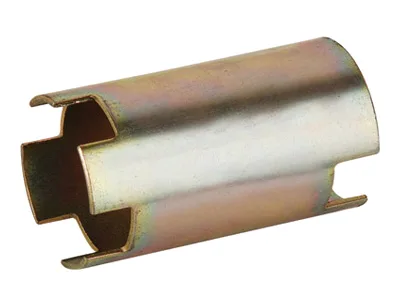
From single part to component set
“Fuel pump electric motor components” is not one part but a family: the housing, the casing, the end cap, the brush plate, the terminal carrier, the bearing retainer, and the small brackets and spacers that hold an in-tank pump together. Buying them one at a time from different suppliers is a common way to accumulate tolerance stack-up and assembly problems. Buying them as a set from one drawing shop is how the interfaces get controlled.
We supply these components as a matched family – drawn from the same material lots, formed on coordinated dies, and inspected against a shared interface scheme – so the customer’s assembly line receives parts that fit each other, not parts that each fit their own drawing.
The components in a fuel pump motor set
| Housing | The stator shell with the bearing seat; fuel-wetted, controlled bore. |
|---|---|
| Casing / outer shell | The closure shell that takes the end cap or the module collar. |
| End cap | Closes the motor; carries the brush plate and terminal seat. |
| Brush plate / terminal carrier | Drawn or stamped plate that locates brushes and seals the leads. |
| Retainers and spacers | Small stamped or deep-drawn rings that set bearing preload and stator position. |
Individually these are modest parts. Together they define the motor’s air gap, its sealing, and its electrical continuity, and those three things are set by how the parts stack – which is why we like to see the whole assembly, not just one drawing.
Why the interface scheme matters more than any single tolerance
Each component has its own dimensional tolerance, and each tolerance contributes to the assembly result:
- Air gap depends on housing bore + stator OD + rotor OD, so a housing bore tolerance held at 0.05 mm can still produce a wide air gap if the stator is at its limit in the other direction.
- Sealing depends on the casing closure geometry plus the cap flange, so both parts must be quoted with the joint in mind, not in isolation.
- Electrical continuity depends on the mating surfaces of the cap and housing being clean and conductive, so any coating decision on one part affects the other.
When we supply the set, we can shift tolerance from a part where it is cheap to a part where it is expensive, and we can hold a stack-up calculation across the family. That is the practical benefit of buying components together, and it is most valuable exactly where the customer’s own assembly has the least room to adjust.
Material and finish consistency across the set
A fuel pump is a galvanic environment waiting to happen: stainless steel, coated steel, brass terminals, and elastomers all sit in the same tank. We keep the metal components in compatible grades where the design allows, and where a dissimilar pairing is unavoidable, we flag it so the customer can decide on isolation. Supplying the set from one shop also keeps the coatings consistent – a cap with one coating supplier and a housing with another is a recipe for an unexpected couple.
Assembly order and the features that support it
Because a component set is assembled in a specific sequence, the parts carry features that exist purely to serve the line:
- Lead-in chamfers so a bearing or stator presses in without shaving material.
- Orientation features – a notch, a flat, or an asymmetric tab – so automation cannot load a part backwards.
- Staking or swaging features where a retainer is permanently deformed over the assembly.
Designing these in from the start costs little in the die and saves a great deal of grief on the line. We routinely add them during the quotation review if the customer’s drawing does not already include them.
Supply model: kits, kanban, and aftermarket
We supply fuel pump components in three modes, and the right one depends on the customer’s business:
- OEM production kits – the full matched set, delivered to the assembly line on a schedule, with lot traceability tying each component to its material heat.
- Kanban replenishment – high-runner components held in stock against a pull signal, so the customer carries less inventory.
- Aftermarket sets – the components a remanufacturer or repair shop needs for a pump rebuild, often in smaller quantities and with more tolerant finishes.
Each mode has different cost drivers: OEM kits reward volume and predictability, aftermarket sets reward flexibility and fast changeover. We quote them differently for that reason.
Quality documentation for a component set
Where the set feeds an OEM program, we supply the documentation as a package rather than per part:
- First article reports for each component, referenced to the shared interface scheme.
- EN 10204 3.1 material certificates for the metals.
- A stack-up report showing that the assembled air gap and the closure joint stay in tolerance at the extremes.
- PPAP Level 3 or PSW where the program requires it.
One component or the whole set, either is possible
Can you supply just one component, or must it be the whole set?
Either is possible; we simply recommend the set where the interfaces are tight, because that is where an isolated part becomes a line problem.
Will the set be made from the same material lots?
We coordinate lots so the components are metallurgically consistent, which matters for galvanic pairing and for weld compatibility.
Do you provide the fasteners and elastomers too?
We supply the metal drawn and stamped components; seals and fasteners are usually specified by the customer, though we help source them where a complete kit is needed.
How is a component set priced?
As a set, with the per-component prices visible, so the customer can see where the cost sits and where a design change would pay off.
Specifying a fuel pump motor component set
Send the full assembly drawing, the interface tolerances that matter (air gap, sealing, continuity), the fuel and temperature environment, the supply mode (OEM kit, kanban, or aftermarket), and the annual volume per component. We will review the interface scheme during quotation and tell you where tolerance can be redistributed to save cost without risking the assembly – which is the whole reason to buy the family from one shop.
Automotive Motor Components is the parent range for parts like this one; the overview page gathers the tooling logic, finishing options and tolerance notes that apply across the family.
Where this part is used
A fuel pump electric motor is a small assembly, and the parts inside it – the stator housing, the closure shell, the end cap, the brush plate, the terminal carrier, the bearing retainers – are each individually modest. The reason they are worth supplying together is the interface between them: the air gap depends on the housing bore and the stator outside diameter, the sealing depends on the closure and the cap flange, and the electrical continuity depends on the brush plate and the terminal carrier. Each of those relationships is a stack, and a stack of individually acceptable tolerances is not an acceptable stack.
You will find these component sets in in-tank fuel pump modules, in external pump housings, and in the module designs used across a wide range of engines and, increasingly, in the hydrogen and ammonia fuel programmes where the material and cleanliness requirements differ sharply from petrol and diesel.
What we need to quote it
Send the assembly drawing if you have one – the whole set is easier to quote together than part by part – and the material and finish requirements for the wetted components. Tell us which components are fuel-wetted and which are not, since that separates the corrosion and cleanliness requirements from the rest. If you are buying the set, specify the kit, kanban or call-off model you want, and the assembly order you need the parts delivered in.
Specifications
| Item | Fuel pump electric motor components |
|---|---|
| Brand | AUNOV |
| Designing | Made to your 2D/3D drawings (PDF, DWG, STEP, IGS) – a manufacturability review comes back with the quotation; the agreed version governs every later batch. |
| Tooling | Dies, fixtures and gauges are made in our own toolroom, so a die can be re-cut against the approved drawing, and first-article timing is measured from the tooling start date. |
| Samples | Prototype and pre-production samples are provided against the drawing, so any deviation is corrected at sample stage, and mass production is gated on that approval. |
| Materials | Carbon steel (SPCC / DC01), 304 / 316 stainless steel, aluminium, brass and copper – the grade is matched to the duty of this pump. |
| Surface finish | Zinc / nickel / chrome plating or e-coat, chosen for the environment this housing sees; salt-spray tested to drawing. |
| Processing | From coil or blank, deep drawing with in-process annealing thins walls evenly; the sequence then runs trim, pierce, form and finish. |
| Equipment | Presses from 5 to 250 T mechanical and 250-500 T hydraulic, annealing ovens on site, plus CNC turning and machining centres. |
| Tolerance | +/-0.05 mm to +/-0.1 mm across the part; tighter bands confirmed against the die before the quotation is fixed. |
| Delivery terms | FOB Ningbo or Shanghai, T/T with deposit and L/C for larger runs; price breaks tie to annual volume. |
Related Products


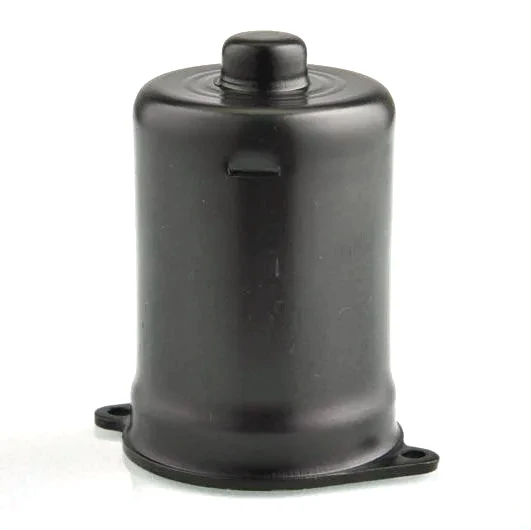

Request a Quote for This Part
Send a drawing or sketch — get material advice, tooling cost and a per-piece price within 24 hours (working days).