
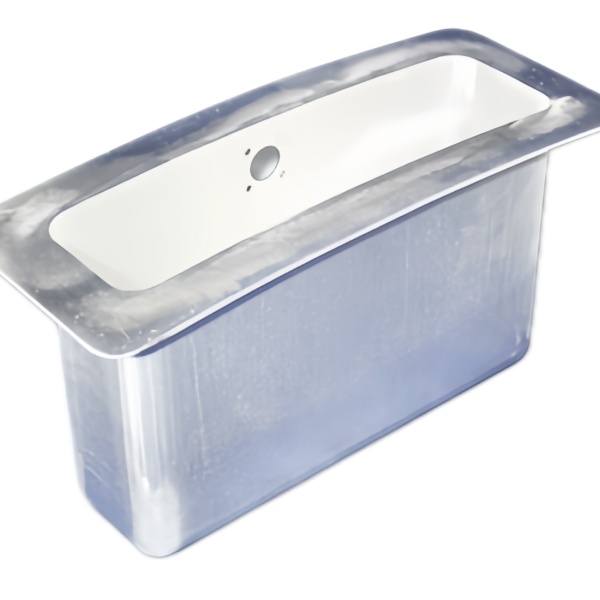
The Steel Deep Drawn Rectangular Pan with Rolled Rim is a corner problem wearing a pan costume. This page covers how rectangular draws behave differently from round ones, what the rolled rim adds to blank development, and the inspection record that ships with each lot of pans.
Corners first: rectangular pans draw like four cylinders fighting each other
A round draw pulls material inward uniformly from all sides. A rectangular pan does something else at each corner: the flange material there flows in two directions at once, compressing as it converges on the die radius. The corner zones are the deep-draw and the straight walls are essentially a bend, which is why the failure modes of a rectangular pan live almost entirely at its corners. Wrinkles form in the corner flanges when blank holder pressure is too low for the compressive flow; tears open at the corner die radius when it is too high or the corner radius is too small for the material.
The rule ratios that govern it: corner radius should be at least 4 times sheet thickness (we prefer 6 times on SPCC 1.0 to 1.5 mm stock) and the draw depth should stay under about 0.6 times the narrow inside width on a first-stage draw. Below those ratios the part wants two stages, and below corner radius of about 2 times thickness it is not a drawing candidate at all – it is a pressing with heavy corner thinning, and we say so at quotation. Corner wall thickness on a good schedule lands 5 to 9 percent below nominal; our first-article report measures it explicitly at all four corners so the number is on file, not discovered in service.
Rolled rims hide the cut edge, and what that does to blank development
The rolled rim is the signature feature of this product: the raw blank edge – which is work-hardened from blanking and sharp enough to cut – is curled inward or outward around itself, producing a safe, stiff finished edge. It also does mechanical work. The roll consumes material; a rim rolled around a 2.5 to 4 mm wire diameter on a pan edge eats an extra 12 to 20 mm of blank perimeter, and that perimeter has to be in the blank from the first hit. Drawings that dimension the finished pan height and forget the roll leave the die maker guessing, which is how you get pans 3 to 5 mm short.
Rim direction is a real design choice. An inward roll gives a smooth exterior face for shows and cleaning, but it shortens clearances and can interfere with a mating flange. An outward roll stiffens the mouth more per unit of material and takes paint better because the coating wraps the convex surface, but it increases the stack height in packaging and the outer envelope dimension. We develop the blank with a trial trim on the first tool set, then hard-code the trim line into a trim die, so rim development is a first-article exercise rather than a recurring fight.
Depth-to-corner radius: the ratio that decides whether a pan wrinkles
Rank the drivers of wrinkle-free rectangular drawing and the depth-to-corner-radius ratio sits near the top. At ratios under 2, a single stage with moderate blank holder pressure works reliably and the corner flange stays stable. Between 2 and 4, draw beads enter the die to brake the straight-wall flange so the corners can flow without dragging the middle; the beads trade material retention for control. Above 4, the honest answer is two draws plus a size-restrike, because no amount of binder pressure fixes flange instability once the corner travel exceeds what the material can compress without buckling.
The other ratio that matters quietly is the length-to-width of the pan itself. Long narrow pans – above about 3:1 – stop behaving like rectangular draws at all and start behaving like channel forms with corner tension; they benefit from lower binder force on the short ends and heavier force at the corners, which our hydraulic cushions zone independently. On our 250 to 500 T hydraulic presses this is a parameter we set per part, record in the setup sheet, and reuse verbatim on repeat orders so a proven pan does not get re-developed by a different shift.
SPCC pans and the grain direction problem on long walls
Cold-rolled SPCC / DC01 arrives with rolling direction, and drawn rectangular pans do not respect it. Material flowing across the grain stretches and thins differently than material flowing along it – typically 2 to 4 percent difference in elongation before local necking – so a pan whose long dimension sits at 90 degrees to the mill grain will pull in at the middle of the long wall, a defect called earing’s rectangular cousin, waisting. The blank layout on the strip controls this: long-axis-along-grain layouts run stable, and where nesting efficiency forces the grain across the part, we add a sizing hit or accept a slightly heavier gauge to absorb the waisting.
After drawing, SPCC pans carry residual stress that shows up at the rim roll: a wall that drew hard across grain will spring open or closed by up to 1 mm per 100 mm of width when the rim curls it. Our dies pre-bias the cup for this. For pans that demand tight flatness – dishwasher liners, equipment drip trays, anything that sits on a gasket – we either stress-relieve at 550 to 600 degrees C before the rim roll or roll the rim first and flatten after, and the choice is recorded on the part’s process sheet.
Rim roll geometry: wire size, roll-in width, and final pan height
A rolled rim has three dimensions customers should specify and usually specify only one. Wire size – the diameter of the imaginary wire the edge wraps – sets edge stiffness and safety; 3.0 mm suits pans to 400 mm wide, 4 mm above that. Roll-in width – how far the finished roll extends below the pan mouth – sets the engagement where a lid or a mating pan seats, and we hold it to +/-0.5 mm against a depth gauge because it is the dimension mating parts actually touch. Final height is the derived result; we dimension height to the rim’s lowest point and note it on the drawing so all three numbers stay honest.
The roll itself is a two- or three-hit curl in a dedicated die station, run after the pan is fully drawn and trimmed. Curling in one hit gives a helical lip that grips gloves and collects wash water; the second hit closes the roll round. On production pans we inspect the rim for the classic open-roll gap – a flashlight test along the lip should show no light at more than a 0.3 mm gap, anywhere on the perimeter.
How we verify rolled-rim pans before they ship
- Check pan mouth dimensions at four corners and two mid-wall points, with corner diagonals measured to catch skew inside 0.8 mm on pans to 500 mm.
- Measure corner wall thickness ultrasonically at all four corners, confirming thinning inside the drawing-specified 9 percent band.
- Gauge rim roll-in width at eight stations against the +/-0.5 mm band, and run the light-gap test for open rolls along the full perimeter.
- Verify pan height at the rim’s lowest point and confirm flatness of the rim plane within 1.0 mm on a surface plate.
- Inspect the paint or coating – where pans are finished, film thickness is measured on flats and inside the roll, where coverage is hardest to hold.
- File the dimensional report, thickness map, and material certificate under your part number; the recorded setup sheet travels with the tool for every repeat order.
Beyond the draw and the rim roll, most pans pick up secondary features on the same floor – pierced drain holes, embossed part marks, or a formed locating dimple in the base – so the pan arrives as a finished pressing rather than a shell that needs a second supplier. We also develop the blank so pans nest for shipping; a rectangular pan that draws true and flat stacks tightly, and the freight saving on a thousand-unit lot often exceeds the rim-roll premium that worried the buyer at the quotation stage.
Choosing between drawing, machining and welding comes down to the shape of the part: the guide to deep drawn covers sets out where each route wins, and the overview page links through to the full Precision Deep Drawn Parts range.
Specifications
| Item | Steel Deep Drawn Rectangular Pan with Rolled Rim |
|---|---|
| Brand | AUNOV |
| Designing | A drawing file or a physical sample starts the review, our engineers reply with a manufacturability assessment and pricing. |
| Tooling | Our own toolroom designs and builds every die, held and maintained under your part number. |
| Samples | First articles go out with a dimensional report and material certification. |
| Materials | Carbon steel (SPCC / DC01) leads the stock list for this part, alongside 304 / 316 stainless steel, aluminium, brass and copper, with grade selection confirmed at drawing review. |
| Surface finish | Zinc, nickel or chrome plating, e-coat, powder coat, anodising or passivation, per the drawing. |
| Processing | The draw sequence is staged, with in-line annealing wherever the draw ratio requires; piercing and CNC machining are done in house. |
| Equipment | Mechanical presses 5-250 T and hydraulic presses 250-500 T, CNC turning and milling cells, a climate-controlled CMM room. |
| Tolerance | As-drawn tolerance +/-0.1 mm, machined features held to +/-0.03 mm. |
| Delivery terms | FOB is standard; DDP offered for EU and US, T/T and L/C accepted, D/P for established customers, call-off scheduling supported. |
Frequently Asked Questions
Why do the corners decide everything on a rectangular pan?
A round draw pulls material inward uniformly from all sides, but at each corner of a rectangular pan the flange material flows in two directions at once and compresses as it converges on the die radius. Those corner zones are effectively doing four cylinder draws against each other, so anything that starves them shows up as a wrinkle or a split before the straight walls notice anything is wrong.
What ratio should be settled first when designing one of these pans?
Depth against corner radius. That relationship decides whether the pan wrinkles on the way down or survives to be trimmed, and it is far cheaper to adjust on a drawing than to discover once the tooling exists. Corner radius, depth and the blank development have to be reviewed together rather than one at a time.
Why does a rolled rim change the blank development?
A rolled rim hides the cut edge, but the metal has to come from somewhere, so enough height has to be left above the trim line to form the roll without shortening the finished pan. Rim roll geometry – the wire size used, the width rolled in and the final pan height – all have to be dimensioned together, because changing one silently changes the others.
Does grain direction matter on a long rectangular wall?
It can, particularly on SPCC and other grades where the grain makes itself felt along a long straight run. Earing behaviour and edge quality both follow the grain, so where the pan is long relative to its width, blank orientation is treated as a process setting rather than left to whatever fit the sheet.
Related Products
Request a Quote for This Part
Send a drawing or sketch — get material advice, tooling cost and a per-piece price within 24 hours (working days).