
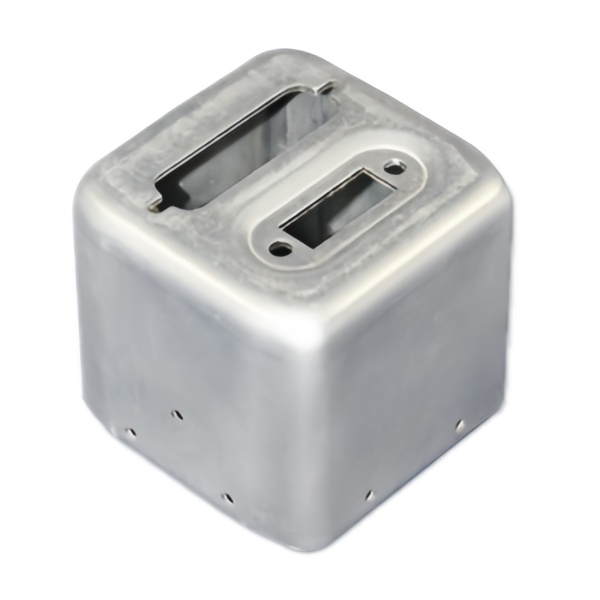
A cubic housing is a closed box, and closed boxes are stiff until you slot the top
A deep drawn steel cubic housing is, geometrically, a box with a closed bottom and four walls drawn in one piece, which makes it torsionally stiff and clean on the inside. Then the top gets slots cut into it for connectors, wires, displays or vents, and those slots are exactly what trade the stiffness back for function. The engineering of this part is the balance: how many slots, how long, and where, before the lid plane that was rigid becomes a floppy frame that will not hold its cover. We plan the slots as part of the draw, not as an afterthought punched into a finished box, because cutting the top after it is closed changes everything about how it behaves.
We draw these on mechanical presses in carbon steel, holding the envelope to roughly +/-0.1 mm and any machined seat to +/-0.03 mm. The slots are pierced in the same or a following operation, and the closed drawn seam is what keeps the box dimensionally stable and, where needed, pressure-tight before the top is opened up.
The slots are planned as part of the draw, and that plan is what we log against your part number. A reorder starts from recorded piercing and draw settings rather than a retune, and the slot width and top-plane flatness we proved on the first article are the ones held on every later batch, so the housing that fits its lid and its internals in month one still fits them in month twenty.
Slot edge burr on a housing top is a handling and a shielding hazard, not a detail. A long slot pierced through steel leaves a burr along its length, and that burr can short a connector or cut an assembler. We deburr the slot edges and we direct the burr away from the opening, and we inspect it on the first article because a slotted top is exactly where a sharp edge does damage.
The closed drawn seam of this housing is its quiet advantage: there is no weld to crack and no joint to leak, so the box holds pressure or weather through its form, not through a seal at a fabricated corner. We keep it as a single drawn piece and we put the only joint where the lid closes, which is the one place you can actually service it.
Slot length versus top stiffness is the trade we make explicit on the drawing. A long slot that runs most of the width turns the lid plane into two rails and the cover will not seat; a set of shorter slots with wide webs keeps the plane rigid. We propose the slot layout from the components, not from a guess, and we show the stiffness consequence before tooling.
The top slots are cut features, and cutting is what weakens the lid plane
A slot is not a hole. A hole leaves a ring of material around it and the surrounding plate stays largely intact; a long slot removes a strip and leaves two cantilevered edges that can flex and that concentrate stress at their ends. On a housing top this matters because the slots are usually where a cover or a gasket has to seat, and a top that has gone flexible will not hold that seal. We size and place slots so the remaining webs between them are wide enough to keep the plane rigid, and we radius the slot ends to stop crack-like stress concentrations.
- Slot length is the lever. A short slot barely affects stiffness; a long slot that runs most of the width turns the top into two rails.
- Slot ends are radiused, never square, because a square end is a stress riser that cracks under vibration or during insertion.
- Web width between slots is held, so the top stays a plate rather than a comb of fingers.
- Burr direction is chosen so it stands away from the sealing or locating face the slot serves.
Drawing a rectangular box square: corner radii, wall straightness, datum
A cubic housing has to be square and straight, not just closed. The four drawn corners set the wall straightness, and a corner that wrinkled on the first pull leaves a wave in the wall that the next assembly notices when a panel will not sit flush. We open the corner radius enough to let the steel flow, hold the walls by the draw, and pick a datum strategy that puts the reference on a drawn face rather than on a cut one, because a drawn face is more repeatable than a trimmed edge.
The datum choice is worth stating explicitly. On a box like this the primary datum is usually one drawn wall and the bottom, and the slot pattern and any machined faces are located from those, not from the loosely held opposite wall. We write that scheme on the drawing and we measure the first article against it, so the slots and the lid line up with the features the assembly actually uses.
We also confirm the internal components the slots must clear before fixing the slot pattern, because a slot placed from a rough guess often collides with a connector or a board once the housing is populated. Sending the internal layout with the enquiry lets us locate the slots from the datum walls with real clearance, so the top opens where the assembly needs it and stays rigid everywhere else.
Slots versus holes: why a long slot needs its own piercing and tolerance
Because a slot is a different beast from a hole, it needs a different piercing tool and a different tolerance logic. A hole is punched by a single punch and die and located by the strip; a slot is punched by a shaped punch that is more sensitive to strip wander and to punch deflection, so its position and its width are held to a band suited to its length. We treat slot width as a feature in its own right, not as “a hole that is long”, and we inspect it on the first article because a slot that is a fraction wide lets a connector rock.
- Slot width tolerance is tighter than the outline, because the connector or gasket it receives is the function.
- Slot position is held from the datum walls, so it lines up with the internal components the housing protects.
- End radius and edge condition are inspected, because a ragged or sharp slot end is a failure point and a handling hazard.
Steel grade and the weld-free seam that keeps the box tight
A deep drawn housing has no weld seam on its walls or bottom, which is one of its quiet advantages: there is no weld to crack, no seam to leak, no heat-affected zone to distort the shape. That only holds if the grade is chosen for the draw. We use cold-rolled carbon steel that draws cleanly for the shell, and we keep the box as a single drawn piece so the pressure- or weather-tightness comes from the forming, not from a joint. Where a stronger grade is wanted for the walls, we confirm it still forms without fracture at the corner radius.
The lid that closes the slotted top is the one place a joint appears, and we design that joint deliberately: the slot pattern leaves enough material for the lid to seat and seal, and we hold the top-plane flatness so the lid does its job. A housing that is perfect on the draw but warped where the lid meets it is a housing that leaks at the only seam that matters.
How we verify a slotted cubic housing
A slotted housing is verified for shape, for slot integrity and for lid readiness together. The routine:
- First-article CMM report on the envelope, corner radii and any machined face, against the stated datum scheme.
- Slot width and position check, confirmed from the datum walls so the top receives its components correctly.
- Slot end radius and edge inspection, to confirm no stress riser and no hazardous burr.
- Top-plane flatness measurement, because the lid and gasket depend on the slotted face staying a plane.
- Wall straightness check, for wrinkle or wave from the draw corners.
- Material certificate confirming the grade that the draw and the seam-free design assumed.
The housing ships with its dimensional report and certificate under your part number, and the draw and piercing settings are archived so a repeat order is a repeat process rather than a redevelopment of the slots.
Send the housing drawing with the slot pattern and the internal layout, and we return a manufacturability review with the quotation and a first article proving the slot integrity and the top-plane flatness. The internal components let us place the slots with real clearance instead of a guess that collides once populated.
Drawing, machining and welding each win on different geometries; the guide to deep drawn covers works through those boundaries, and the full Precision Deep Drawn Parts range is reachable from the overview page.
Specifications
| Item | Steel Deep Drawn Cubic Housing with Top Slots |
|---|---|
| Brand | AUNOV |
| Designing | Send drawings, or send a sample to be measured, you get a DFM review together with the quotation. |
| Tooling | Dies designed and built in our own toolroom, with your part number on the tool record. |
| Samples | First-off samples are sent with dimensional data and material certs. |
| Materials | Stock for this part leads with carbon steel (SPCC / DC01), alongside 304 / 316 stainless steel, aluminium, brass and copper, per the drawing. |
| Surface finish | Zinc, nickel or chrome plating, e-coat, powder coat, anodising or passivation, as called out on your print. |
| Processing | Progressive deep draw stages with in-line annealing as the draw ratio demands, pierced and machined on the same floor. |
| Equipment | Press capacity from 5 to 500 T across mechanical and hydraulic lines, in-house CNC cells and a temperature-controlled inspection room. |
| Tolerance | Tolerances to +/-0.1 mm as drawn, +/-0.03 mm on machined features. |
| Delivery terms | Prices FOB, with DDP for EU and US on request, T/T or L/C, D/P on repeat business, call-off schedules supported. |
Frequently Asked Questions
Why do the top slots have to be planned as part of the draw?
A closed drawn box is torsionally stiff and clean inside, and cutting the top after it is closed changes how it behaves. The slots trade that stiffness back for function, and once the lid plane has become a frame rather than a plate it will not hold its cover. Planning them in means we know where that limit is before tooling is cut.
Why is a slot specified differently from a hole?
A long slot has two ends and two long edges, so it can bow, open or close along its length in ways a round hole does not. It needs its own piercing approach and its own tolerance rather than borrowing a callout that was written for circular features.
Can this box be pressure-tight?
The one-piece drawn seam is what gives the closed box that capability, and being weld-free keeps it dimensionally stable. What decides it in practice is how much of the top is opened up, so tightening requirements and slot layout have to be settled together rather than in sequence.
How do you keep a rectangular box square?
Corner radii, wall straightness and a datum scheme that all three agree on, because a box that draws out of square tends to stay out of square. The envelope is held to roughly +/-0.1 mm with any machined seat at +/-0.03 mm.
Related Products



Request a Quote for This Part
Send a drawing or sketch — get material advice, tooling cost and a per-piece price within 24 hours (working days).