
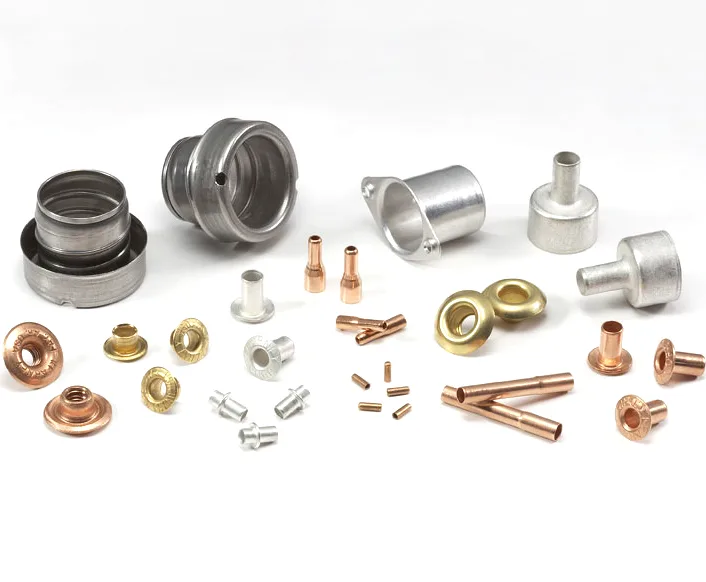
When a drawing says “deep drawing” three times, it is telling you nothing about the part
A page that describes its part as sheet metal forming, deep drawn, deep drawing, stainless steel parts, and deep is not poorly written – it is a symptom of how these catalogue entries are assembled, from a keyword list rather than from a design. The practical consequence is real: a description that repeats process words instead of naming the product tells the reader nothing about what the part does, and a reviewer who has that description has to ask a question before they can review anything at all. Naming the product is the first requirement of a useful specification, and on a custom part it is the cheapest thing a customer can change.
We deep draw from coil or blank with interstage annealing so walls thin evenly, and batch records are filed so a repeat order starts from approved data, on a press shop with 5-250 T mechanical and 250-500 T hydraulic presses and annealing ovens on site, with first articles and batch samples checked on the CMM. Tolerance runs +/-0.05 mm to +/-0.1 mm across the part with wall thickness held to print, and GD&T per the drawing with PPAP-style reports on request. Carbon steel in SPCC and DC01 grades, 304 and 316 stainless steel, aluminium and brass are held on site, with special grades sourced to the drawing when volumes justify. Plating, powder coating, anodising or polishing per the print, with alternatives quoted with the quotation and samples approved in writing. This page is about what a useful part description has to contain, and the four questions that turn a vague enquiry into a reviewable one.
What a reviewer can and cannot do with each kind of description
A description that names the process but not the product can be reviewed for manufacturability in general and for nothing else. Specifically:
| What it allows | A comment on the material against the process – whether a stainless steel part of this geometry is formable, whether the wall is achievable, whether the tolerance bands are realistic for a draw. This is real value, and it is the most a reviewer can do without knowing the function. |
|---|---|
| What it forbids | Any comment on tolerance priorities, because there is no way to know which dimension matters. Any comment on material substitution, because there is no way to know the environment. Any comment on finishing, because there is no way to know whether the finish is a corrosion requirement or an appearance one. Any comment on the design itself, because the design’s purpose is unknown. |
| What it guarantees about the outcome | A part that meets every requirement on the drawing and does not do the job. Because the drawing did not say what the job was, nobody checked whether the part could do it. |
That last row is the important one. A drawing review exists to catch the mismatch between a part and its function, and a description that omits the function removes the reviewer’s ability to do the one thing they are there for.
Question 1: what is this part, in one sentence
The single most valuable addition to an enquiry is a sentence saying what the part does and what it connects to. It costs the customer nothing and it changes the review fundamentally. Three examples of the difference:
- “Deep drawn stainless steel part, 1.2 mm” – nothing can be reviewed beyond formability.
- “Deep drawn stainless steel bracket, 1.2 mm, mounts a sensor to a machine frame” – now the review can ask about the load, the mounting, the environment, and whether a bracket is the right form.
- “Deep drawn stainless steel cover, 1.2 mm, seals over an electronics enclosure in a wet environment” – now the review can ask about the seal, the ingress rating, the corrosion duty, and the surface inside.
The same part, in these three versions, would receive three different reviews and probably three different recommendations. That is the value of the sentence.
Question 2: which dimensions are critical, and which are not
With the function unknown, a reviewer cannot tell which dimensions the part’s assembly depends on – and this is the single most costly gap on a drawing of this kind. Three consequences when it is missing:
- Tolerance effort is spread evenly, which is the most expensive way to specify anything. A part with twelve dimensions all at the same tolerance is more expensive and less reliable than one with two critical dimensions flagged and ten relaxed.
- A general band gets applied to a dimension that cannot tolerate one. A bore that locates a shaft, or a flange that seals, will be given a general band and will not work, and the failure will appear in assembly rather than on inspection.
- A tight band gets applied to a dimension that does not need it, which costs money in tooling and in process difficulty for no functional benefit. A coining operation to hold a decorative feature’s thickness is the classic example.
So the reviewer’s most valuable output on a part described this way is to ask which dimensions matter and then to say, explicitly, which tolerances can be relaxed. That conversation is worth more than any observation about formability.
Question 3: what environment, and what is the finish for
Material selection and finishing are entirely environment-driven, and on a description like this there is nothing to review them against. Four things worth establishing, and each of them changes the answer:
- Is the part indoors, outdoors, wet, salty, or in a process environment? This decides the material grade and the finish, and it is the difference between 304 and 316 and between passivation and plating.
- Is the finish a corrosion requirement or an appearance one? They lead to completely different specifications. A corrosion requirement is about the finish’s integrity, its coverage, and its adhesion. An appearance requirement is about colour and gloss, and it can often be met more cheaply by a material choice.
- Does the part contact a fluid or a food or a medical surface? This changes the material question entirely and it brings regulatory requirements that are not optional.
- Is the part visible, and does its appearance matter? A visible part needs a retained colour reference sample, because a finish code does not settle a question about whether the last batch matched.
Question 4: is this part’s geometry actually the best form
With the function known, a reviewer can do something they cannot do without it: suggest a different form. This is often the most valuable output of a review, and it is impossible on a description that says only “deep drawn stainless steel part”. Five possibilities that come up regularly:
- Two parts instead of one. Removes a tolerance chain, removes a joint, and often removes the hardest feature. Legitimate where the design was conceived as one piece.
- Drawn instead of machined, or the reverse. Depends on volume, wall requirements, and how many tight features there are.
- A different section. A channel instead of a flat, or a hat instead of a channel, when stiffness in a specific direction is the requirement.
- A different material. Aluminium instead of stainless steel where mass is not critical and the environment is mild; stainless steel where the environment is not.
- Fewer features. On a part described as a deep draw, the number of pierced features and their position is often the thing that is making it expensive, and consolidating or relocating them can change the cost materially.
None of these can be suggested without knowing what the part is for, because the whole point is that the right answer depends on the function.
Wall thickness held to print, and the honest reason it is a material specification
Wall thickness held to print is the stated requirement, and on a part described this way it is worth explaining why it is a purchasing specification rather than a press specification. A drawn wall is the blank’s thickness modified by the draw, and the modification depends on the draw ratio, the material’s condition, and the lubrication. So:
- A tight wall band is bought, not made. It requires material purchased to a thickness specification, and that is a lead-time and cost decision.
- The minimum wall is at the punch nose, in the base or at the deepest point, and it is a specific location on the part – so a wall specification should state where the minimum is expected, not just the band.
- The material’s condition affects the wall as well as the shape. A harder or softer grade forms differently and produces a different thinning profile, so on a wall-controlled part the grade and temper are part of the wall specification.
What to put on an enquiry
Seven things, and the first three are the ones that make a review possible at all:
- What the part does, in one sentence, and what it connects to.
- Which dimensions are critical, flagged separately from the rest, and which can be relaxed.
- The environment, and whether the finish is for corrosion or appearance.
- Material grade, and the reason for it – what the environment or the function drove that choice.
- Wall thickness, where its minimum is, and whether the material will be bought to a thickness specification.
- Any fluid contact, any food or medical contact, and any regulatory requirement, because these change the specification rather than refine it.
- The batch size, and whether the design will change, because both determine whether the tooling economics work.
Whether a conversation before quoting would help
Would it help to talk through the part before we quote? On an enquiry described in process words, this is worth more than any amount of written review. Thirty minutes of conversation establishes the function, the environment, the critical dimensions, and the volume, and it turns a guess into a specification. The supplier’s part in that conversation is to ask the questions rather than to assume – and the customer’s part is to answer the one that matters most, which is what the part is for. Everything else on this page is a consequence of that answer.
Not sure whether to draw, machine or weld this geometry? The guide to deep drawn covers compares the three routes and shows where each one wins; the full Precision Deep Drawn Parts range is linked from the overview page.
Specifications
| Item | Sheet Metal Forming Deep Drawn Deep Drawing Stainless Steel Parts Deep |
|---|---|
| Brand | AUNOV |
| Designing | Made to your 2D/3D drawings (PDF, DWG, STEP, IGS) – DFM notes are returned before any tooling is cut; the same drawing is used for every repeat order. |
| Tooling | Our toolroom covers die design, wire-cut EDM and maintenance, so a die can be re-cut against the approved drawing, and maintenance is tracked against the part number. |
| Samples | First-article samples ship with a dimensional report and material certificate, so the approved first article becomes the gauge reference, and later batches are gauged back to the signed sample. |
| Materials | Carbon steel (SPCC / DC01), 304 / 316 stainless steel, aluminium and brass are held on site; special grades are sourced to the drawing when volumes justify. |
| Surface finish | Plating, powder coating, anodising or polishing, per the print; alternatives quoted with the quotation, samples approved in writing. |
| Processing | Deep drawing from coil or blank, with in-process annealing so walls thin evenly; batch records are filed so a repeat order starts from approved data. |
| Equipment | Press shop running 5-250 T mechanical and 250-500 T hydraulic presses, annealing ovens on site; first articles and batch samples are checked on the CMM. |
| Tolerance | +/-0.05 mm to +/-0.1 mm across the part, wall thickness held to print; GD&T per drawing, PPAP-style reports on request. |
| Delivery terms | CIF or DDP, with FOB available, T/T with deposit and L/C for larger runs; call-off schedules are supported. |
Frequently Asked Questions
What makes a useful deep drawn part description?
Naming the product in one sentence – what it does, not the process words. A description that repeats “deep drawing” and “stainless steel parts” three times tells a reviewer nothing and forces a question before anything can be reviewed.
Which dimensions are critical on a custom drawn part?
The ones the mating part depends on – a bore, a seat, a flange face – are called out as critical, while non-critical features carry a wider band. GD&T per the drawing and PPAP-style reports are supplied on request.
Which materials are held for custom deep drawn stainless steel parts?
Carbon steel in SPCC and DC01, 304 and 316 stainless steel, aluminium and brass, with special grades sourced to the drawing. Tolerance runs from +/-0.05 mm to +/-0.1 mm with wall thickness held to print.
How is a vague enquiry turned into a reviewable one?
Four questions settle it: what is the part, which dimensions are critical, what environment and finish, and is the geometry the best form. We answer them on the enquiry and quote within 24 hours, minimum order 1,000 pieces.
Related Products



Request a Quote for This Part
Send a drawing or sketch — get material advice, tooling cost and a per-piece price within 24 hours (working days).