
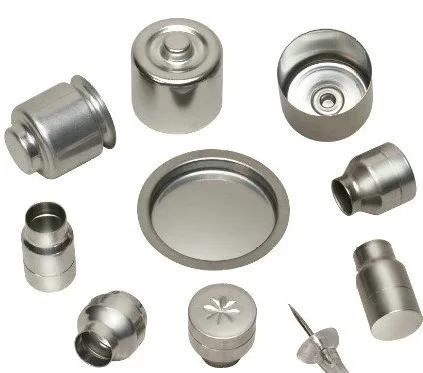
A cups and covers assortment is a catalogue, and a catalogue has a different failure mode
Drawn cups and covers in steel and brass is a family product – a range of cup and cover sizes for motor applications, sold as an assortment rather than as a single part. The technical manufacturing is straightforward and well understood. What makes it worth writing about is that an assortment is not a single part, and the way it is specified, quoted, and inspected is where the real work lies. A family order has a failure mode that a single-part order simply cannot have: the family drifts, and the drift is invisible until a customer tries to use a size from one batch with a size from another.
We coil-blank and progressively draw, coining on the final station where the print calls for it, and batch records are filed so a repeat order starts from approved data, on mechanical presses 5-250 T and hydraulics 250-500 T with in-line annealing furnaces, backed by CNC turning centres and a climate-controlled inspection room. General tolerance on drawn sections is +/-0.1 mm with +/-0.03 mm on machined seats, and finer bands are confirmed from capability data before quoting. Materials held include carbon steel, 304 and 316 stainless steel, aluminium and brass, with the final grade fixed at the drawing review. Finish is selected from the drawing – plating, coating, anodising or passivation – with the finish inspected alongside the dimensional report on the first article. This page is about the family, and about the four things that have to be true for an assortment to work.
Requirement 1: a master drawing, not twenty drawings
The single most valuable document in a family order is a master drawing that defines the family rather than twenty drawings that describe twenty parts. It has to state four things:
- What varies. For a cups and covers family it is almost always the diameter, sometimes the depth, and occasionally the wall. Naming the parameter makes the family a family.
- What is held constant. The material, the temper, the finish specification, the tolerance scheme, and the general proportions. These are what make a size in one batch interchangeable with a size in another.
- The size range, with each size confirmed feasible before the range is committed. The smallest and largest sizes in a family are the ones that need checking, because the smallest is where the tooling and handling get difficult and the largest is where the draw ratio and the blank size get difficult.
- Which dimensions scale with size and which do not. This is the requirement that most often goes unstated and it causes the real problems. A wall thickness held constant across a wide diameter range is a manufacturing requirement, not a design one, and it may be unachievable at one end.
Requirement 2: per-size approval, not a single signed sample
On a family order the approval discipline has to be per size, and this is where the drift starts if it is not. A first article approved for one size says nothing about the other nineteen. The requirements that follow:
- An approved sample per size, retained as that size’s reference. On a high-volume size, a full sample; on a low-volume size, a measured report may be enough – and the rule should be agreed rather than assumed.
- A signed master drawing that the approval is against, so that a later question about a size has a document to answer it.
- Batch records per size and per part number, so a repeat order for one size can start from approved data without waiting for the rest of the family, and so that a traceability question about one size does not require reconstructing the whole family.
Requirement 3: a tolerance scheme that scales honestly
General tolerance on drawn sections at +/-0.1 mm and machined seats at +/-0.03 mm is a reasonable family scheme, and the question is how it applies across the range. Four sensible rules:
- Linear features take an absolute tolerance, and it is the same one across the family. A diameter tolerance does not scale with diameter on a drawn part, because the diameter is set by the punch and the punch’s accuracy does not change with size.
- Depth-based dimensions may need a scaled tolerance, because a deeper draw has more accumulated variation.
- Wall thickness is a material specification, and a family that holds the wall constant across the range is holding it constant by buying material to a thickness specification. This is a purchasing decision that should be a conscious one.
- Where a dimension is genuinely critical, flag it per size. A flange that positions a cover needs its position flagged; a decorative bead does not. Flagging the critical dimensions and leaving the rest general produces a part that is both cheaper and more reliable than one where everything is tight.
Requirement 4: per-size finishing and materials, not a blanket note
Finish is selected from the drawing, with the finish inspected alongside the dimensional report on the first article. On a mixed-material family this is where a blanket specification becomes wrong for some sizes:
- Passivation applies to stainless steel only, and anodising to aluminium only. A family offered in steel, stainless steel, aluminium and brass cannot have one finish note – it has to be a finish matrix.
- Plating thickness against size. A plating thickness is a small fraction of a large part’s dimension and a large fraction of a small part’s. On a small size, a plated dimension and an unplated dimension are meaningfully different, and the drawing has to say which it is.
- Masking cost scales inversely with size. A masked thread or flange on a very small part is a larger proportion of that part’s cost than on a large one. A family where only the small sizes are awkward is a family where the small sizes cost more, and the quotation should show it.
What is actually different across a cups and covers family
For motor applications specifically, the cup and cover carry a few requirements that scale differently and are worth naming:
- The cover’s interference fit. Where a cover fits over a boss, the cover’s ID and the boss’s OD are a pair. A family of covers that each has to fit a corresponding family of bosses has an interrelationship, and the worst-case combination in the range is the one that has to be controlled – not the nominal at each size.
- Sealing faces, where a cover seals against a housing. Flatness on a small part is relatively easier to achieve and relatively easier to lose in handling, and a seal’s compression varies if the cover is out of flat.
- Stiffness. A cover resists being pushed in, and a thin cover’s stiffness is what gives it its feel. Wall thickness held constant across a diameter range means the small covers are proportionally much stiffer than the large ones, which is usually the right direction – and where it is not, the family should specify a scaling wall instead.
- The retention feature, where a cover snaps or threads onto a housing. A snap’s force is a function of the material and the wall, and it scales with size – so a family with snap covers needs a force specification per size, not one number for the family.
What to put on the ordering documentation
Eight things, and on a family order the documentation matters more than on a single part:
- The master drawing, with the varying parameter, the fixed parameters, and the size range.
- The size list, with the volume against each size. This is what determines the tooling decisions – and the deciding question is whether one tool covers a range of sizes or each size needs its own.
- A feasibility statement for the smallest and the largest size, confirming both are within the process’s practical limits before the range is committed.
- The tolerance scheme’s rules, so a size not yet drawn still has a defined specification.
- The finish matrix – by material, and by size where plating thickness matters.
- The material per size, with the grade and temper, and whether the wall is held constant across the range.
- The approval plan per size, – sample or measured report – and which sizes are the critical ones.
- Inspection depth per size, and the sampling rule, agreed rather than assumed.
Whether every size in the family is actually needed
Does the customer need all the sizes? This is the single most valuable question on a family order and it costs nothing to ask. A family of twenty sizes where four cover the overwhelming majority of demand is a much better order for both sides: fewer tools, less stock, shorter lead times, and a lower quotation. A family where every size is genuinely needed is a legitimate order and worth doing properly – but the two cases are very different commercially, and the difference is one question at enquiry. It is also worth asking whether the family’s sizes are fixed, because a family with a defined range and a family that grows by one size per year are different products with different planning, and the second one is better handled by designing the tooling plan for a range rather than for a list.
If you are weighing drawing against machining or welding for this geometry, the guide to deep drawn covers sets out where each route wins; the full Precision Deep Drawn Parts range is linked from the overview page.
Specifications
| Item | Drawn Cups and Covers Assortment, Steel and Brass |
|---|---|
| Brand | AUNOV |
| Designing | Driven by your drawing or a physical sample – unusual walls, threads or tolerances are feasibility-checked first; changes are priced before they are made. |
| Tooling | Progressive and drawing dies are designed and built in house, so tooling lead time stays under our control, and first-article timing is measured from the tooling start date. |
| Samples | Samples are issued for approval before the run, and production starts only after written sign-off. |
| Materials | Materials held include carbon steel, 304 / 316 stainless steel, aluminium and brass; the final grade is fixed with the drawing review. |
| Surface finish | Finish selected from the drawing: plating, coating, anodising or passivation; finish thickness and adhesion checked on the first article. |
| Processing | Coil blanking and progressive drawing, coining on the final station where the print calls for it; batch records are filed so a repeat order starts from approved data. |
| Equipment | Mechanical presses from 5 to 250 T and hydraulic presses 250-500 T, with in-line annealing furnaces, backed by CNC turning centres and a climate-controlled inspection room. |
| Tolerance | +/-0.1 mm general on drawn sections, +/-0.03 mm on machined seats; finer bands confirmed from capability data before quoting. |
| Delivery terms | CIF or DDP, with FOB available, payment by T/T, L/C at sight or D/P; each volume tier carries its own quoted price. |
Frequently Asked Questions
Why is an assortment riskier than a single part?
Because a family can drift and a single part cannot. Worst of all, that drift is invisible until a customer tries to use a size from one batch with a size from another, by which point the parts are in the field rather than on the inspection bench.
Why does a family need one master drawing instead of a drawing per size?
A master drawing holds the features that must stay common to the whole family, with the per-size values tabulated against it. Twenty independent drawings give twenty opportunities for the family to drift apart in the details nobody thought to cross-check.
Does one approved sample cover the whole range?
No. Each size is approved on its own, because approval transfers where geometry changes and not necessarily where it does not. Batch records are filed so a repeat order starts from that approved data instead of starting again.
Do all sizes share the same tolerance and finish?
They should not. The tolerance scheme has to scale honestly with size, and finishing and material are specified per size rather than under a blanket note. General tolerance on drawn sections is +/-0.1 mm with +/-0.03 mm on machined seats, and finer bands are confirmed from capability data before quoting.
Related Products


Request a Quote for This Part
Send a drawing or sketch — get material advice, tooling cost and a per-piece price within 24 hours (working days).