
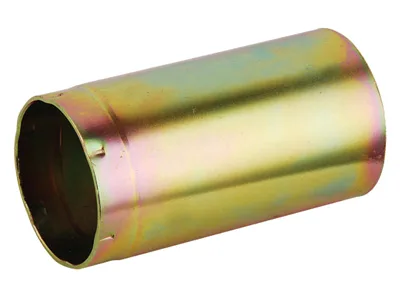
A magnetic cylinder is a drawn part with an electrical specification
A pump magnetic cylinder – the drawn sleeve or yoke that closes the magnetic circuit around a motor or a solenoid in a pump – is unusual among deep drawn parts because its acceptance criteria are not just dimensional. The part has to carry magnetic flux efficiently, and that means the material, the heat treatment, and even the drawing strain all matter to the electrical performance, not only to the geometry.
We produce these from low-carbon steels and from soft magnetic stainless steel, and the first question with any magnetic cylinder is which of those two worlds applies, because the answer changes the material, the anneal, and the cost.
Material: soft magnetic steel versus non-magnetic stainless steel
Two contrasting routes dominate, and confusing them is a common and expensive mistake:
| Low-carbon steel (e.g. DC01, or a low-Si electrical steel) | Carries flux well after a stress-relief anneal restores permeability lost in drawing. The standard choice when the cylinder is part of the magnetic circuit. |
|---|---|
| Silicon electrical steel | Lower core loss and higher permeability, better for high-frequency or high-efficiency circuits. Harder to draw and more expensive; used where the loss budget demands it. |
| 1.4301 / 1.4404 stainless steel | Effectively non-magnetic in the annealed austenitic state – correct when the cylinder must isolate the magnetic circuit rather than close it, and when corrosion resistance is the priority. |
| Ferritic stainless steel (e.g. 1.4016 / 430) | Magnetic and corrosion-resistant; a compromise when both flux and corrosion matter, though permeability is lower than electrical steel. |
The trap is a designer specifying “stainless steel” for a magnetic yoke, expecting it to carry flux. Austenitic 304 drawn into a yoke will barely magnetise. If the part is in the magnetic circuit, it must be a magnetic grade – and if it is a magnetic grade, the drawing and anneal must be chosen to preserve that.
Annealing: restoring the permeability that drawing destroys
Deep drawing cold-works the steel, and cold work wrecks soft magnetic properties – permeability drops, coercivity rises, and core loss climbs. A magnetic cylinder that is not annealed after forming can lose a large fraction of its flux-carrying capability. The remedy is a stress-relief anneal, typically in a controlled or reducing atmosphere to avoid oxidation of the surface that the flux path depends on:
- Temperature and time: chosen for the grade; low-carbon steels generally want a higher-temperature anneal than the corrosion-sensitive ferritic grades can tolerate.
- Atmosphere: a bright anneal (hydrogen or nitrogen-hydrogen) keeps the surface clean and scale-free; an oxidised surface adds a non-magnetic layer that hurts the circuit.
- Cooling rate: controlled to avoid re-introducing residual stress or unwanted phases.
Where a customer’s magnetic model assumes a permeability value, we need to know whether that value is as-formed or as-annealed, because the difference is significant. We quote the anneal as part of the magnetic specification when the cylinder is in the flux path.
Wall thickness, flux, and saturation
For a given material, the flux a cylinder can carry scales with the cross-sectional area of the magnetic path, which is the wall thickness times the circumference. Too thin and the material saturates, the effective permeability collapses, and the circuit loses flux where it is needed most. Too thick and the part wastes material and weight without adding usable flux once the path is already well below saturation. We size the wall from the customer’s flux requirement rather than from the current part’s thickness, because parts are often carried over from a predecessor whose field was different.
Concentricity, air gap, and the electrical consequence of a dimensional error
In a motor or solenoid, the cylindrical gap between the yoke and the moving or rotating element is the air gap. Its size sets the magnetising current and the efficiency, and its concentricity sets the force balance:
- A uniform air gap gives a symmetric flux and a balanced force. Bore-to-yoke concentricity within 0.05-0.10 mm TIR is normal for these parts.
- An eccentric gap creates an unbalanced radial force that pushes the rotor or plunger to one side – a source of vibration, noise, and accelerated wear.
- An oval or lobed bore from a poor draw or a worn die makes the gap vary around the circumference, which shows up as a once-per-revolution force variation.
This is why a magnetic cylinder is inspected for roundness and concentricity, not only for diameter. The drawing process has to deliver a round, concentric bore, and the die must be maintained to keep it there over millions of strokes.
Magnetic testing and what we document
Where the magnetic performance is a specified characteristic, we can include a functional check – a flux or inductance measurement against a reference fixture – on the first article and on lot samples. That, combined with the material certificate and the anneal record, gives the customer a traceable magnetic pedigree for the part rather than a promise.
Annealing after drawing without distorting the part
Can you anneal after drawing without distorting the part? Yes, with a fixture or a controlled cycle; stress-relief anneal temperatures are high enough that an unsupported thin cylinder can sag, so we design the process around the geometry.
Will a drawn magnetic cylinder match a machined one electrically? With the right grade and anneal, yes for most motor and solenoid applications – and it will be much cheaper at volume.
What if the customer draws the flux path through the housing wall? Then the housing must be a magnetic grade and annealed; we flag this at quotation so the customer’s magnetic model and our material choice agree.
Do you guarantee a permeability value? We guarantee the grade and the anneal; the delivered permeability is measured on a sample and reported, which is the practical guarantee for a formed part.
Specifying a magnetic cylinder
Tell us whether the part is in the magnetic circuit or isolating it, the flux or inductance requirement, the air gap and its concentricity, the corrosion exposure, and the frequency if core loss matters. Those inputs decide the grade, the anneal, and the dimensional tolerances – and they are the difference between a cylinder that performs electrically and one that merely fits.
If you are weighing drawing against machining or welding for this geometry, the guide to deep drawn covers sets out where each route wins; the full Precision Deep Drawn Parts range is linked from the overview page.
Specifications
| Item | Pump magnetic cylinder |
|---|---|
| Brand | AUNOV |
| Designing | Send drawings, or send a sample to be measured – DFM notes are returned before any tooling is cut; the same drawing is used for every repeat order. |
| Tooling | Progressive and drawing dies are designed and built in house, so a die can be re-cut against the approved drawing, and first-article timing is measured from the tooling start date. |
| Samples | Samples are issued for approval before the run, so the sample is retained as the master, and the signed sample is kept for future reorders. |
| Materials | Materials held include carbon steel, 304 / 316 stainless steel, aluminium and brass; mill certificates and heat numbers accompany the first article. |
| Surface finish | Finish selected from the drawing: plating, coating, anodising or passivation; finish thickness and adhesion checked on the first article. |
| Processing | Progressive drawing through several stages, annealed between draws, then trim and pierce; every stage is logged against your part number. |
| Equipment | 5-250 T mechanical presses, 250-500 T hydraulic presses and annealing furnaces in line, backed by CNC turning centres and a climate-controlled inspection room. |
| Tolerance | +/-0.05 mm on drawn diameters, tighter bands confirmed against the drawing; GD&T per drawing, PPAP-style reports on request. |
| Delivery terms | FOB, with DDP offered for EU and US addresses, payment by T/T, L/C at sight or D/P; call-off schedules are supported. |
Frequently Asked Questions
Why is this part accepted on a measurement that has nothing to do with dimensions?
Because its job is magnetic. A pump magnetic cylinder closes a magnetic circuit, so permeability and the losses that accompany it matter more than any single size. Two parts can be dimensionally identical and perform differently, which is why acceptance includes a magnetic test rather than stopping at the dimensional report.
Soft magnetic steel or non-magnetic stainless steel – how is that decided?
By whether the part is meant to carry flux or stay out of the circuit. Soft magnetic steel is chosen where the cylinder has to conduct; stainless steel is chosen where it must not, or where corrosion rules out the alternative. They are not substitutes for one another, and confusing them changes what the pump does rather than merely how long it lasts.
Why is annealing part of making this part instead of something added afterwards?
Drawing damages exactly the property that justifies the material. Cold work raises hardness and lowers permeability, so a cylinder can leave the press correct in every dimension and poor in the one thing it was specified for. Annealing restores permeability, which makes heat treatment part of making the part rather than a remedy applied afterwards.
How does a dimensional error turn into an electrical one?
Through the air gap. Concentricity and roundness decide how uniform the gap around the moving part is, and that gap dominates the reluctance of the magnetic circuit. A dimension comfortably inside its limit can still show up as uneven flux and reduced output, so this is one of the few parts where tolerances are set by the electrical result rather than by assembly fit.
Related Products


Request a Quote for This Part
Send a drawing or sketch — get material advice, tooling cost and a per-piece price within 24 hours (working days).