
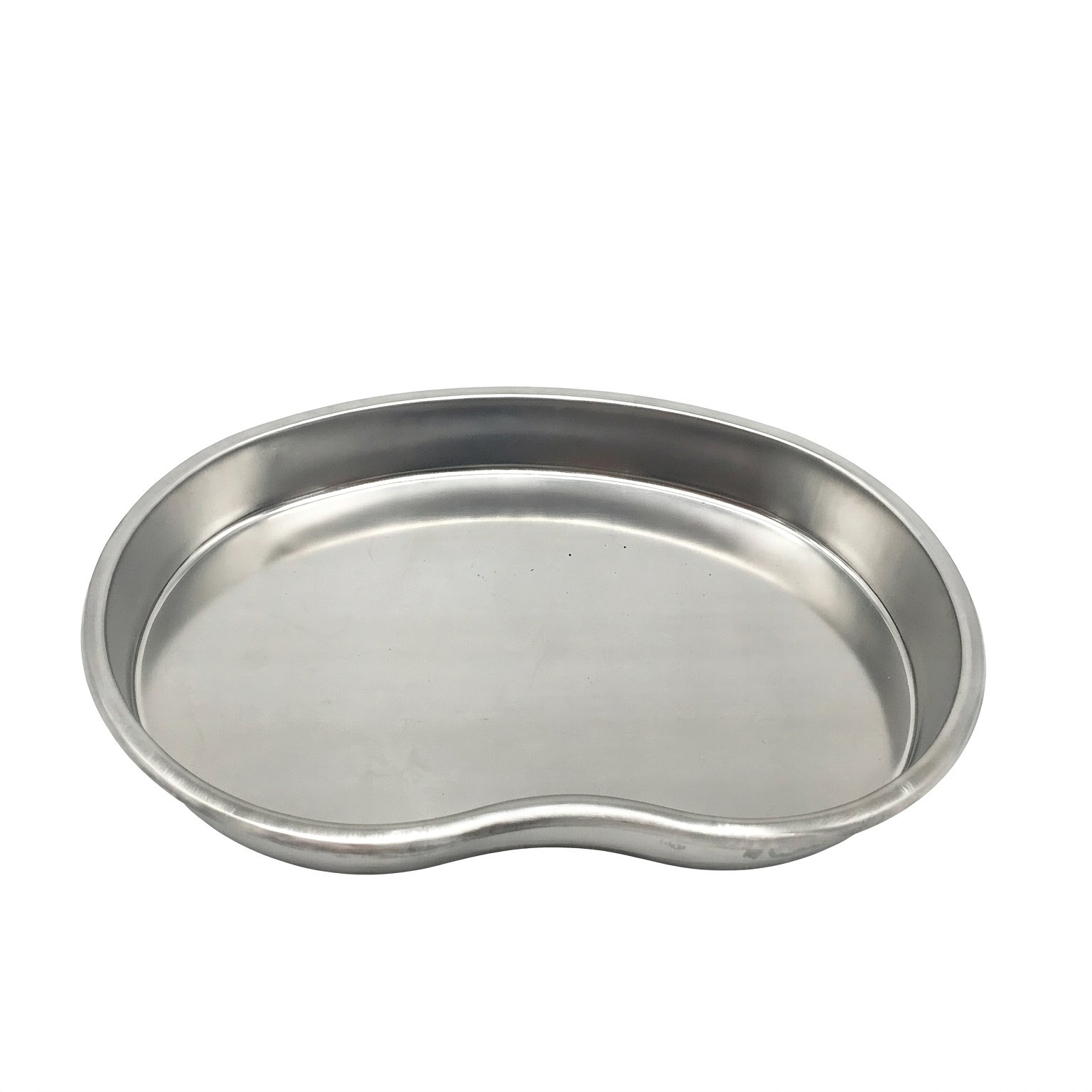
A sterilization tray must survive being heated, and then it must come out clean
A deep drawn stainless steel sterilization tray lives in a cycle: it is filled with instruments, sealed in a pouch or a wrap, put into a sterilizer, exposed to steam under pressure and temperature, dried, and then used. That cycle is the design requirement, and it is a requirement no other tray in this family has. The two halves of the cycle pull in opposite directions: the tray must survive steam and pressure, and then it must come out clean enough to touch a surgical instrument.
We draw these progressively through several stages, annealed between draws, then trim and pierce, and batch records are filed so a repeat order starts from approved data, on 5-250 T mechanical presses and 250-500 T hydraulic presses with annealing furnaces in line, CNC turning centres for secondary operations, and CMM inspection. Tolerance runs +/-0.05 mm to +/-0.1 mm across the part with finer bands confirmed from capability data before quoting. Carbon steel in SPCC and DC01 grades, 304 and 316 stainless steel, aluminium, brass and copper are all held, with the grade matched to the duty of this tray. Finish is selected from the drawing – plating, coating, anodising or passivation – with masking and laser marking available where needed. This page is about the sterilization cycle, the cleanability that has to survive it, and the four things that go wrong.
The cycle, and what it does to the metal
Sterilization is typically steam at 121 to 134 degrees Celsius under pressure, held for a defined time, and it affects a drawn stainless steel part in several ways:
- Repeated thermal cycling. A tray that goes from room temperature to 134 degrees and back, hundreds of times, will move. The drawn part’s residual stresses relax with each cycle, and the tray’s flatness and its squareness will change permanently over its life. This is a real and measurable effect and it is why a tray’s dimensions after N cycles may differ from its dimensions new.
- Corrosion under the cycle. Steam at temperature is an aggressive environment, particularly if the tray has crevices that hold condensate. Chloride-contaminated steam from a water supply is a genuine risk in sterilization, and a tray with a rough or unpassivated surface will corrode faster.
- Surface chemistry. A stainless steel surface that carries free iron from machining will corrode and will stain the instruments above it. Passivation after the anneal is therefore a hard requirement, not a finishing preference.
- Drying and residue. After the cycle the tray has to dry completely. A tray with pockets or tight corners holds water and will either dry slowly or leave a residue. Cleanability and dryability are the same requirement.
Cleanability, and the geometry that defeats it
A sterilization tray is cleaned – usually in a washer-disinfector before or after the cycle – and it has to come out with no residue. The geometry has to permit that, and this is where most tray design decisions are actually made:
- No closed pockets. A drawn tray’s formed dimples, embossed stiffening features and deep perforations can create closed volumes. These hold water, hold soil, and are impossible to verify visually. On a sterilization tray this is a design defect rather than a detail, and where a stiffening dimple is required it needs a through-feature or a drain.
- Drainage, in a defined direction. A tray that does not drain completely will hold water. The drain direction has to be specified, and it has to be the direction the tray is actually held – which is a requirement the customer’s process defines, not the designer.
- Flatness versus rigidity. A tray needs rigidity so instruments do not move in it, and rigidity is usually achieved by a formed rib or a bead. The tension is that a rib that forms a pocket defeats cleanability. The resolution is a rib that drains – a rib that runs to a drain hole, or one whose profile has no closed geometry.
- Perforation, and where the water goes. Perforated trays are common and they drain well, but the perforations are also where contamination enters and where a sharp edge can damage a pouch. Their size, their burr condition, and their position relative to the instruments above them are all requirements.
- Surface finish. A smoother surface is easier to clean and easier to verify. On a drawn part, the surface is as-drawn unless it is polished or electropolished, and a surface with draw marks will hold soil in the marks. Where cleanability is critical, the surface condition is a specification rather than an assumption.
Wall thickness, and where it fails first
The stated band is +/-0.05 mm to +/-0.1 mm with the wall held to print, and on a sterilization tray the wall is relevant for three reasons:
- Thin regions corrode faster. A drawn tray’s wall is thinnest at the punch nose and at the corners, and a thin region has less material to lose before it fails. On a tray that will see a corrosion allowance over its life, the minimum wall is the design number.
- Rigidity. A tray that flexes will let its contents move, and in a sterilization pouch a flexing tray can puncture it. The wall’s thickness and the formed features together determine the tray’s rigidity, and both are worth calculating.
- Corrosion allowance. If the tray has a defined service life in cycles, the wall has to be thick enough to survive that number of cycles. This is a straightforward calculation and it is worth doing rather than assuming the drawn thickness is adequate.
A steam-sterilised tray maps cleanly onto 304
Carbon steel in SPCC and DC01 grades, 304 and 316 stainless steel, aluminium, brass and copper are all held, with the grade matched to the duty of this tray. The mapping is fairly clear:
- 304 stainless steel is the standard and the correct answer for a steam-sterilized stainless steel tray. It survives the cycle, it is cleanable, it is non-shedding, and it is the material the whole sterilizable-tray world is built on.
- 316 stainless steel where the steam supply is chloride-contaminated, or where the tray is also used in a chemical process, or where the environment is saline. 316 is the sensible answer for a hospital with a water supply above a certain chloride level, and it is a real and often-missed specification point.
- Carbon steel is not a realistic material for a steam-sterilized tray – it will rust in the first cycle. It is held on site for general work and it is worth stating plainly that a steel tray cannot be steam sterilized.
- Aluminium is used for some instrument trays and for autoclave-compatible fixtures, but it is a poor choice for a tray that holds surgical instruments, because it is softer, it will scratch instruments, and it corrodes in alkaline wash chemistries.
- Brass and copper appear in some autoclave and steam fittings rather than in trays, and copper in particular is not a cleanable tray material.
Finishing, and passivation is the requirement
Finish is selected from the drawing – plating, coating, anodising or passivation – with masking and laser marking available where needed. On a sterilization tray:
- Passivation on stainless steel is mandatory, for the free-iron reason above, and it should be a stated process step with a verification method. A tray that has not been passivated will stain instruments, and the staining is attributable to the tray.
- Pickling if there is any welding or heat tint. A welded tray needs pickling before passivation.
- Polishing or electropolishing on the interior, where cleanability is critical. This is one of the few cases in this family where an interior polish is justified by function rather than appearance, because a smooth interior is materially easier to clean and to verify.
- Masking, where anything must stay uncoated – and on a tray that is usually very little, since the whole tray is meant to be cleanable. Where a tray has a marking area or a specific datum, those get masked.
- Laser marking is available and is genuinely useful on a reusable tray, because a reusable tray is the part most likely to end up in the wrong place. A part number or a lot mark on a tray is a traceability measure rather than a cosmetic one, and on a surgical instrument tray it is a meaningful one.
A moulded tray, or a drawn stainless steel one
Eight things, and the first two are what make a sterilization tray a sterilization tray rather than a shallow case:
- The sterilization method and cycle, – steam temperature and pressure, hold time, and the number of cycles the tray is designed to survive. This sets the material, the wall, and the finish, and it is the first thing to establish.
- Drainage direction and dryability, stated as requirements, including any closed pockets that have been designed out.
- Wall thickness held to print, with the minimum location, and the corrosion allowance if a cycle life is specified.
- All internal corners and radii, with a maximum radius stated for cleanability rather than a minimum for formability. These are opposite requirements on a formed part and the cleanability one usually wins.
- Perforations, if any, with their size, their burr condition, and their position relative to the contents.
- Passivation stated, and pickling if the tray is welded.
- Any interior surface finish, and its roughness, where cleanability requires it.
- Marking, if the tray is reusable, and what it has to say.
Is a drawn stainless steel tray right, or a moulded tray?
Is a drawn stainless steel tray the right answer, or is this a moulded tray? Moulded polymer trays dominate surgical instrument trays for good reasons: they are cheap, they sterilize by a wider range of methods including hydrogen peroxide plasma, they are lighter, and they have no crevices from a draw. A drawn stainless steel tray earns its place where a wider temperature range is needed, where a tray must survive repeated mechanical handling, where autoclave compatibility of every element is required, or where the customer’s specification is metal. It is worth asking at enquiry – and where the answer is “moulded”, the part changes completely and a great deal of the specification above stops being relevant.
Draw ratio, wall thinning, radii and trim — the design decisions behind a part like this are worked through with numbers in our deep drawn covers guide, and the Precision Deep Drawn Parts pages collect the rest of the family.
Specifications
| Item | Deep Drawn Medical Sterilization Tray |
|---|---|
| Brand | AUNOV |
| Designing | Files reviewed in PDF, DWG, STEP or IGS; the signed-off revision is the reference for production. |
| Tooling | Die design and toolmaking stay in house, so die cost stays transparent, and maintenance is tracked against the part number. |
| Samples | First-article samples ship with a dimensional report and material certificate, so any deviation is corrected at sample stage, and mass production is gated on that approval. |
| Materials | Carbon steel (SPCC / DC01), 304 / 316 stainless steel, aluminium, brass and copper – the grade is matched to the duty of this tray. |
| Surface finish | Finish selected from the drawing: plating, coating, anodising or passivation; masking and laser marking available where needed. |
| Processing | Progressive drawing through several stages, annealed between draws, then trim and pierce; batch records are filed so a repeat order starts from approved data. |
| Equipment | 5-250 T mechanical presses, 250-500 T hydraulic presses and annealing furnaces in line; secondary ops run on CNC turning centres, inspection on the CMM. |
| Tolerance | +/-0.05 mm to +/-0.1 mm across the part, wall thickness held to print; finer bands confirmed from capability data before quoting. |
| Delivery terms | FOB Ningbo or Shanghai, payment by T/T, L/C at sight or D/P; repeat orders reuse the approved first article. |
Frequently Asked Questions
Why a drawn stainless steel sterilization tray rather than a moulded one?
A drawn stainless steel tray survives the steam-and-pressure cycle and comes out clean enough to touch a surgical instrument, where a moulded tray can soften, retain residue, or reach its temperature limit. The drawn form also gives smooth, cleanable radii and a seamless floor that a moulded part with gates and parting lines does not, and it is the route when the tray must be reusable and traceable.
Which stainless steel is used for a sterilization tray?
304 stainless steel is the usual match for steam sterilization, with 316 where the duty calls for more chloride resistance, and the grade is held with mill certificates so the tray traces to its coil. Passivation is specified because it restores the chromium layer that keeps the surface cleanable through repeated cycles.
How is a drawn stainless steel tray kept clean through the sterilization cycle?
The geometry is drawn so there are no trapped pockets, and the finish – passivated, and plated or coated per the drawing – sheds residue in the washer-disinfector before and after the cycle. Laser marking and masking are available where needed, and the cleanability is designed in rather than checked for afterwards.
What traceability comes with a deep drawn medical sterilization tray?
Batch records are filed so a repeat order starts from approved data, and every stage is logged against your part number from the coil through the draw to the finish. Because the tray touches surgical instruments, that traceability is part of the product and travels with the first article, not an afterthought.
Related Products


Request a Quote for This Part
Send a drawing or sketch — get material advice, tooling cost and a per-piece price within 24 hours (working days).