
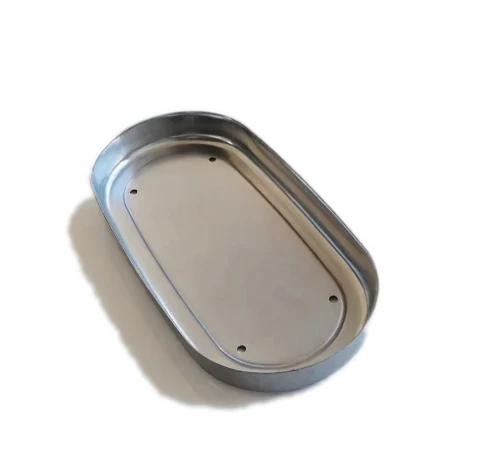
Stainless Steel or aluminium for your custom drawn part? An engineer’s decision guide
Every custom deep drawing project eventually hits the same fork: stainless steel or aluminium. The wrong choice does not usually fail catastrophically – it fails quietly, as a part that costs 30% more than it needed to, or one that corrodes in year two, or one that arrived on time but weighs twice the target. This page is the comparison we walk through with customers before quoting custom drawn parts, written as we would explain it across a table: what each metal buys you, what it costs, and which questions decide it.
The short version
Choose stainless steel (304/316L) when the part meets corrosive media, needs stiffness in thin walls, or must survive abrasion and handling. Choose aluminium (1050/3003/5052) when weight, thermal conduction, or deep formability drive the design – and when the environment is friendly or the finish system handles it. When both look viable, the tie-breaker is usually total cost at your volume, and the calculation has more lines than material price per kilo.
Formability: aluminium draws deeper, stainless steel draws stiffer
Aluminium alloys stretch further before they tear. A 2:1 depth-to-diameter draw that takes stainless steel three stations and an anneal may take aluminium two stations and none – fewer die stations means lower tooling cost and faster first articles. For deep shells, cans and covers, aluminium’s formability is real money.
Stainless Steel fights back with stiffness. A 304 wall of 0.8 mm feels and behaves like a 1.2 mm aluminium wall in bending and handling. If the part must not dent, flex, or buzz under vibration, stainless steel holds its shape with less thickness – and that partiallly offsets its higher density when the comparison is stiffness-per-gram rather than volume-per-gram.
Corrosion: different mechanisms, different honesty required
Stainless Steel corrodes rarely but specifically – chlorides are its enemy, and 304 will pit in coastal salt or food brine where 316L would shrug. The fix is usually a grade step, not a coating, which is why stainless steel parts stay maintenance-free for decades in the right grade.
Aluminium corrodes immediately but harmlessly – it builds its own oxide shield in minutes. The risks are galvanic contact (aluminium bolted to steel in wet conditions eats the aluminium), and strong alkali or acid wash-down. Protection comes from anodising or conversion coating plus isolation washers – a design habit, not an afterthought.
The cost comparison that actually matters
Per kilo, stainless steel sheet costs roughly 1.5-3× the common aluminium alloys. But the piece price comparison at volume runs through four more factors:
- Density. Aluminium is a third the weight – and sheet is bought by weight. A drawn cap that weighs 90 g in 304 weighs ~32 g in 3003; material cost per part is closer than the per-kilo numbers suggest.
- Die stations. Fewer redraws in aluminium: lower tooling amortisation per part.
- Press time. Stainless Steel deep draws run slower; aluminium cycles faster on the same press class.
- Finishing. Stainless Steel often ships bare (passivated); aluminium usually carries anodise or conversion – a real cost line that must join the comparison.
On a typical mid-size drawn housing at 20,000 pieces a year, these factors land the two metals within 10-15% of each other in piece price more often than buyers expect – which is why the decision should be made on engineering grounds and settled by the quotation, not by per-kilo folklore. We quote both metals on request when the fork is genuinely close.
Tolerance and finishing behaviour
- As-drawn tolerances are similar: ±0.10 mm typical, ±0.05 mm with sizing, on both metals.
- Springback is livelier in aluminium – flange angles need die compensation; our toolroom owns that problem, but it is why flange-angle tolerances are quoted slightly looser in 5052 than in 304.
- Finishing: stainless steel polishes to mirror and passivates for free-corrosion service; aluminium anodises into a hard ceramic skin and accepts every paint system. Cosmetic standards are agreed on physical sign-off samples for either metal.
Worked examples from real programs
A sensor housing for a chemical plant: 316L won on media alone; the 30% material premium was cheaper than one field replacement.
A motor cover 180 mm across, 60 mm deep: aluminium 3003 won – the depth would have added two stainless steel redraw stations, and thermal spreading was a bonus the customer had not asked for.
A food-equipment cap, polished, handled daily: 304 won – aluminium’s softness shows every fingerprint and dent under a gloss finish.
Questions we are asked about the stainless steel-vs-aluminium choice
Can you start in aluminium and switch to stainless steel later (or the reverse)?
The die can usually be re-cut for the new material with adjusted radii and clearances; the earlier the switch, the cheaper. Tell us early if the decision is pending – the design can keep both doors open at little cost.
Is galvanic corrosion a real risk in a mixed assembly?
Real and predictable. Isolation washers, conversion-coated interfaces, or a grade change on one side solves it; flag mixed-metal joints at RFQ and the drawing will handle them.
Which metal holds tighter tolerances?
Both hold ±0.05 mm sized. Stainless Steel holds them better through thermal swings; aluminium holds them better through deep draws with fewer stations. Your environment decides which advantage matters.
Requesting a quotation in both metals
Send the drawing, volume, media/temperature and weight or stiffness constraints. On request we quote the same part both ways – die sequence, finishing system and piece price for each – so the stainless steel-or-aluminium decision is made on numbers specific to your part, not generalities.
Draw ratio, wall thinning, radii and trim — the design decisions behind a part like this are worked through with numbers in our deep drawn covers guide, and the Precision Deep Drawn Parts pages collect the rest of the family.
Specifications
| Item | Custom Deep Drawn Aluminum Enclosure Tray |
|---|---|
| Brand | AUNOV |
| Designing | Made to your 2D/3D drawings (PDF, DWG, STEP, IGS) – unusual walls, threads or tolerances are feasibility-checked first; the agreed version governs every later batch. |
| Tooling | Die design and toolmaking stay in house, so no tooling step is outsourced, and the charge is refundable against agreed volumes. |
| Samples | Prototype and pre-production samples are provided against the drawing, so the approved first article becomes the gauge reference, and later batches are gauged back to the signed sample. |
| Materials | Carbon steel, 304 / 316 stainless steel, aluminium and brass are all held in stock; mill certificates and heat numbers accompany the first article. |
| Surface finish | Plating, powder coating, anodising or polishing, per the print; masking and laser marking available where needed. |
| Processing | Multi-stage deep drawing with interstage annealing, trimmed and pierced in following dies; first articles verify the whole flow before the run is released. |
| Equipment | 5-250 T mechanical presses, 250-500 T hydraulic presses and annealing furnaces in line; first articles and batch samples are checked on the CMM. |
| Tolerance | +/-0.05 mm to +/-0.1 mm across the part, wall thickness held to print; critical dimensions carry CMM data with the shipment. |
| Delivery terms | CIF or DDP, with FOB available, payment by T/T, L/C at sight or D/P; repeat orders reuse the approved first article. |
Related Products


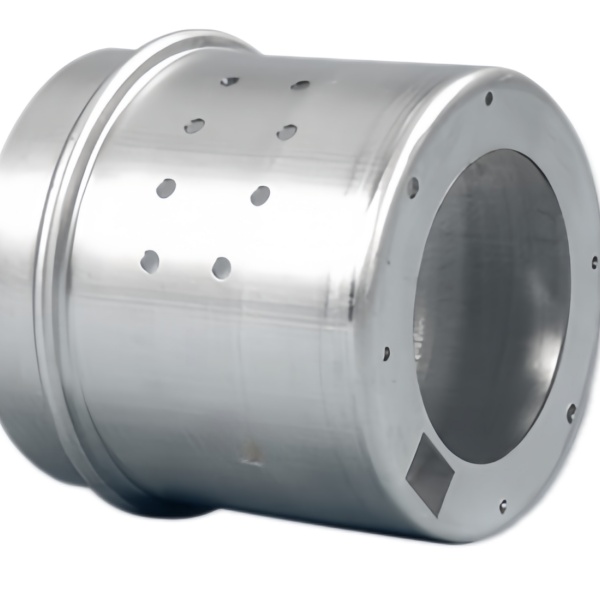
Request a Quote for This Part
Send a drawing or sketch — get material advice, tooling cost and a per-piece price within 24 hours (working days).