
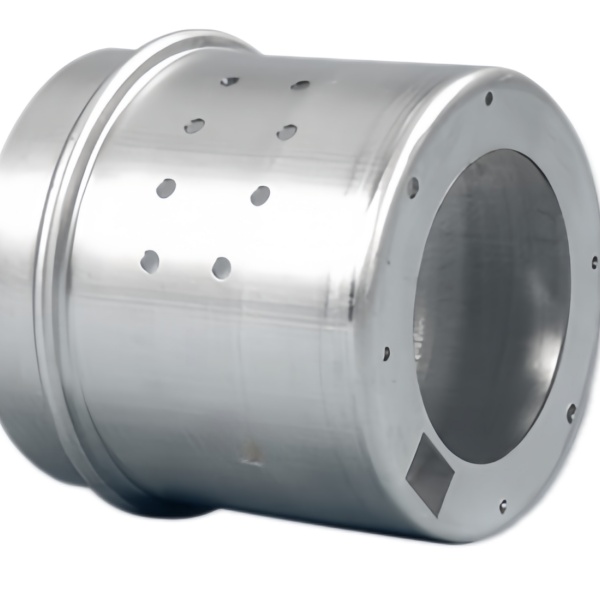
A drum shell is a long draw, and the wall thins where the vent row lands
A drum shell is a deep, narrow draw, and the depth is what makes it a different animal from a shallow can. The wall is stretched the full length of the stroke, and it thins progressively from the open end toward the closed end, because the material at the punch nose has travelled the farthest. Where the vent holes land on that wall, the local thickness is already below nominal, and the hole row sits in the thin band, which is exactly the place you do not want a row of holes unless you have planned for it.
We map the wall thickness along the length on the first article, ultrasonically, and we place the vent row in the section where the wall still has margin, or we thicken the blank locally at the row, because a hole row in the thinnest band is a row of weak points that fatigue or dent. The failure is not an instant tear; it is a row that bulges or cracks after cycles, and it starts at the thinnest hole. The thickness map is the document that keeps the vent row out of the danger zone.
The other effect of the long draw is earing at the open end, the four-lobe pattern from rolled sheet, which we trim and check at four positions so the open end is round before the head is crimped on, which is the subject of a later section.
Vent holes near the seam weaken the row, and the pitch is a fatigue callout
The vent holes on a drum are rarely a single hole; they are a row, and a row of holes is a row of stress concentrations. The pitch between holes decides how much wall is left between them, and that residual ligament is what carries the load around the row. Too tight a pitch and the wall between holes is a thin web that fatigues and cracks; too wide and the venting is uneven. We treat the pitch as a fatigue callout, not a spacing convenience, and we calculate the ligament width against the expected pressure or load cycles.
Holes near the drum seam are the worst case, because the seam is already a region of local thinning and residual stress from the draw closure, and a vent hole landing in it adds a concentration on top of one. We keep the vent row clear of the seam by a margin we set from the seam width, and where the drawing puts a hole near the seam we move it or reduce its size in the review, because a hole in the seam is a hole that leaks or cracks first.
The hole itself is pierced after the shell is final, supported behind so it stays round, and deburred, because a burr on a vent edge disturbs the flow the vent exists to manage.
- Treat vent pitch as a fatigue callout; calculate the ligament width between holes.
- Keep the vent row clear of the draw seam by a set margin.
- Place the row in a wall section that still has thickness margin after the long draw.
- Pierce after the shell is final, supported, and deburred.
Drawing a shell this deep means an intermediate anneal, not a bigger press
The instinct on a deep drum is to reach for a bigger press, but a deeper draw is limited by the material’s ductility, not the press tonnage. Past a certain draw ratio the wall has work-hardened past what it can take, and more force just splits it at the nose radius. The fix is an intermediate anneal between draw stages, which restores the ductility so the next reduction can happen, and the deep drum is therefore a staged draw with a softening cycle, not a single heroic stroke.
We plan the stages from the limiting draw ratio of the aluminium, typically two reductions of 25 to 30 percent each with an anneal between, and we keep the anneal in-line so the shell does not age between stages and gain a temper we did not plan. The press assignment follows the force profile: the deep draws run where ram force is controlled, because a fast mechanical ram into work-hardened aluminium is how nose-radius splits happen.
The anneal also protects the surface, because an over-worked wall that is then pierced for vents is a wall that cracks at the hole. A drum that is annealed on schedule pierces clean; one pushed through without softening cracks at the first vent hole.
The same staging discipline protects the dimensional repeatability of the deep draw. A drum drawn past its anneal window varies wall thickness batch to batch, and that variation moves the open-end roundness and the vent-row position, because both depend on a wall that drew the same way every time. By holding the anneal on schedule we hold the draw repeatable, which is what lets the crimp and the vent row land in the same place on every drum, not just on the first article, and it is why a deep drum is specified by its process window rather than by the press that happens to be free.
The open end roundness sets the head crimp, and vent holes do not change it
A drum closes with a crimped or seamed head, and the head seals on the open-end circle of the shell, not on its diameter. A shell that is the right diameter on average but oval by 0.3 mm will crimp tight on the long axis and leave a gap on the short one, and the gap is a leak the seam roller cannot close. We hold open-end circularity tight, typically within 0.1 to 0.15 mm total, and we measure it with a three-point gauge or on the CMM, because the crimp follows the circle, not the calliper reading.
The vent holes do not change this. Holes in the wall do not move the open end, so the roundness check is independent of the vent row, and we verify the open end before the head is applied, because a crimp hides an oval mouth instead of fixing it. The closed end matters less for sealing but is checked for flatness so the drum stands, and we check it on the surface plate during first article.
The seam closure itself is a separate operation we support, but its success depends on the roundness we delivered, so the roundness is the characteristic the crimp operator inherits from us, and we record it so the seam can be judged against a known circle.
Hole burr direction on a drum decides whether the liner scrapes or seals
On a vented drum the burr direction at each hole decides what happens inside. A burr on the inner surface points into the drum, and if the drum carries a liner or a rolling element, that burr scrapes the liner or catches the element on every cycle, eventually wearing a path that leaks or contaminates. A burr on the outer surface is less harmful to the contents but interferes with any fitting or label that sits on the wall. We specify the burr to the inside or outside deliberately and pierce accordingly, and we deburr the side that faces the contents.
The burr also affects the vent function. A ragged inner burr disturbs the very flow the vent is meant to manage, creating turbulence and local wear, so for drums where the vent feeds a controlled flow we keep the inner edge clean by a secondary cut or tumble, and we measure burr height at the first article on the inner surface, because that is the side the product sees.
For drums that seal a liner against the wall, the inner surface finish including burr is part of the seal, so we verify it as a sealing characteristic, not a cosmetic one.
How we verify a vented drum that is measured more for roundness than for holes
A vented drum is judged more for the circle it keeps than for the holes it carries, because the head crimp and the liner seal depend on roundness. The first article carries the checks below and production is audited against it.
- Open-end circularity is measured with a three-point gauge or CMM and held to the crimp datum, independent of the vent row.
- Wall thickness is mapped ultrasonically along the length and the vent row placed clear of the thin band.
- Vent pitch and ligament width are checked as a fatigue callout, with the row clear of the seam.
- Inner-surface burr height is measured at the holes, because that side faces the contents or liner.
- Closed-end flatness is checked on the surface plate so the drum stands true.
- Material and heat are traced to the mill certificate so the aluminium drawn is documented.
Send the drawing or a sample drum, and the review returns the wall map, the vent pitch we recommend, and the open-end roundness we will hold, so the drum that ships crimps and seals on the first head.
Our deep drawn covers guide puts numbers to the design decisions behind a part like this — draw ratio, wall thinning, radii and trim; the Precision Deep Drawn Parts pages collect the rest of the family.
Specifications
| Item | Aluminum Deep Drawn Drum Shell with Vent Holes |
|---|---|
| Brand | AUNOV |
| Designing | Send us your 2D drawing, or mail a sample for measurement, you get a DFM review together with the quotation. |
| Tooling | Every die designed and built in our toolroom, each die held against your part number. |
| Samples | Sample parts arrive with dimensional data and material certs. |
| Materials | Aluminium is the primary stock for this part, alongside carbon steel (SPCC / DC01), 304 / 316 stainless steel, brass and copper, and the grade is fixed at the drawing review. |
| Surface finish | Surface treatment per the drawing: plating, e-coat, powder coating, anodising, passivation, fixed at the drawing review. |
| Processing | Staged deep drawing with in-line annealing where needed, then pierced and machined in house. |
| Equipment | 5-250 T mechanical presses plus 250-500 T hydraulic presses, in-house CNC cells and a temperature-controlled inspection room. |
| Tolerance | Tolerances to +/-0.1 mm as drawn, with machined features to +/-0.03 mm. |
| Delivery terms | FOB is standard; DDP offered for EU and US, payment T/T or L/C, D/P for repeat accounts, blanket orders and call-offs supported. |
Frequently Asked Questions
Where should the vent holes go on a deep drawn drum shell?
Never in the thinnest band. The wall thins progressively from the open end toward the closed end, and a hole row landing in the thin section becomes a row of weak points that bulge or crack after cycling. We map wall thickness along the length on the first article and either place the row where the wall still has margin or thicken the blank locally at the row.
Why does this shell need an intermediate anneal rather than a bigger press?
Because the limit is the material, not the tonnage. A draw this long accumulates work hardening, and past the reduction the aluminium can take between anneals the metal tears no matter how much force stands behind the punch.
Does hole burr direction actually matter on a drum?
It decides whether the liner scrapes or seals. Burr direction is a drawing callout rather than a shop preference, so it should be written down instead of being left to whoever sets up the pierce.
What gets inspected more carefully, the holes or the roundness?
The roundness. The open end sets the head crimp and the vent holes do not change that relationship, so the shell is measured as much for roundness as for anything to do with the holes.
Related Products


Request a Quote for This Part
Send a drawing or sketch — get material advice, tooling cost and a per-piece price within 24 hours (working days).