
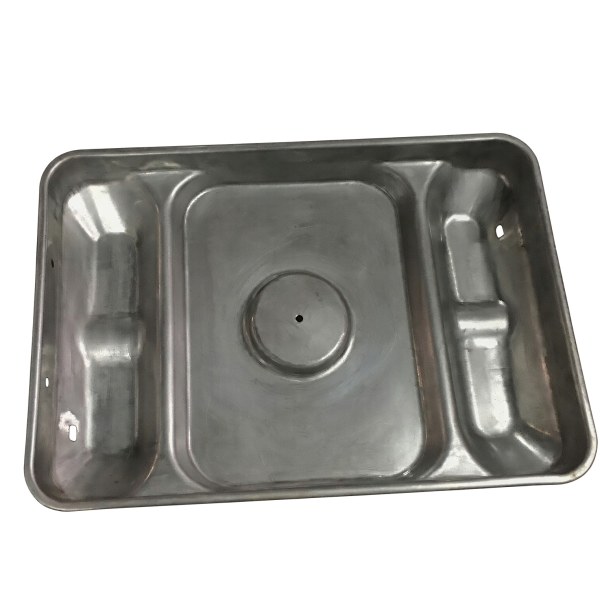
Galvanised means the coating is part of the forming problem
A galvanised pan body is not a steel pan with a protective skin applied afterwards. In the most common case the zinc is already on the strip when it arrives, and it has to survive every operation that the steel survives: blanking, drawing, restriking, trimming, piercing and any subsequent handling. That reframes the whole part. The question is no longer only whether the steel can be drawn into the pan, but whether the coating can be drawn into the pan without cracking, flaking or thinning to the point where it no longer protects anything.
Zinc is ductile, but it is not as ductile as steel, and it behaves differently depending on how it was applied. Electro-galvanised coatings, typically 5 to 20 microns per side, are relatively soft and compliant and will follow a fairly tight bend. Hot dip galvanised coatings, typically 20 to 60 microns per side with an intermetallic layer between the zinc and the steel, are thicker and more brittle and will crack or flake at radii that the base steel handles comfortably. Knowing which one is on the strip is therefore not a purchasing detail; it decides the forming limits for the part.
Two routes: coated blank, or form and then plate
There are two manufacturing routes and they produce different parts. In the first, coated strip is drawn directly, which preserves the coating over the whole formed surface including the inside of the pan and the drawn radii. In the second, the pan is formed from plain steel and zinc is applied afterwards by electroplating, which puts a uniform coating on everything the electrolyte can reach, including cut edges and the insides of holes, but which is applied to a part whose forming stresses are already locked in.
The drawn-from-coated-blank route is the better one for a pan that will be handled or used outdoors, because the coating on the drawn wall is continuous and has been deformed with the metal. Its weakness is that cut edges created after forming expose bare steel, and any piercing or trimming operation leaves a raw edge. The form-then-plate route covers those edges, and its weaknesses are thickness control inside a deep pan and the risk of hydrogen embrittlement where the steel is high strength, which requires a baking step after plating. For a low carbon pan body in SPCC the embrittlement risk is minor; for a high strength steel it is not, and a post-plate bake becomes mandatory rather than optional.
- Coated blank then draw: continuous coating on the drawn wall, bare steel at every cut edge.
- Form then electroplate: coating on cut edges, less uniform deep inside, requires a bake on high strength steel.
- Both routes have to be named, because a supplier quoting one will not deliver the other at the same price.
- Cut edges are the corrosion start point in the first route and the reason for the second.
Zinc ductility and the radius rule
The single most useful rule on this part is that the inside radius of any bend or drawn corner should be large relative to the coating thickness and the steel thickness. For hot dip material, an inside radius of three times the material thickness is a reasonable working minimum before the coating starts to show fine cracking on the outside of the bend; below two times the thickness the coating will crack visibly and will flake when the part is handled. For electro-galvanised strip, the acceptable radius is smaller, around one and a half times the thickness, because the coating is thinner and softer.
Drawn corners behave like bends that happen three-dimensionally, and they are worse than a simple bend because the coating is strained in two directions at once. A drawn radius of four times the material thickness is the figure to design against for a hot dip coated pan, and if the geometry will not allow it there are three honest responses: change to electro-galvanised strip, form the pan from plain steel and plate it afterwards, or accept local coating damage and specify a repair. Accepting damage silently is the one option that should not be on the list, because a cracked coating still looks acceptable at goods inwards and starts to rust in the field.
Coating damage has a second effect that is less obvious. Once the zinc layer is broken, the exposed steel becomes the anode in a local couple with the surrounding zinc, and corrosion concentrates at that small area rather than spreading. This is the mechanism that makes galvanising so effective on cut edges, and it also means the failure is localised and deep rather than uniform and shallow. A scratched coating on a pan is not a cosmetic defect; it is a corrosion cell.
Growth: where the coating sits inside the tolerance
Zinc adds to every dimension it covers, on both sides of the section. A coating of 20 microns per side makes a 1.2 mm strip into a 1.24 mm section, and it shrinks every hole by 40 microns on diameter and every internal feature by the same amount. On a pan body with drawn dimensions of plus or minus 0.1 mm, this is a substantial fraction of the tolerance band, and it is invisible in the drawing if the drawing does not say which state it refers to.
The convention that removes the argument is to name the state for every toleranced dimension: as formed and coated, or as formed before coating. Where a feature is machined after coating, as it often is for a locating diameter or a sealing face, that has to be stated as well because a machined feature becomes the one place on the part with no zinc, which is both a corrosion concern and an appearance concern. Where the pan carries a stack of drawn dimensions that all have to add up, it is usually simpler to write the drawing in the as-formed state and add a single note on the coating thickness, than to convert every dimension into a coated figure.
Cut edges, welds and touch up
A galvanised pan assembled into a product will normally have cut edges from trimming, holes from piercing and possibly a welded or riveted joint. Each is a place where the coating is absent or altered, and each needs a decision.
A cut edge on galvanised steel is protected by the zinc that remains around it, which is the electrochemical effect described earlier, and for a small edge in a mild environment that is enough. For an edge exposed to salt or to constant condensation, the zinc is consumed over time and the protection becomes limited, so a heavy cut edge should either be sealed with a zinc rich paint or be designed out by arranging the trim so that the edge is not in the wet region.
A weld destroys the coating in the heat affected zone and leaves a region of bare steel with an oxide skin. Galvanised steel can be welded, but the process needs a ferritic consumable, a slightly wider gap and either good extraction or a fume class that the shop can handle. Afterwards the zone must be recoated, usually with a zinc rich primer, and the requirement to do so should be on the drawing rather than left to the welder.
Touch up is a real operation and it should be specified with the same care as the primary coating. A zinc rich repair paint is not the same as the original coating, it does not have the same thickness, and it will look different. If the pan is a visible part, the appearance of a repair has to be included in the appearance standard, or a part that is fully functional will be rejected on appearance.
Salt spray hours, and what the number leaves out
A salt spray requirement is usually written as a number of hours to red rust, and the number is quoted as if it described the coating. It does not. Salt spray results depend on the coating type and thickness, on the surface preparation, on where the sample was cut from and whether the edge was protected, on the chamber conditions and on whether the test was continuous or cyclic. Two suppliers can both report 240 hours and deliver very different parts.
Three details make the requirement meaningful. State what is being observed: white rust is zinc corrosion product and is not structural, red rust is steel corrosion and is the failure of interest, and a requirement should name which one and at what point. State where on the part the observation is made, because a flat face and a cut edge behave completely differently. And state the surface condition, because a scratched or formed sample is not the same test as a flat polished coupon. For a galvanised pan body in an ordinary outdoor duty, an electro-galvanised coating in the 8 to 15 micron range with a requirement of no red rust at 96 to 120 hours of neutral salt spray is a coherent specification; a hot dip coating of 40 microns or more with a requirement in the 500 hour range is coherent for a harsher duty. What is not coherent is a thick coating requirement and a thin coating price.
Questions that come up on galvanised pan bodies
Can the pan be drawn from hot dip strip? Only with generous radii, four times the material thickness or more at the drawn corners. If the geometry is tighter, the answer is electro-galvanised strip or forming plain and plating afterwards.
Is a cracked coating acceptable anywhere? No. A crack in the zinc forms a localised corrosion cell and the appearance of the part gives no warning. Where cracking is unavoidable in a local area, specify a repair and inspect it.
What should be inspected in production? Coating thickness on a sample from each coil or each batch, coating continuity on every part where the drawing calls for it, formed dimensions after coating, and a visual check of the drawn radii for cracking under low magnification at the start of each run.
Does the coating change the material to specify? It changes the supply condition, not the base grade for a low carbon pan. SPCC or DC01 is the usual base for both hot dip and electro-galvanised pan bodies, and the coating class is what changes between a mild and a harsh duty.
Not sure whether to draw, machine or weld this geometry? The guide to deep drawn covers compares the three routes and shows where each one wins; the full Precision Deep Drawn Parts range is linked from the overview page.
Specifications
| Item | Galvanized Steel Deep Drawn Pan Body |
|---|---|
| Brand | AUNOV |
| Designing | Send us your 2D drawing, or mail a sample for measurement, you get a DFM review together with the quotation. |
| Tooling | Our own toolroom designs and builds every die, each die held against your part number. |
| Samples | The first-article set ships with dimensional data plus material certs. |
| Materials | Carbon steel (SPCC / DC01) leads the stock list for this part, alongside 304 / 316 stainless steel, aluminium, brass and copper, with the final grade confirmed at the drawing review. |
| Surface finish | Finish options: plating, e-coat, powder coating, anodising or passivation, per the drawing. |
| Processing | Staged deep drawing with in-line annealing where needed, then pierced and machined in house. |
| Equipment | Our press floor runs 5-250 T mechanical and 250-500 T hydraulic presses, CNC turning and milling cells, a climate-controlled CMM room. |
| Tolerance | Drawn tolerances held to +/-0.1 mm, machined features held to +/-0.03 mm. |
| Delivery terms | FOB as standard, DDP available for EU and US destinations, T/T or L/C, D/P on repeat business, call-off scheduling supported. |
Frequently Asked Questions
Why is galvanising part of the forming problem on a pan body?
In the common case the zinc is already on the strip and must survive blanking, drawing, restriking and trimming without cracking or flaking. The coating, not just the steel, has to be drawn into the pan.
How does coating type change the forming limits?
Electro-galvanised coatings are relatively soft and follow a fairly tight bend, while hot-dip coatings are thicker and more brittle and crack at radii the base steel handles comfortably, so the radius rules differ by coating type.
Where does the zinc coating sit inside the tolerance?
Coating growth is accounted in the tolerance stack, cut edges and welds may need touch-up, and salt-spray hours are specified with the failure mode in mind rather than as a single number.
How are galvanised pan bodies quoted and inspected?
We confirm the coating type and radius rules before tooling, with a dimensional report plus coating inspection on the first article. The typical minimum order is 1,000 pieces with a 24-hour quotation.
Related Products


Request a Quote for This Part
Send a drawing or sketch — get material advice, tooling cost and a per-piece price within 24 hours (working days).