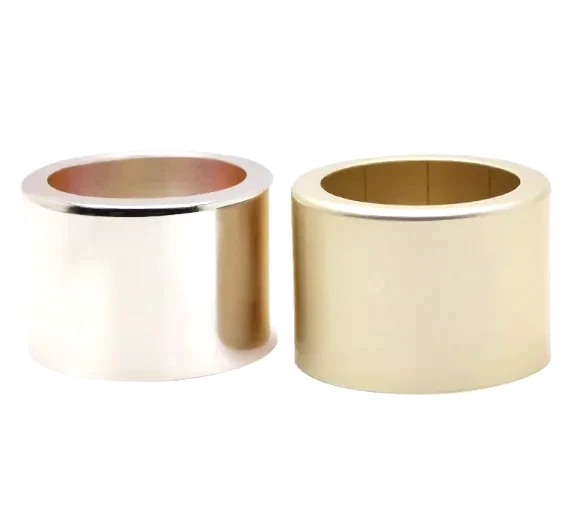
A plain-bore bearing sleeve looks like the simplest part in the family – a tube with a hole through it. It is also the part where drawings most often flag the wrong diameter as critical. The bore is specified tightly and the outside is left to general tolerance, and on a press fit it is the outside that decides whether the sleeve goes into its housing at all.
Two diameters doing two different jobs
On a press-fit sleeve both diameters are structural, which is unusual – most sleeves have one functional diameter and one clearance one. The bore carries the shaft, so it is held to the running clearance the bearing needs. The outside carries the interference fit, so it is held to the band the housing bore demands. Get the bore right and the outside loose and the sleeve spins in its housing; get the outside right and the bore tight and the shaft seizes. Neither is a tolerance that can be left general.
Interference is a range, not a number
A press fit is specified as an interference range between the housing bore and the sleeve outside diameter, and the two parts have to be toleranced to meet each other across the whole range rather than at nominal. Too little interference and the sleeve works loose under load; too much and it is either damaged going in or it crushes inward and closes the bore it was meant to hold open. Where the sleeve is thin-walled, the inward crush is the real limit, and it is why the wall thickness belongs in the calculation.
A thin sleeve closes up when it is pressed in
This is the failure that surprises people. Pressing a thin-walled sleeve into a housing compresses it, and the bore shrinks by a predictable part of the interference. A sleeve that measured correctly before fitting can therefore grip its shaft after fitting. We allow for the closure in the bore tolerance, and on thin walls we say so at quotation, because the alternative is a fitting that measures right and does not turn.
The bore is finished after fitting, or the wall is held for it
There are two honest routes: either hold the drawn wall consistent enough that the bore after pressing stays in band, or finish the bore by machining after the sleeve is fitted. The first is cheaper and suits generous walls; the second is the answer where the clearance is tight or the wall is thin. Which one applies is a drawing-stage decision, not a production one.
How the sleeve is checked before it ships
Both diameters are measured, the wall is checked for the consistency the closure calculation depends on, and press-fit samples are verified against the actual housing bore where one is supplied.
First articles are retained with the recorded forming settings, so a reorder is made to the same diameters and the same wall. On a press fit, that is what keeps the second batch going into the housing the same way.
This part belongs to our Deep Drawn Parts range, where the process notes and tolerance practice behind the whole family are collected.
Specifications
| Item | Brass Bearing Sleeve Bushings, Plain Bore |
|---|---|
| Brand | AUNOV |
| Designing | Your drawing sets the part – samples are reverse-measured into a controlled drawing; revisions are re-quoted once rather than silently absorbed. |
| Tooling | Progressive and drawing dies are designed and built in house, so tooling lead time stays under our control, and the charge is refundable against agreed volumes. |
| Samples | Sample approval is documented: dimensions, finish and material recorded for later comparison. |
| Materials | Stock covers carbon steel (SPCC / DC01), 304 / 316 stainless steel, aluminium and brass; material substitutes are proposed only with your written approval. |
| Surface finish | Zinc, nickel or chrome plating, anodising, passivation or e-coat; the agreed finish travels with the part number. |
| Processing | Deep drawing on maintained presses, blank size and lubrication logged per run; first articles verify the whole flow before the run is released. |
| Equipment | Mechanical presses 5-250 T plus 250-500 T hydraulics, with in-line annealing, backed by CNC turning centres and a climate-controlled inspection room. |
| Tolerance | +/-0.05 mm on drawn diameters, tighter bands confirmed against the drawing; finer bands confirmed from capability data before quoting. |
| Delivery terms | FOB Ningbo or Shanghai, payment by T/T, L/C at sight or D/P; sea or air freight is quoted to your door. |