
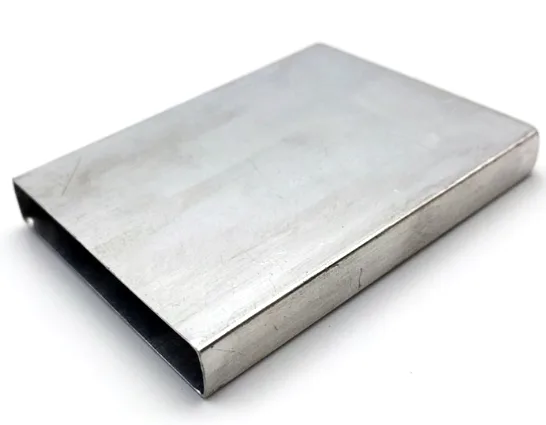
A rectangular lid is a shallow box, and a shallow box has one thing that always goes wrong
A stainless steel deep drawn rectangular tray lid is the simplest shape in this whole family and one of the least forgiving. It is a shallow rectangular shell with a flange – a tray that closes onto a tray. There is no complex feature, no thread, no tight tolerance to negotiate. And yet it has one recurring failure that appears on virtually every project of this type: the lid does not sit flat on the base, so the seal does not seal, and the reason is almost never the part’s dimensions. It is the panel.
We deep draw on maintained presses with blank size and lubrication logged per run, every stage logged against your part number, on 5-250 T mechanical and 250-500 T hydraulic presses with annealing ovens on site, CNC turning centres for secondary operations, and CMM inspection. Drawn diameters to +/-0.05 mm with tighter bands confirmed against the drawing, and critical dimensions carrying CMM data with the shipment. Materials held include carbon steel, 304 and 316 stainless steel, aluminium and brass, with special grades sourced to the drawing when volumes justify. Finish is selected from the drawing with the finish inspected alongside the dimensional report on the first article. This page is about the panel, the flange, and the three things that decide whether this part works.
Flatness is the whole specification
A tray lid’s job is to close onto a base and either seal or locate. Either way, it depends on the flange contacting the base’s rim continuously. So the flange has to be flat, and a shallow drawn panel does not naturally want to be flat. Three causes, each with a different fix:
- Residual stress from the draw. Forming the walls leaves the panel with residual stresses, and those stresses relax over time and over handling. A lid that measures flat at the first article can bow after a month in a warehouse. This is why a flatness requirement alone is not enough – the part’s material condition matters too.
- The rectangle itself. A rectangular panel is inherently less stable than a round one. A round panel has no corners to pull against and its residual stress is symmetric. A rectangular panel has four corners where the flow changes and four long edges where the material is stretched differently, and that asymmetry is what produces a bow. Rectangular is inherently harder to keep flat.
- Handling and stacking. A shallow lid is easy to bend, and lids are stacked. A lid that has been stacked under weight in a box will not be flat on arrival, and this happens on every one of these parts that is not properly packaged.
The fixes, in order of effectiveness: coining on the final station to press the panel to a controlled flatness; a hemmed or flanged edge, which turns the panel’s edge into a beam and dramatically increases its resistance to dishing; and restrictive packaging, which costs nothing on the drawing and is frequently forgotten until the first customer complaint.
The flange is a sealing surface and a locating surface
Four properties of the flange, and they interact:
- Flatness. A flange with any crown or dish contacts only at its extremes. On a seal that means the seal compresses at two points and the middle leaks.
- Parallelism to the panel. A flange tilted relative to the panel produces a flange that seals on one side and gaps on the other. This is a separate requirement from flatness and has to be stated separately.
- Corner radius. The corners of a rectangular flange are where it is hardest to keep flat, and they are where the material flows most during the draw. A generous corner radius helps the draw, the flatness and the seal; a tight corner radius on a shallow rectangular draw is asking for a lifted corner.
- Overall squareness. Where the lid locates into a base rather than only sealing, squareness controls whether it enters. This is a dimensional requirement across the diagonals, and it is one of the more common causes of a lid that will not close.
Corner thinning, and the four corners that are all different
A rectangular draw is a two-direction material flow, and the consequence is that the four corners behave differently from the walls and from each other:
- The corners are the most stretched region. Material has to travel furthest to reach a corner, so the corner wall is the thinnest part of the part and the most highly stressed. On a lid this is where a crack would start and where a dent is most likely.
- Opposite corners differ. Because the flow is not perfectly symmetric, one corner will consistently differ from its opposite. This is not a defect – it is geometry – and it means a flatness or squareness requirement that is too tight for a rectangular draw will fail consistently at the same corner, which is a useful diagnostic.
- Where the wall is thinnest, the panel is least supported. A thin wall region next to a corner is where the panel’s stiffness drops and where dishing starts.
The design response is the same one that appears in every drawn rectangular part: specify the wall thickness to print rather than to a general band, and where a specific thickness matters – at a sealing flange, at a corner – state it there. And design the corner radius generously, because that is what controls the thinning.
Stainless Steel, and what it means for a lid
Materials held include carbon steel, 304 and 316 stainless steel, aluminium and brass, with special grades sourced to the drawing when volumes justify. For a tray lid the choice is often driven by the contents rather than by the part:
- 304 stainless steel for food service, general washdown, and ordinary environments. It is the standard answer for a tray lid because it is cleanable, corrosion-resistant, and it looks the part it is meant to look like.
- 316 stainless steel for chloride-bearing environments – salt air, de-icing exposure, acidic foodstuff, chemical environments. 316 is the correct answer for salt and for acidic contents, and using 304 there is a common and expensive mistake.
- Aluminium for a light lid or where mass matters, and where an anodised finish is wanted. The trade-off is that aluminium is softer, so an aluminium lid deforms more easily in handling and needs more care in its corner radii.
- Carbon steel with coating where cost governs and the environment is dry. It will need coating on both faces – including the inside, which is where a tray’s contents sit and where a coating failure is most visible.
The stainless steel-specific point worth making: a drawn stainless steel lid work-hardens at its corners and its flange. That is beneficial for wear resistance, and it means the material at the formed features is harder and less ductile than the mill condition – so if the lid is later formed or reformed in assembly, the corners will crack rather than bend. This is worth noting on any part that is assembled by bending.
Finishing, and masking is mandatory here
Finish is selected from the drawing, with the finish inspected alongside the dimensional report on the first article. On a tray lid the finishing decision has one hard rule and three softer ones:
- Mask the sealing face and the locating face. A coating on a sealing flange changes its dimension and adds a compressible layer that can creep. If the design uses a gasket, a coated sealing face is often acceptable and sometimes better; if it uses bare metal on metal, it is not. This has to be decided, and it should be on the drawing.
- Coat both faces, including the inside. An inside face that is left as raw formed steel – with drawing lubricant still on it – will rust, and it will rust where the contents are, which is the least visible and most damaging place for it to happen.
- Coating flattens or crowns the flange. A powder-coated flange has a rounded edge at its boundary and a slightly crowned panel, which on a sealing flange is a functional change. Electroplating or passivation is dimensionally better behaved.
- Coating changes nothing else that matters on this part type – unlike a bracket with tight bores, a lid’s coating is not usually a fit problem. So the finishing choice on a lid is free to be driven by appearance and by the contents rather than by dimensional concerns.
Passivation is the standard for stainless steel here, and it needs no masking, adds nothing to dimensions, and gives full corrosion resistance. Plating is available where appearance or wear resistance demands it. Anodising applies to aluminium and gives the best dimensional behaviour of the coating options.
Measure flange flatness in the free state against a named surface
Seven things worth settling, and they are mostly about the panel rather than the perimeter:
- Flange flatness against a named surface, measured in the free state with the part supported in a defined way – or the number means nothing.
- Parallelism from the flange to the panel, as a separate callout from flatness.
- Corner radius specified, because it controls the thinning, the flatness and the seal.
- Wall thickness to print, and where the minimum is – at the corners.
- Squareness, where the lid locates rather than only seals.
- Whether the sealing face is bare, coated, or has a gasket, and if masked.
- The packaging requirement, if the lid has to arrive flat. This is not a drawing item but it is a real production requirement and specifying it prevents a whole class of customer complaints.
And the practical observation from these projects: the part that causes the most trouble is rarely the lid’s dimensions, which are easy to hold. It is the flatness in transit, which is a packaging problem, and it is the corner that lifts after a year of thermal cycling, which is a material and geometry problem. Both are solved at the design stage and neither is solved at the inspection bench.
The design decisions behind a part like this — draw ratio, wall thinning, radii and trim — are worked through with numbers in our deep drawn covers guide, and the Precision Deep Drawn Parts pages collect the rest of the family.
Specifications
| Item | Custom Stainless Steel Sheet Metal Deep Drawn Metal Stamping Spinning |
|---|---|
| Brand | AUNOV |
| Designing | The drawing is reviewed first; the agreed version then governs every batch. |
| Tooling | Die design and toolmaking stay in house, so a die can be re-cut against the approved drawing, and the charge is refundable against agreed volumes. |
| Samples | Approval is in writing, and the signed sample is kept as the reference for repeats. |
| Materials | Materials held include carbon steel, 304 / 316 stainless steel, aluminium and brass; special grades are sourced to the drawing when volumes justify. |
| Surface finish | Finish selected from the drawing: plating, coating, anodising or passivation; the finish is inspected with the dimensional report on the first article. |
| Processing | Deep drawing on maintained presses, blank size and lubrication logged per run; every stage is logged against your part number. |
| Equipment | Press shop running 5-250 T mechanical and 250-500 T hydraulic presses, annealing ovens on site, with CNC turning centres for secondary operations and CMM inspection. |
| Tolerance | +/-0.05 mm on drawn diameters, tighter bands confirmed against the drawing; critical dimensions carry CMM data with the shipment. |
| Delivery terms | FOB Ningbo or Shanghai, T/T with deposit and L/C for larger runs; repeat orders reuse the approved first article. |
Frequently Asked Questions
Why is flatness the whole specification on a rectangular lid?
A stainless steel rectangular lid is a shallow shell with a flange, and its recurring failure is that it does not sit flat on the base, so the seal does not seal. The cause is almost never the part’s dimensions – it is the panel – which is why flatness, not a tight size, is the specification that decides whether the lid works.
How is flange flatness held on a drawn stainless steel lid?
The flange is both a sealing surface and a locating surface, so it is measured in the free state against a named surface and held to a tight band rather than checked only under clamp load. The relationship is proved on the CMM at first article, and masking is mandatory so the finish does not disturb the flat reference.
Which stainless steel for a rectangular tray lid?
304 is used for general duty, with 316 for chloride or marine exposure, and special grades are sourced to the drawing when volumes justify. The grade is chosen for the environment the lid sees, and mill certificates accompany the first article.
What is the minimum order for a custom stainless steel lid?
Runs start at 1,000 pieces, with tooling made in-house to your print. We return a quote within 24 hours of the drawing, and first articles are measured on the CMM before the full run, so the flatness and the flange are confirmed on metal first.
Related Products


Request a Quote for This Part
Send a drawing or sketch — get material advice, tooling cost and a per-piece price within 24 hours (working days).