
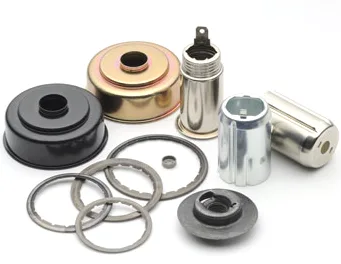
An automotive seals assortment is a catalogue where one wrong part is a warranty claim
An automotive seals, grommets and fittings assortment is a family of elastomeric and metal sealing parts. It looks like a product listing rather than an engineering problem, and it is actually one of the harder things in this entire catalogue to do properly. The reason is not the sealing physics. It is that a seal is a two-material, two-part-system product where the metal and the elastomer each have to be right, and a catalogue offers a customer the opportunity to pick the wrong one from a list of plausible-looking options.
We coil-blank and progressively draw, coining on the final station where the print calls for it, and every stage is logged against your part number, on 5-250 T mechanical presses and 250-500 T hydraulic presses with annealing furnaces in line, CNC turning centres for secondary operations, and CMM inspection. Flange and rim dimensions to +/-0.05 mm with the wall controlled by the draw, and capability is checked on the first article before the run continues. Stock runs to carbon steel, 304 and 316 stainless steel, aluminium and brass, with material substitutes proposed only with your written approval. Natural, plated or coated per the print, with the agreed finish logged and the finish inspected alongside the dimensional report on the first article. This page is about what a seal assortment actually has to control, and the four things that separate a catalogue that works from one that generates complaints.
Requirement 1: a seal is defined by its gap, not by its size
Every seal in this family – whether it is a grommet, a bushing, a fitting, or a conduit seal – has one controlling relationship: the interference between the seal and the thing it seals. This is the single most important thing about specifying a seal, and it is the thing a size-based catalogue is worst at expressing.
- An elastomer seal’s ID is specified by the cable or tube’s OD range, not by a nominal. The seal is chosen so that its specified ID range overlaps the cable’s specified OD range. This is why a grommet’s drawing has to state the cable’s diameter range, and why a grommet’s ID cannot be a single number.
- A metal-to-metal seal is a defined interference, and its tolerance is on the pair, not on either part. A fitting that seals against a face has a defined contact band and a defined torque, and both parts’ tolerances contribute to whether the seal works.
- Where a seal rides on a shaft or a tube, the seal’s bore and the shaft’s OD form a fit and the shaft’s surface finish and hardness are part of the specification. A seal on a rough shaft will not seal, and no amount of seal quality fixes that.
- Where the seal is a lip or a boot, its ID range and its elasticity determine the range of cable diameters it can accommodate – and that range is the product’s actual specification, whether or not a catalogue says so.
Requirement 2: the elastomer is a specification, not a note
In a family assortment, the elastomer is where most of the variation and most of the failures live. Four properties have to be stated, and each is a different requirement:
| Hardness | Determines the interference the seal can tolerate and the force needed to fit it. A range too hard will not conform to a cable’s ovality; too soft and it will extrude or tear on assembly. This is the primary material specification and it belongs on the drawing with a tolerance in Shore units. |
|---|---|
| Compression set | Under a constant squeeze a rubber gradually deforms and stops pushing back. A seal with poor compression set in a static application will eventually leak, and the leakage will be slow and hard to attribute. This is a temperature-and-time property and it is what makes elastomer selection a real engineering decision. |
| Temperature range and media | Elastomer hardens and becomes brittle when cold, and softens, swells or is destroyed when hot or in a solvent. On an automotive application the underhood temperature and the fluids present – oil, coolant, fuel, salt water, brake fluid – decide the compound. A family that offers the same seal for all of these is offering a seal for none of them. |
| Ageing and weathering | An exterior or underhood seal sees UV, ozone, and thermal cycling. An unprotected elastomer degrades – it cracks, hardens, and loses its seal. Where a seal is exposed, the grade has to be matched to that exposure. |
Requirement 3: the metal and the elastomer have to agree, permanently
On a bonded seal or grommet, the metal and the rubber are joined and the joint is a permanent part of the product. Three requirements on the metal that are specific to this:
- The metal’s surface where the rubber bonds has to be prepared – cleaned, roughened, primed – and this is a process requirement, not a surface appearance. A bonding surface described as “as received” will not produce a consistent bond.
- The metal’s coating has to be compatible with the bond and applied at the right point. A plated surface can be bonded if the plating is appropriate, and a coating applied after bonding would defeat the bond entirely. So the assembly sequence is a design decision.
- The metal’s geometry has to locate the rubber mechanically as well as chemically – a groove, an undercut, or a knurl. This is a stamping feature and it is where the metal half of a bonded grommet’s strength is decided.
Requirement 4: a catalogue has a selection problem, and it is the hard part
On a single part, a correct specification is enough. On a catalogue, a correct specification per part is not enough – the customer also has to pick the right one, and that is a design responsibility that the supplier carries whether it is acknowledged or not. Four ways to make the selection safe:
- State the cable or tube range on each option, prominently. If a grommet’s listing says “for 8-12 mm cable”, the customer can self-select correctly without a drawing review. This is the single most valuable thing a seal catalogue can do and it is almost always missing.
- State the environment on each option. Underhood oil, coolant, fuel, salt spray, and general weather are different requirements, and a catalogue that does not distinguish them is inviting a mismatch.
- Use distinct part numbers and a naming convention that encodes the range. A grommet for 8-12 mm cable in a hot-oil application should not be adjacent in the catalogue to one for 8-12 mm cable in a general-weather application, and its identifier should make the difference visible.
- Include the elastomer compound in the part description. “NBR, 70 Shore A” is more useful than “rubber grommet”, and it lets a customer who knows their fluid pick correctly.
The assortment economics, and why the smallest sizes dominate the cost
On a family of seals and grommets, three economic facts matter and they are counter-intuitive:
- Masking scales badly. A metal part in a grommet with a masked flange has a masking operation that is a fixed cost per part – a plug, a tape, a rack. On a very small part that operation is a large fraction of the part’s cost. So the smallest sizes in a catalogue are disproportionately expensive to finish, and the quotation should show it.
- The smallest sizes dominate the handling cost. A 5 mm grommet is hard to pick, hard to orient, and easy to lose. The handling cost does not scale down with the part, so the small sizes cost disproportionately more in labour than the large ones.
- Each size needs its own tooling and its own first article. On a twenty-size family that is twenty sets of gates, twenty sample approvals, and twenty sets of dimensional data. The approval effort is a fixed cost of the family and it does not amortise the way a single-part order’s does.
What to put on the catalogue and the drawings
Eight things, and the first four belong on the catalogue entry rather than on a drawing, which is what makes it a catalogue and not a parts list:
- The cable or tube diameter range each option serves, stated on the listing.
- The elastomer compound and hardness, stated on the listing and on the drawing.
- The environment each option suits – fluids, temperature, exposure.
- Whether the option is a bonded assembly or a metal part with a separate seal, since the two have different service lives and different failure modes.
- For a bonded part: the bond strength or peel requirement, and the metal’s surface preparation at the bond area.
- The ID tolerance stated as a range, with the mating cable’s OD range, so the fit is a property of the pair.
- Flange and rim dimensions at +/-0.05 mm, with the sealing or bearing surfaces identified.
- Which surfaces are masked, and whether dimensions apply before or after finish.
How much of the catalogue is genuinely used
How much of this assortment is actually used? Seal and grommet catalogues are almost always assembled from a customer’s historical usage, and the most common finding from reviewing one is that a small number of the listed sizes carry the overwhelming majority of the demand while the rest sit. A catalogue trimmed to the sizes that are genuinely used is faster to select from, cheaper to stock, and less likely to produce a mismatch – and the sizes that are rarely used are usually the ones where the selection criteria are most ambiguous. It is worth asking which sizes actually move, and it is a much better question than asking whether the catalogue can be expanded.
The engineering calls behind a part like this — draw ratio, wall thinning, radii and trim — each get worked examples in our deep drawn covers guide; the Precision Deep Drawn Parts pages gather the rest of the family.
Specifications
| Item | Automotive Seals, Grommets and Fittings Assortment |
|---|---|
| Brand | AUNOV |
| Designing | Your drawing sets the part – unusual walls, threads or tolerances are feasibility-checked first; changes are priced before they are made. |
| Tooling | Die design and toolmaking stay in house, so no tooling step is outsourced, and first-article timing is measured from the tooling start date. |
| Samples | Samples are issued for approval before the run, so any deviation is corrected at sample stage, and later batches are gauged back to the signed sample. |
| Materials | Stock runs to carbon steel, 304 / 316 stainless steel, aluminium and brass; material substitutes are proposed only with your written approval. |
| Surface finish | Natural, plated or coated – the print decides, and the agreed finish is logged; the finish is inspected with the dimensional report on the first article. |
| Processing | Coil blanking and progressive drawing, coining on the final station where the print calls for it; every stage is logged against your part number. |
| Equipment | 5-250 T mechanical presses, 250-500 T hydraulic presses and annealing furnaces in line, with CNC turning centres for secondary operations and CMM inspection. |
| Tolerance | +/-0.05 mm on flange and rim dimensions, wall controlled by the draw; capability is checked on the first article before the run continues. |
| Delivery terms | FOB Ningbo or Shanghai, payment by T/T or L/C, quoted in USD or EUR; sea or air freight is quoted to your door. |
Frequently Asked Questions
Why is an automotive seal assortment a hard problem?
A seal is a two-material, two-part system where the metal and the elastomer each have to be right, and a catalogue lets a customer pick the wrong combination from plausible options. One wrong part is a warranty claim, not a cosmetic miss.
How is a seal defined: by size or by gap?
By its gap, not its size. The gap the seal closes – and the compression it must hold across temperature and age – defines the elastomer and the metal backing, so the specification starts from the joint rather than the part drawing.
Why must the metal and elastomer agree permanently?
They expand and age differently; the bond or interference that holds them together at assembly has to survive the service temperature cycle, or the seal loosens in place. The elastomer is specified as a material, not a note.
How is a seals assortment quoted and verified?
Each seal’s gap, elastomer and metal are matched in the catalogue and checked on the first article. The typical minimum order is 1,000 pieces with a 24-hour quotation.
Related Products



Request a Quote for This Part
Send a drawing or sketch — get material advice, tooling cost and a per-piece price within 24 hours (working days).