
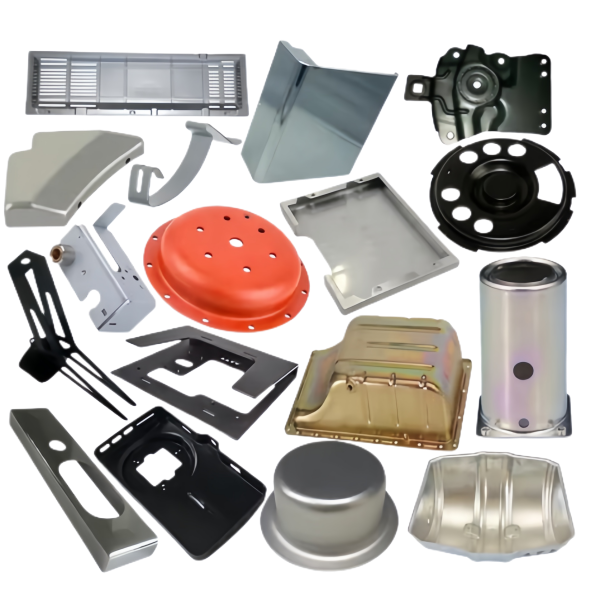
An order that mixes brackets, covers and trays is three production problems in one carton. The way to keep it sane is to schedule by how each part is made rather than by the order the customer listed them, because the three families want different machines, different dies and different handling.
Group by tool family, not by part name
Brackets are brake-formed from flat stock, covers are shallow draws with pierced features, trays are deeper draws that often carry rails. Running them in family order means the brake work runs together, the shallow covers run together and the trays run together. Scheduling them by part number instead is how a cover ends up on a bracket die and a setup gets lost between jobs.
Within a family, group by thickness and grade
A die set calibrated for 1.5 mm carbon steel is wrong for 2.0 mm aluminium, and the two should not share a setup sheet. Grouping by stock thickness and grade inside each family produces three mini-runs with three approved setups, and it keeps the clearance that was set for one material from being silently used for another.
Short lots are where pierce position drifts
Pierce position moves on short runs because the die never warms up and the strip never settles the way it does on a long one. We hold it by piloting the strip on dual pins at every station and by pinning the pierce die to the form die with a common locator, so a cover’s slots and a tray’s drain holes land where the drawing put them regardless of lot size. On lots under 500 we add a first-and-last-part pin check, because that is exactly where drift hides.
Label the carton per family
The output of a mixed run is packed and labelled by family, not by the customer’s part list, so the reorder pulls the right mini-run without sorting. It also means a reprint of one family does not require re-approving the other two.
How a mixed lot is released
Each family is released against its own approved setup, and pierce position is verified on the first and last part of every short run. That is what lets a mixed order be shipped as one carton without any of the three families being inspected at the end instead of during.
Setups and first-and-last checks are recorded per family, so a reorder of the trays alone runs on the setup that was approved for them. On a mixed order, that is what keeps the second carton composed like the first.
This part belongs to our Metal Stamping range, where the tooling notes and forming practice behind the whole family are collected.
Where this part is used
Mixed orders that ship brackets, covers and trays in one carton are common in OEM builds where several sheet-metal families go into the same assembly and the buyer wants one delivery. We see them in control-cabinet work, in test and measurement equipment, and in maintenance and service packs where a kit has to arrive complete rather than as three separate shipments.
The difficulty is scheduling rather than forming. Three families want different machines, different thicknesses and often different finishes, and the way to keep the order sane is to plan by how each part is made rather than by the order the customer happened to list them.
What we need to quote it
Send the bill of materials split by part, with thickness and grade per line, and tell us the kitting rules — which parts share a carton, whether the kit is labelled per family, and whether it ships assembled or flat-packed. If the three families share a finish, say so, because that decides whether we run one plating batch or three.
Specifications
| Item | Assorted Stamped Brackets Covers and Trays |
|---|---|
| Brand | AUNOV |
| Designing | Share your print, or send a part to be measured, DFM feedback is returned with the quote. |
| Tooling | Dies engineered and produced in our own toolroom, held under your part number. |
| Samples | First-article samples ship with dimensional data and material certs. |
| Materials | Materials held: carbon steel (SPCC / DC01), 304 / 316 stainless steel, aluminium, brass, copper, with the final grade confirmed at the drawing review. |
| Surface finish | Plating, e-coat, powder coating, anodising or passivation as the drawing calls out, as called out on your print. |
| Processing | Staged deep drawing, with in-line annealing where the draw ratio requires, pierced and finish-machined on the same floor. |
| Equipment | Our press floor runs 5-250 T mechanical and 250-500 T hydraulic presses, CNC turning centres, climate-controlled CMM room. |
| Tolerance | Tolerances to +/-0.1 mm as drawn, +/-0.03 mm on machined surfaces. |
| Delivery terms | Standard terms FOB, DDP offered to EU and US, T/T or L/C, D/P on repeat business, call-off schedules supported. |
Frequently Asked Questions
Why schedule a mixed order by how each part is made rather than by its name?
An order mixing brackets, covers and trays is three production problems in one carton. Grouping by tool family keeps changeovers to a minimum, so the press is reset for a family rather than for a part.Scheduling by part number looks tidier on paper and costs considerably more on the floor.
Why does thickness and grade grouping matter inside one family?
Because every change resets what the process was relying on. Different gauge or different material means different settings, and interleaving them reintroduces variation repeatedly. Running them together as one setup is how a mixed lot keeps behaving like one batch rather than several.
Why is drift worse on short runs?
Short lots never get stable. Most processes settle in the first pieces and then hold, so a run that finishes before it settles has spent its whole life drifting, and pierce position is usually what shows it. Shorter runs therefore warrant checking sooner and more often, not less.
How should a mixed lot be released?
Per family, with the carton labelled accordingly and the records able to identify which family a given piece came from. A lot that cannot be traced back further than “the shipment” makes any later question unanswerable, and that is precisely the cheap thing worth arranging in advance.
Related Products


Request a Quote for This Part
Send a drawing or sketch — get material advice, tooling cost and a per-piece price within 24 hours (working days).