
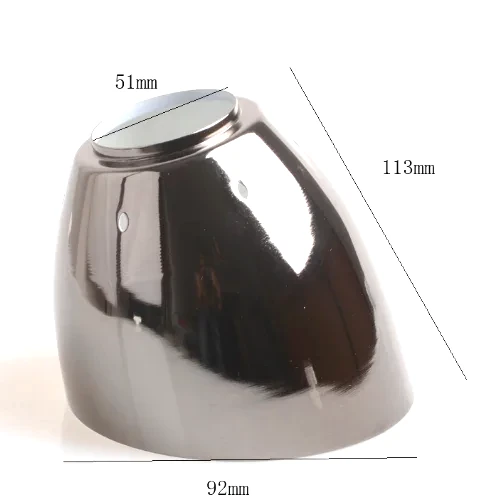
An emery finish is not a coating; it is a mechanical surface, and it has a direction
A polished spun aluminium dome with an emery finishing specification contains two separate processes – spinning, which forms the dome, and emery finishing, which is a specific mechanical surface treatment. The second one is worth understanding properly because “emery” is used loosely and means different things, and because an emery finish has properties that a conventional polish does not: it has a direction, it retains its texture, and it hides surface defects rather than removing them.
We coil-blank and progressively draw, coining on the final station where the print calls for it, and every stage is logged against your part number, on 5-250 T mechanical presses and 250-500 T hydraulic presses with annealing furnaces in line, CNC turning centres for secondary operations, and CMM inspection. Turned secondary features to +/-0.03 mm and as-drawn walls to +/-0.1 mm, with critical dimensions carrying CMM data with the shipment. Carbon steel, 304 and 316 stainless steel, aluminium and brass are all held in stock, with special grades sourced to the drawing when volumes justify. Natural, plated or coated per the print, with the agreed finish logged and finish thickness and adhesion checked on the first article. This page is about the finish, and about the four things that make an emery surface a specification rather than a description.
What an emery finish actually is
Emery finishing is a mechanical abrasion process using an abrasive – traditionally emery, which is a natural aluminium oxide – applied in a controlled way to produce a surface with a fine, even texture. Modern equivalents use synthetic aluminium oxide or other abrasives and the term is often used for a family of satin or brushed finishes. Four properties distinguish it from a polish:
- It has a direction. The abrasive’s travel creates a lay, and the lay runs in one direction. This is the defining characteristic of an emery finish and it is a specification requirement – the lay’s direction has to be stated, because on a dome an incorrect lay direction changes the appearance entirely and because the direction affects how the part wears and how it holds fingerprints.
- It is a texture, not a smoothness. A polished surface is smooth; an emery surface is finely textured. The texture has a measurable roughness, and that roughness is what gives the part its appearance and its grip. Calling both “polished” on a drawing is genuinely ambiguous and needs resolving.
- It removes very little material. A satin or emery finish on a thin drawn dome removes microns, not tens of microns, so it does not change the geometry materially. That makes it a much safer finish on a thin part than a heavy polish.
- It can hide rather than remove defects. A directional abrasive finish follows the surface it is applied to, so it will not remove a dent, a waviness, or a draw line that is deeper than the abrasive’s cut. This is its main limitation and it is the reason a dome with waviness cannot be fixed by finishing – only by coining or by changing the geometry.
Spin forming, and what the dome’s geometry means for the finish
The dome is spun, and spinning’s own characteristics interact with the finish in specific ways:
- Spinning’s tool-mark pattern is directional and circumferential, and an emery finish applied with a different lay direction crosses it. Where the finish’s lay and the spin marks disagree, the surface reads as a cross-hatch rather than a clean satin, and this is a common and disappointing result that is entirely avoidable by specifying the lay direction relative to the dome’s axis.
- A spun dome’s wall is uniform, which is an advantage for a cosmetic part – a drawn dome of the same size would show thickness variation through a directional finish, and a satin surface makes thickness variation more visible rather than less because the texture catches the light at a different angle across a thicker region.
- The dome’s curvature concentrates the abrasive’s contact. On the shoulder of the dome – the region where the surface changes direction – the abrasive’s pressure and its travel change, and that is where a hand-finished or rotary-finished dome will show a difference in texture from the dome’s crown. On a visible part, the shoulder is the region that gets looked at and it should be specified with the same care as the rest.
- The open edge and any flange are finished differently from the dome’s body, because they are accessible to a different process and often are finished separately. The boundary between the two finishes needs to be a designed feature rather than an arbitrary stop.
Coining, and why it comes before the finish
Coining on the final station where the print calls for it is the operation that controls the dome’s flatness and its surface, and it has to come before the abrasive finish for two reasons:
- A finish cannot correct shape. Coining presses the dome to a controlled form and a controlled surface. An abrasive finish applied afterwards removes microns and cannot fix a dome that is out of shape. So the sequence is fixed: shape first, finish second.
- Coining improves what the finish can achieve. A coined surface has a more consistent texture for the abrasive to work on, so the finished result is more uniform from part to part. A dome that is coiled and then emery-finished will be more consistent batch to batch than one that is simply emery-finished.
Aluminium, and what it means for an emery surface
Materials held include carbon steel, 304 and 316 stainless steel, aluminium and brass, with special grades sourced to the drawing when volumes justify. Aluminium is named on this part, and the reasons and the consequences are:
- Aluminium takes an abrasive finish well and it can be brought to a very fine satin. It is softer than steel, so the abrasive cuts faster – which means the process needs more control to be repeatable, and it means an over-finished area will show as a burnished patch.
- Its oxide forms immediately and the abrasive works on it, so a freshly finished surface will be slightly softer and will develop an oxide that changes its appearance over the first days. On a visible part this settling-in effect should be anticipated, and a reference sample should be assessed after a period rather than immediately.
- Fingerprints. A fine satin surface on aluminium shows fingerprints readily, and on a visible dome this is a real complaint. A slightly coarser texture hides them better than a fine one, and an anodised or sealed surface resists them – which is a design trade worth considering on a part that will be handled.
- Aluminium conducts heat well, which on a dome that has to dissipate or avoid heat is usually an advantage, and where the dome is used as a heat spreader the finish’s thermal effect should be considered – a heavily abraded surface with a high roughness has slightly lower effective conductivity than a smoother one.
- 1050 and 3003 are the usual choices for a spun dome because of their ductility, and 5052 or 6061 where strength or machining is required at the cost of formability.
Specifying the finish, which is the whole job on this part
Turned secondary features to +/-0.03 mm and as-drawn walls to +/-0.1 mm is the dimensional structure, and on this part the finish carries the aesthetic and functional requirements. Seven things that belong in the finish specification:
- The process named, not just the result. Rotary abrasive, belt abrasive, vibratory, or hand – and the abrasive type or grit, because “emery finished” covers a range of outcomes.
- The lay direction, stated relative to the dome’s axis. This is the single most important item on the finish specification for a dome.
- Surface roughness as a number, in addition to a reference sample. A satin finish has a roughness range and stating it gives the process a target; the sample settles the appearance.
- A retained reference sample, agreed in writing. On a cosmetic dome this is the specification, and it should be assessed after the finish has settled rather than on the day it is made.
- Which surfaces are finished, and where the boundary between finished and unfinished regions is. The open edge, the flange, and the interior are usually different.
- Whether the surface is sealed or protected after finishing, and with what. A fine abrasive surface on aluminium will oxidise and will hold fingerprints; a clear protective treatment changes the appearance slightly and should be part of the specification.
- Deburring state, stated as a burr limit, because an abrasive finish will not remove a burr and a burr on a hand-held dome is both a quality and a safety issue.
Seamless, uniform wall, and no tooling
Eight things in total, and the weighting is different from most parts in this family because the finish is doing so much:
- The dome’s geometry – diameter, height, wall thickness with its tolerance, and the thickness’s minimum location.
- Dome roundness and concentricity of the open edge to the dome’s axis, because an emery finish makes waviness more visible rather than less.
- Any turned secondary feature, at the tight band – typically a rim, a hole pattern, or a mounting flange – with its position relative to the dome’s axis.
- Whether coining is required, and the flatness or form it is there to achieve.
- The finish process, the lay direction, the roughness, and a retained sample – the four parts of the finish specification.
- Which surfaces are finished and where the boundary is.
- Any protective treatment, and its effect on the appearance.
- Material grade and temper, confirmed in writing, because the temper affects how the surface responds to the abrasive.
Does the part need to be spun at all?
Does the part need to be spun at all? A spun dome is seamless, its wall is uniform, and it is the natural choice for a hemispherical or domed form. But a deep-drawn dome with a good coining operation can be very close in appearance and much cheaper at volume, and on a dome where the seam would not be visible a drawn part is a legitimate alternative. The deciding factors are volume, whether the seam would show, and whether the wall’s uniformity matters functionally. It is worth asking, because spinning is a slower, higher-cost process and the reason to pay for it on this part should be a specific requirement rather than a default.
The engineering calls behind a part like this — draw ratio, wall thinning, radii and trim — each get worked examples in our deep drawn covers guide; the Precision Deep Drawn Parts pages gather the rest of the family.
Specifications
| Item | Polished Spun Aluminum Dome, Emery Finished |
|---|---|
| Brand | AUNOV |
| Designing | Your drawing sets the part – a manufacturability review comes back with the quotation; the same drawing is used for every repeat order. |
| Tooling | Progressive and drawing dies are designed and built in house, so tooling lead time stays under our control, and the charge is refundable against agreed volumes. |
| Samples | Prototype and pre-production samples are provided against the drawing, so the approved first article becomes the gauge reference, and the signed sample is kept for future reorders. |
| Materials | Carbon steel, 304 / 316 stainless steel, aluminium and brass are all held in stock; special grades are sourced to the drawing when volumes justify. |
| Surface finish | Natural, plated or coated as the print decides; the agreed finish is logged, and thickness and adhesion are checked on the first article. |
| Processing | Coil blanking and progressive drawing, coining on the final station where the print calls for it; every stage is logged against your part number. |
| Equipment | Mechanical presses from 5 to 250 T and hydraulic presses 250-500 T, with in-line annealing furnaces, with CNC turning centres for secondary operations and CMM inspection. |
| Tolerance | +/-0.03 mm on turned secondary features, +/-0.1 mm on as-drawn walls; critical dimensions carry CMM data with the shipment. |
| Delivery terms | FOB Ningbo or Shanghai, T/T or L/C, with D/P accepted on repeat business; price breaks tie to annual volume. |
Frequently Asked Questions
What is an emery finish on a spun aluminium dome?
An emery finish is a mechanical surface, not a coating. It has a direction, it retains its texture, and it hides surface defects rather than removing them, so the direction must be specified on the print for the part to be reproducible.
Why is coining done before the emery finish?
Coining on the final station sets the wall and radius to size, and the emery finish then rides a controlled, uniform surface. Finishing before coining would be wiped out by the coining pressure, so the order is fixed by the process.
Can the dome be made without spin forming?
Often yes for shallow geometries, but a true dome with a seamless, uniform wall and no weld seam is the reason spinning is chosen. The drawing decides and we quote both routes so the cheaper one is not missed.
What aluminium grades suit a polished spun dome?
1050, 3003, 5052 and 6061 aluminium, with the temper matched to the forming depth. As-drawn walls are held to +/-0.1 mm and turned features to +/-0.03 mm. The typical minimum order is 1,000 pieces with a 24-hour quotation.
Related Products

Request a Quote for This Part
Send a drawing or sketch — get material advice, tooling cost and a per-piece price within 24 hours (working days).