
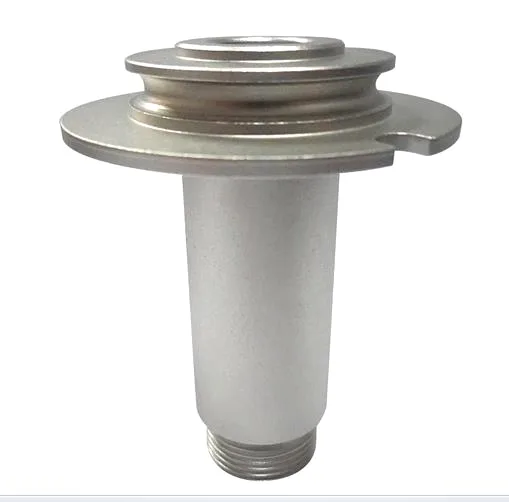
Multi-material is an unusual phrase on a turning page and it is worth being precise about what it means. It does not mean a part made of two alloys, because a turned part is one piece of one alloy. It means a family of turned parts, made from any of the four materials held in stock, and the interesting engineering is not in the machining – it is in choosing correctly among materials that look equivalent on a drawing and behave completely differently once they are mated, heated, or put in a specific environment.
So this page is mostly about the choice, and only partly about how the parts are made. On the making side there is not much to say that is not true for any turned part: turn it from bar or billet, hold concentricity across the operations, inspect on the CMM, and log everything against the part number. The tolerance of +/-0.01 mm on turned and milled features is achievable and the finer bands get confirmed from capability data before quoting, which is the honest position on any feature tighter than the general band.
Choosing between four materials that all machine
Carbon steel, 304 and 316 stainless steel, aluminium and brass are all available. Here is what actually distinguishes them on a turned part.
Carbon steel
Cheap, strong, available in every strength grade, and the default for a part where stiffness and load capacity matter more than corrosion or appearance. Its specific disadvantages on a turned part: it rusts, and a rusting surface changes dimension at the fit and changes appearance; it needs a coating or a plating if it will be exposed; and it has to be plated after machining, which means all the toleranced dimensions need to be stated pre-plate or post-plate, and it means threads need to be cut or masked with care because plating changes them.
304 and 316 stainless steel
Corrosion-resistant, strong, and – on a turned part – significantly harder to machine than the other three. Austenitic stainless steel work-hardens aggressively, has poor chip formation, galls, and demands a rigid setup, sharp positive-geometry tooling, and uninterrupted cutting. It also has the highest springback of the group, which matters on a thin-walled turned feature, and it will not tolerate a dwell.
The 304 versus 316 choice is the chloride question, and it is the same question asked on the stainless steel pump and valve bodies elsewhere in this catalogue: 304 is adequate for fresh water, clean air and mild general service; 316L is required for anything chloride-bearing, coastal, de-icing or marine, and it is the L-grade specifically because it resists sensitisation if the part is welded or heated. On a turned part that will be welded, or that will be in a fabrication process with heat input, the low carbon is not optional.
Aluminium
Light, free-cutting, thermally conductive, and it will not rust – it will oxidise to a white powder and lose appearance. On a turned part it is the easiest of the four to machine and the fastest, and it is the right choice whenever weight or thermal conductivity is a requirement. Its specific weaknesses: a lower modulus, so an aluminium part of the same shape is roughly a third as stiff as a steel one; a higher thermal expansion coefficient, so it changes dimension with temperature more than the others; and poor performance at threads and at fits that need to hold, because it galls and wears.
The alloys available here – carbon steel, 304/316, aluminium and brass – are the four standard ones, and for aluminium the specific grade matters as much as in any other case. 6061 for general duty, 5052 where corrosion is the concern, and 6063 on any part that will be anodised, because 6063 has a lower silicon content and takes a decorative anodise more consistently.
Brass
Easy to machine, corrosion-resistant, conductive, and – importantly for a turned part – naturally self-lubricating enough for threads and fits. Brass is the material for a turned part that needs a thread that will work, a bearing surface, or a finish that looks good without plating. Its specific weaknesses: it is heavy for a small part, it can dezincify in certain water conditions – a real failure mode for brass plumbing and valve components, and it is a question worth asking about if the part carries water – and it is expensive relative to steel.
Once two materials are on the same assembly, the choice stops being about the part
This is the part of the page that matters most, because the failure caused by a wrong material choice here does not appear on the turned part at all – it appears on the assembly, months later, as corrosion in a place nobody was looking.
Galvanic corrosion
Two dissimilar metals in electrical contact in the presence of an electrolyte corrode together, and the more noble metal corrodes very little while the less noble one corrodes preferentially. The area ratio matters enormously: a small aluminium or zinc part in large contact with a steel or stainless steel part corrodes far faster than the reverse, because the small area has a large current density.
The practical list for these four materials:
- Aluminium in contact with steel or stainless steel is a galvanic couple and it is a common one, because steel fasteners in aluminium are the default assembly method. The standard mitigations are a plating or anodised layer on the aluminium that isolates it, a stainless steel or cadmium-plated fastener, a washer that breaks the electrical path, or a deliberate sealant at the joint.
- Brass in contact with steel or aluminium is also a couple, and brass is the more noble of the two, so the steel or aluminium corrodes. Brass fittings screwed into steel or aluminium housings are standard practice and need the same consideration.
- 316L against 304 is a mild couple and generally not a concern; 316L is slightly more noble.
- Stainless Steel in contact with aluminium is the worst of the common cases because the potential difference is larger, and because aluminium’s oxide film, once breached, corrodes rapidly at the breach.
None of this is a reason to avoid a material combination. It is a reason to be deliberate: specify the fastener material, specify whether the joint is isolated, and state whether the assembled condition is a wet or a dry one.
Thermal expansion mismatch
The four materials expand at very different rates, and on a turned part that mates against another turned part, or that presses into a housing, the rate difference produces load as the temperature changes.
- Aluminium against steel in an interference fit. Aluminium expands roughly twice as fast as steel. On a part that is an interference fit on assembly and is also heated in service, the fit will tighten and can crush the aluminium. This is why an aluminium part pressed into a steel or stainless steel housing with a nominal interference is often specified with a reduced interference and a defined assembly temperature.
- Aluminium against brass. The two are close enough in expansion rate that this is usually not a problem, and this pairing is one of the few that is dimensionally comfortable.
- Brass against steel. Close enough that a threaded brass-to-steel joint is a normal, long-lived arrangement – though again the water chemistry question, dezincification, is the real limitation rather than the expansion.
- Any of them against a plastic. Almost always the larger mismatch, and on a turned part in a plastic housing the plastic is nearly always the part that changes.
Where the mating partner expands more than the turned part, the interference loosens with heat; where it expands less, the interference tightens. Neither is necessarily a problem, but one of them usually is, and it is worth stating the service temperature range on the drawing so the fit can be assessed at both ends.
Machining, and the four genuinely different behaviours
Once the material is chosen, the machining note on this part becomes straightforward – turn from bar or billet, hold concentricity across operations, inspect on the CMM. But four behaviour notes are worth carrying because they change how the part is made:
- Stainless steel: no interruption mid-feature, positive rake, rigid workholding, and expect the tool life to be the constraint. Plan the operations so that a stainless steel part is not clamped again after a critical feature is cut, because the re-clamp is where work-hardened material meets a fresh cut.
- Aluminium: the easiest, but prone to chatter on a long slender feature and to burr on a sharp edge. Sharp edges on an aluminium part also become the initiation point for any later corrosion, so a break is functional rather than cosmetic. Set the tool for good chip evacuation – a chip recutting a machined surface on an aluminium part produces a burr and a surface defect in one pass.
- Brass: machines beautifully with sharp tooling, but the lead content matters. Free-machining brass grades take a finer chip and cut faster; architectural-grade brass does not. If the part is a high-volume brass component, specifying the free-machining grade is one of the cheapest cycle-time reductions available.
- Carbon steel: the general case. The specific note is on plating: threads, and any dimension that has to hold a fit, need to be specified post-plate or masked.
Tolerance, and where it should sit
+/-0.01 mm on turned and milled features is achievable and finer bands are confirmed from capability before quoting. On a multi-material family, one thing is worth saying clearly to anyone specifying these parts: the achievable band is not the same across the four materials. A dimension held to the same band on stainless steel and on aluminium will cost differently, will be inspected differently, and in practice will behave differently – because stainless steel’s dimensional stability after machining is worse, because aluminium’s springback and thermal drift are larger, and because brass and steel hold a turned dimension better than the austenitic stainless steel grades do.
So the sensible approach on a family like this is to identify which dimensions are truly common to the function, hold those tight on every material, and allow the material-dependent ones to be stated per grade. Concentricity across a turned feature, thread form, and anything that mates to another part should be common. Lengths and cosmetic diameters can be per-grade.
Inspection and records
- Mill certificates and heat numbers accompany the first article. On a multi-material family this is more than a formality – it is the only way to know, three years later, which alloy a batch actually was, and on a galvanic or a corrosion question it is the first thing anyone will ask for.
- Material identity on every part, where the family mixes materials. Mixed up on the shop floor, the failure is not visible and the assembly will behave as though two similar alloys were mixed.
- Dimensional report on the first article, with the material and the finish recorded against it.
- CMM data on the critical dimensions, which on this part means the ones that mate, not the ones that are largest.
The actual duty: water, air, enclosure, road or chemical
What is the actual duty – is this part in water, in air, in a sealed enclosure, on a road, in a chemical environment – and is it mated to a dissimilar metal? Those two questions, asked before the material is chosen, will determine most of what follows: whether stainless steel is needed over carbon steel, whether 316L is needed over 304, whether the joint needs isolating, and whether the fit has to allow for expansion. A multi-material turned part is the easiest kind of part to buy and the easiest kind of part to buy badly, precisely because the material choice looks like a line item rather than a decision. It is not a line item. On a part that fails from galvanic corrosion or from a fit that tightened in service, the material choice was the failure, and it was made in ten seconds on a drawing. It is worth spending those ten seconds properly.
The CNC Machining Parts range is the parent for parts like this one; tooling logic, finishing options and tolerance notes for the whole family are gathered on its overview page.
Specifications
| Item | Steel Turned Poppet with Flanged Dome Head |
|---|---|
| Brand | AUNOV |
| Designing | Made to your 2D/3D drawings (PDF, DWG, STEP, IGS) – a manufacturability review comes back with the quotation; the approved drawing is kept as the controlled master. |
| Tooling | Our toolroom covers die design, wire-cut EDM and maintenance, so a die can be re-cut against the approved drawing, and the die remains dedicated to your part. |
| Samples | Sample parts are measured and reported before submission, so the approved first article becomes the gauge reference, and later batches are gauged back to the signed sample. |
| Materials | Carbon steel, 304 / 316 stainless steel, aluminium and brass are all held in stock; mill certificates and heat numbers accompany the first article. |
| Surface finish | Surface treatment matched to the duty: plating, coating or polishing; finish thickness and adhesion checked on the first article. |
| Processing | CNC turning from bar or billet, concentricity held across operations; every stage is logged against your part number. |
| Equipment | Turning centres fed from bar, with machining centres for milled features; secondary ops run on CNC turning centres, inspection on the CMM. |
| Tolerance | +/-0.01 mm on turned and milled features; finer bands confirmed from capability data before quoting. |
| Delivery terms | Order ships FOB unless you prefer DDP; payment by T/T or L/C, freight quoted to destination. |
Related Products



Request a Quote for This Part
Send a drawing or sketch — get material advice, tooling cost and a per-piece price within 24 hours (working days).