
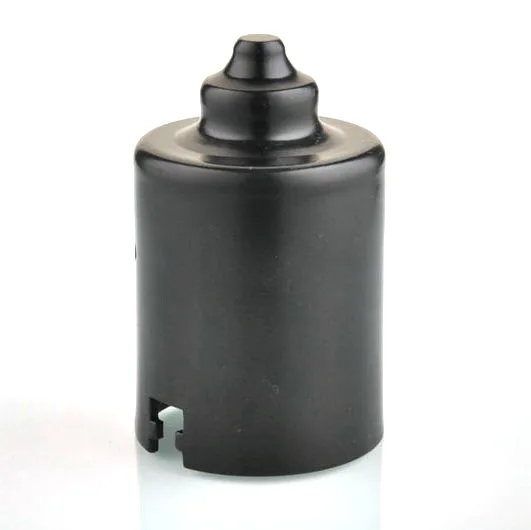
Edges tell the truth: blanking and trimming quality on a wiper motor cap
A wiper motor cap looks simple – a shallow drawn dome or disc with a finished edge – and that simplicity concentrates attention on the one feature that reveals everything: the edge. Blanking quality, trim condition and burr control are where cap programmes succeed or bleed scrap, because there is no deep-draw drama to hide behind. This page covers the edge-quality engineering that separates a cap shipped clean from a cap that generates incoming complaints.
Blanking: where every cap’s quality begins
The cap’s edge is born at the blanking station, and the cut’s character follows the clearance between punch and die. Too tight, and the cut zone work-hardens with a heavy burnish band and early tool wear; too wide, and the fracture zone roughens with a rolled burr that survives every deburring shortcut. The working window for 0.8-1.2 mm steel sits around 5-8% of sheet thickness per side, and – the part buyers rarely see specified – it must hold around the entire perimeter, which means die guidance and press condition are part of edge quality, not just the insert dimensions. A cap blanked on a tired press with worn guides shows elliptical burr distribution: heavy at two opposite points, clean between. That signature is diagnostic, and we read it on every new coil lot.
Burr control: the pragmatic engineering
Burrs on a cap matter for three reasons: they cut gaskets, they jam automatic assembly, and they hold plating solution that blooms as corrosion later. Perfectly burr-free blanking is not an industrial reality, so the engineering question is where the burr goes and how it is treated. Our standard sequence: blank with the burr facing away from any functional face; design the draw so the blank’s burr edge ends up inside the drawn shell where it irons smooth against the punch; and where the edge remains exposed after trimming, run a dedicated deburring pass – tumbling for small caps, a brush or vibratory stage inline for larger ones. The residual burr height specification we hold is under 0.05 mm on functional edges, verified with a profile gauge on a sampling plan. Caps that seal or cap a bearing get the tighter end of that range.
Trim vs. restrike vs. drawing from pre-blanked coil
Caps reach their final edge by one of three routes, chosen by geometry and volume. Direct trim from the drawn shell suits shallow caps: one trim station, a clean sheared edge, done. Restrike-and-trim adds a calibration stroke first for caps whose dome must be dimensionally exact – the edge is cut after the dome is sized, so neither operation fights the other. And for the highest volumes, caps draw progressively from coil with the blank pierced in-strip, so the edge never sees loose-part handling. Each route yields slightly different edge character – progressive-drawn caps show the cleanest edges because every cut happens in guided tooling – and the choice is quoted openly because it moves both tooling and piece price.
Plating reveals what blanking hid
The electroplating line is the honest auditor of edge quality. Burrs plate as nodules; work-hardened burnish bands plate thin; shear fractures plate rough. A cap that passes visual inspection bare often fails the salt-spray coupon at the edge first, for exactly these reasons. Our control closes the loop: edge-quality samples go with every plating batch, the salt-spray evaluation includes the edge explicitly, and any drift in edge character routes back to the blanking station rather than being “fixed” at the plater. Customers reviewing our test reports see the edge called out as a location, not averaged away across the part.
A specification, under a stated limit
Cap diameter, dome depth, sheet thickness and material; the edge’s function (sealed, press-fit, cosmetic, free); finishing spec; volume. The edge function decides the process route more than any other input – a sealing cap and a cosmetic cap with identical dimensions can justify different tooling entirely. First articles run two to three weeks after die approval at small-cap scale, edge-quality samples included as standard.
Can you guarantee a burr-free edge?
Can you guarantee a burr-free edge?
We guarantee a specification – under 0.05 mm on functional edges, verified by gauge. “Burr-free” as an absolute is not a manufacturable promise, and a supplier who makes it has simply not defined their measurement.
Our caps rust at the edge first – whose defect is it?
Usually shared: the blanking character created thin or rough plating zones, and the plating specification did not test the edge. We will section and measure the deposit on a returned cap and tell you honestly which side of the loop failed.
Is a machined-edge cap worth the cost?
For sealing caps on premium motors, sometimes – a machined edge is genuinely flawless and gasket-friendly. For everything else, well-executed shearing plus deburring is indistinguishable at assembly. Send the application; we will not sell machining where tumbling does the job.
Automotive Motor Components is the parent range for parts like this one; the overview page gathers the tooling logic, finishing options and tolerance notes that apply across the family.
Specifications
| Item | Wiper motor cap |
|---|---|
| Brand | AUNOV |
| Designing | Driven by your drawing or a physical sample – samples are reverse-measured into a controlled drawing; the agreed version governs every later batch. |
| Tooling | Die design and toolmaking stay in house, so tooling lead time stays under our control, and the die remains dedicated to your part. |
| Samples | Pre-production samples come with a full inspection report, so any deviation is corrected at sample stage, and the signed sample is kept for future reorders. |
| Materials | Carbon steel (SPCC / DC01), 304 / 316 stainless steel, aluminium, brass and copper – the grade is matched to the duty of this cap. |
| Surface finish | Corrosion protection comes from zinc or nickel plating, housings additionally take powder coating or electrophoresis, and laser etching can be added on request. |
| Processing | Deep drawing runs from coil or blank; in-process annealing keeps wall thinning even, and trim, pierce, form and finish follow. |
| Equipment | Mechanical presses from 5 to 250 T, hydraulic presses 250-500 T, annealing ovens, plus CNC turning and machining centres. |
| Tolerance | +/-0.05 mm on controlled dimensions and +/-0.1 mm on general features; capability studies supplied on request. |
| Delivery terms | CIF or DDP, with FOB available, T/T or L/C, with D/P accepted on repeat business; each volume tier carries its own quoted price. |
Related Products

Request a Quote for This Part
Send a drawing or sketch — get material advice, tooling cost and a per-piece price within 24 hours (working days).