
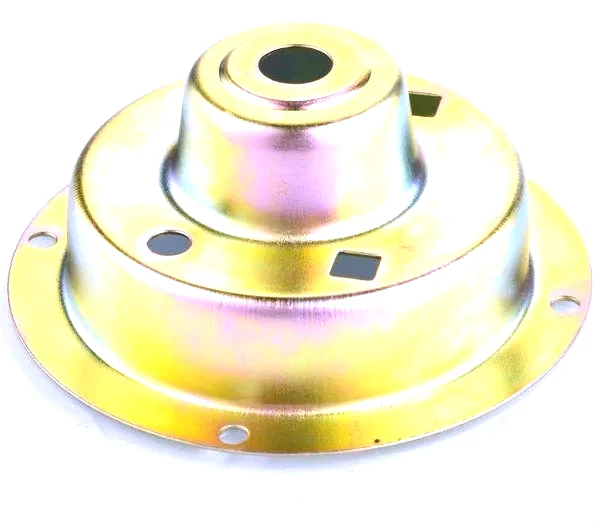
Two environments inside one air-conditioning motor
An electric motor in an air-conditioning system faces a split personality. On one side it can meet refrigerant and refrigerant oil – aggressive solvents that attack the wrong elastomer or coating – and on the other it sits in a duct where condensate forms, drains, and pools for years. A housing that handles only one of those environments will fail in the other, which is why air-conditioning motor housings deserve their own material and sealing logic.
We draw these housings from stainless steel and from coated steel, sized for the motor and its mounting, and this page covers the two environments and the design choices they force.
Refrigerant-side compatibility
Where the housing contacts refrigerant (in a compressor motor or a pressure-side component), the compatibility question is not about the metal – common steels and aluminium are stable against modern HFC and HFO refrigerants – but about everything else on the part:
- Coatings and platings must resist the refrigerant and the oil it carries; a coating chosen for outdoor corrosion may dissolve or blister in refrigerant.
- Seals and gaskets must be compatible with both the refrigerant and the oil, which narrows the elastomer choice; the housing’s groove dimensions must suit that elastomer.
- Cleanliness matters more than usual: residue from drawing lubricant left inside a refrigerant-side housing becomes a contaminant in the circuit, and a contaminated circuit can block a capillary tube or damage a compressor. We clean and, where specified, degrease and document cleanliness on these parts.
Condensate-side corrosion
On the air side, the housing meets condensate – essentially distilled water, but collecting dust, and remaining wet for long periods in a humid climate. The corrosion mechanisms:
| 1.4301 (304) | Good general resistance to condensate; the usual choice for air-side housings. |
|---|---|
| 1.4404 (316L) | Preferred where condensate pools against the metal or where the environment carries chlorides (coastal, industrial). |
| Aluminium | Light and corrosion-resistant in a neutral condensate, but pitting is a risk where the water carries chloride; needs a coating for long life. |
| Coated steel | Cost option; the coating must survive continuous wetting without blistering at the cut edges. |
The detail that catches people out is the cut edge: a coated steel housing corrodes first at the sheared edge where the coating is interrupted. A passivated stainless steel part has no such weak point, which is why it is preferred where the housing stays wet.
Drainage and the pooling problem
A housing that traps condensate will corrode from the inside regardless of material. Two design moves prevent it:
- A drain path – a formed low point or a pierced drain hole so water leaves rather than pools. The hole must be at the true low point in the installed orientation, which we establish with the customer rather than guessing.
- No horizontal ledges – a formed shelf inside the housing holds water. A sloped or relieved internal profile drains itself; a small die change at design time avoids a lifetime of corrosion.
Cold starts, expansion valves, and thermal cycling
A motor that starts cold and runs hot cycles its housing through a wide temperature range, and if the housing is on the refrigerant side the range is wider still. The consequences are the same as in other thermal parts – fits change, seals take a set – but the cold end adds one more: at low temperature some steels become less ductile, and a housing that is already stressed by a press-fit stator or a crimped cap can crack. We keep stresses at the press fits within a band that stays safe at the low end of the operating range, not just at room temperature.
Noise: the housing is part of the product
Air-conditioning noise is a customer-facing quality issue, and a motor housing radiates sound. A housing that is stiff and round radiates less than a thin, oval, or resonating one, and a firm mounting (no rattle clearance) removes a whole class of noise. Where the acoustic target is tight, we work with the customer on wall thickness, rib features, and the mounting interface rather than treating the housing as neutral.
An air conditioning motor housing runs 25 to 90 mm
- Diameter: 25-90 mm.
- Length: 25-120 mm.
- Wall: 0.6-1.6 mm.
- Features: flange or mounting feet, drain hole or path, seal grooves, bearing or stator seats, terminal seat.
Cleanliness for refrigerant-side service
Do you clean the housing for refrigerant-side use?
Yes, with a documented cleanliness level where specified; drawing-lubricant residue is a contaminant in a refrigerant circuit and we treat it as such.
Which material for a coastal installation?
316L or a well-specified aluminium with a coating; a plain 304 part in a chloride-bearing condensate will pit.
Can you form a drain hole in the low point?
Yes, in-die, but we need the installed orientation to place it correctly – a drain in the wrong place is worse than none.
Will the housing pass an acoustic target?
Stiffness and roundness help, and we can add ribs where a resonance is a problem; the target is met with the customer’s mounting, so the interface matters as much as the housing.
Specifying an air-conditioning motor housing
Tell us which side of the system the housing is on (refrigerant, air, or both), the refrigerant and oil type if applicable, the condensate exposure and installed orientation, the temperature range, the cleanliness requirement, and the acoustic target. Those inputs decide the material, the coating, the drain geometry, and the sealing scheme – which is what keeps an air-conditioning housing from corroding through or contaminating the circuit over a vehicle’s life.
This part belongs to our Automotive Motor Components range. The automotive motor components pages collect the process notes, common materials and inspection points behind every product in the family.
Specifications
| Item | Air conditioner DC motor housing – deep drawn |
|---|---|
| Brand | AUNOV |
| Designing | Send drawings, or send a sample to be measured – unusual walls, threads or tolerances are feasibility-checked first; the approved drawing is kept as the controlled master. |
| Tooling | Dies, fixtures and gauges are made in our own toolroom, so the die charge appears as its own quotation line, and maintenance is tracked against the part number. |
| Samples | Prototype and pre-production samples are provided against the drawing, so the approved first article becomes the gauge reference, and later batches are gauged back to the signed sample. |
| Materials | Carbon steel (SPCC / DC01), 304 / 316 stainless steel, aluminium, brass and copper – the grade is matched to the duty of this housing. |
| Surface finish | Zinc / nickel / chrome plating or e-coat, chosen for the environment this housing sees; salt-spray tested to drawing. |
| Processing | Blanking, multi-stage deep drawing with interstage annealing, trimming and piercing, coining, then finishing. |
| Equipment | Mechanical presses from 5 to 250 T, hydraulic presses 250-500 T, annealing ovens, plus CNC turning and machining centres. |
| Tolerance | +/-0.1 mm to +/-0.2 mm general; critical features held to the drawing and verified on the first article. |
| Delivery terms | CIF or DDP, with FOB available, T/T or L/C, with D/P accepted on repeat business; call-off schedules are supported. |
Related Products


Request a Quote for This Part
Send a drawing or sketch — get material advice, tooling cost and a per-piece price within 24 hours (working days).