
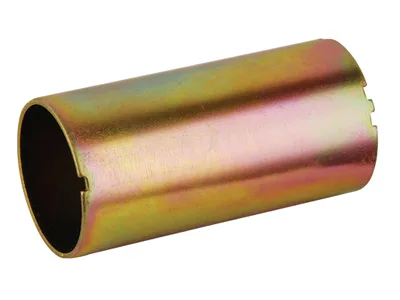
Why a fuel pump motor housing is not just another motor can
A fuel pump electric motor housing looks like any other small motor can – a drawn cylinder with a closed end, a bearing seat, and a terminal exit. What makes it its own engineering problem is where it lives: submerged in fuel, inside a tank, for the life of the vehicle, with the fuel itself as the coolant and the electrical insulation barrier at the same time. Every material and tolerance decision has to survive contact with gasoline, ethanol blends, or diesel, plus the thermal cycling of a pump that runs hot and then sits in cold fuel.
We draw these housings from stainless steel or from aluminium, depending on the pump architecture and the fuel chemistry, and the choice is not cosmetic. It determines corrosion behaviour, galvanic risk with the pump’s other metal parts, weight, and whether the housing can be welded or crimped to the end cap.
Fuel compatibility drives the material choice
The single most common design mistake we see is specifying a housing for gasoline and then having the customer switch the vehicle to E85 or high-ethanol fuel without revisiting the housing. The relevant behaviours:
| 1.4301 (304) | Good general resistance; widely used for gasoline and diesel. Ethanol at high concentration can attack some elastomers more than the steel. |
|---|---|
| 1.4404 (316L) | Better resistance to acidic fuel contaminants and to the water that ethanol blends absorb; preferred for flex-fuel. |
| Aluminium 3003 / 5754 | Light, good for a housing that is not the pressure boundary; needs a coating or a compatible pairing to avoid galvanic corrosion against steel internals. |
| Coated steel | Cost option where the internal surface is protected; the coating must survive the fuel and any dissolved water. |
Ethanol blends are hygroscopic: they pull water out of the air, and that water pools at the bottom of the tank where the pump sits. A housing material with a marginal corrosion margin will pit exactly where the water layer is. This is why we push flex-fuel programs toward 316L rather than accepting 304 on cost.
No sparks, no static: the safety requirements
A motor inside a fuel tank must not produce an ignition source, and the housing is part of that chain. Two design rules follow:
- Every metal part must be electrically bonded. The housing, the end cap, the stator, and the pump body are all tied to a common ground path so static charge cannot accumulate and arc. The joint between the housing and the end cap is a grounding joint as much as a mechanical one, so a non-conductive coating on the mating surface is a defect, not a finish choice.
- No loose internal clearances that can generate a spark. A drawn housing with a slack fit to the stator lets parts vibrate and fret; the fretting removes the bond and, in principle, can spark. We hold the stator bore to a fit that keeps the assembly rattle-free.
These requirements are why we treat the housing-to-cap joint as a controlled characteristic and document the bond resistance where the customer’s safety case requires it.
The housing as a pressure and sealing boundary
Depending on the pump type, the housing is either a fuel-wetted shell inside the tank or, in some designs, part of the pressurised boundary. The sealing features we form or provide for:
- End-cap crimp or weld lip – a rolled or coined edge that takes a crimped cap or a laser weld. A rough or oval lip produces a leak or a weak bond.
- Terminal exit – feed-throughs for the motor leads must be sealed both for fuel and for electrical isolation, usually by a bonded header; the housing provides the seat and the concentricity for that header.
- Bearing seat – the closed end or an internal shoulder locates the motor shaft bearing; the seat concentricity and roundness set the rotor air gap and the noise level.
A housing whose bearing seat is out of round by more than a few hundredths of a millimetre will produce a pump that whines or wears its bearing early – the pump runs, but it does not last.
Cooling by immersion and the thermal case
A submerged pump is cooled by the fuel around it, so the housing’s job is partly thermal. A stainless steel housing has a lower thermal conductivity than aluminium, which matters when the pump runs dry or hot. We size the wall so the housing does not act as a thermal blanket, and where weight and thermal margin both point to aluminium, we help the customer manage the galvanic pairing with a coating and an insulated interface to the steel internals. Running a pump dry – low tank, high load – is the worst case, and the housing must not deform or lose its seal during the resulting temperature spike.
In-tank fuel pump housings run 25 to 55 mm across
- Diameter: 25-55 mm, matching common in-tank pump sizes.
- Length: 40-120 mm; deeper housings use a two-stroke draw.
- Wall: 0.6-1.5 mm stainless steel, thicker for aluminium to keep stiffness.
- Base features: bearing seat, port, or mounting spigot, formed or coined in-die.
- End: open for a crimp/weld cap, or formed with an integral end and a separate brush/terminal plate.
Galvanic isolation between aluminium and steel
Can you guarantee no galvanic corrosion between an aluminium housing and a steel pump body?
No – galvanic risk is a system property. We help you manage it with coatings and insulated interfaces, but the pairing has to be designed, not assumed.
How do you keep the stator bore round over a long housing?
Through a redraw over a long guided punch and a final sizing pass; length-to-diameter above 3 needs that discipline or the bore drifts.
Is the housing WPC or low-sulfur gasoline compatible?
The steel grades we use are; the coatings and elastomers are the parts that need checking against the specific fuel, and we will flag that in the quotation.
What drives cost?
Material grade (316L over 304), the number of secondary features (bearing seat, port, terminal seat), and annual volume that justifies the progressive die.
Specifying a fuel pump housing
Tell us the fuel type and ethanol content, the tank environment (submerged or external), the bearing and stator interfaces, the cap method, the terminal arrangement, and the temperature extremes. Those inputs determine material, wall, draw route, and the sealing features – and getting them right at quotation is what keeps a pump housing from becoming a field-campaign part three years later.
Automotive Motor Components is the parent range for parts like this one; the overview page gathers the tooling logic, finishing options and tolerance notes that apply across the family.
Specifications
| Item | Fuel pump electric motor housing |
|---|---|
| Brand | AUNOV |
| Designing | Driven by your drawing or a physical sample – a manufacturability review comes back with the quotation; changes are priced before they are made. |
| Tooling | Tooling is built and held under your part number, so the die charge appears as its own quotation line, and first-article timing is measured from the tooling start date. |
| Samples | Pre-production samples come with a full inspection report, so any deviation is corrected at sample stage, and later batches are gauged back to the signed sample. |
| Materials | Carbon steel (SPCC / DC01), 304 / 316 stainless steel, aluminium, brass and copper – the grade is matched to the duty of this housing. |
| Surface finish | Corrosion protection comes from zinc or nickel plating, housings additionally take powder coating or electrophoresis, and laser etching can be added on request. |
| Processing | Blanking, multi-stage deep drawing with interstage annealing, trimming and piercing, coining, then finishing. |
| Equipment | 5-250 T mechanical and 250-500 T hydraulic presses, annealing ovens, and CNC turning and machining centres for secondary work. |
| Tolerance | +/-0.1 mm to +/-0.2 mm general; critical features held to the drawing and verified on the first article. |
| Delivery terms | FOB Ningbo or Shanghai, T/T or L/C, with D/P accepted on repeat business; repeat orders reuse the approved first article. |
Related Products


Request a Quote for This Part
Send a drawing or sketch — get material advice, tooling cost and a per-piece price within 24 hours (working days).