
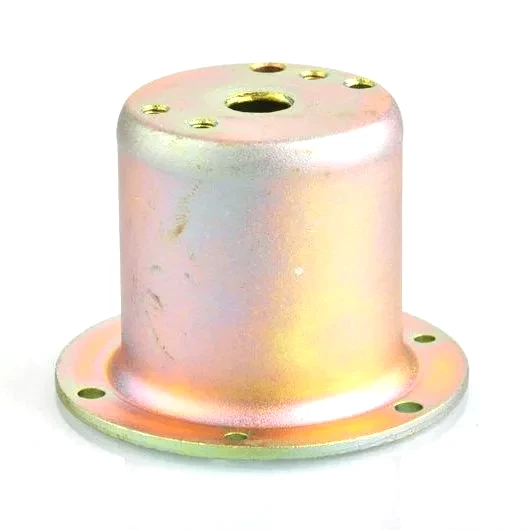
One shell instead of five parts: the consolidation argument
Older wiper motor designs assembled their wiper motor shell from pieces: a rolled tube, a welded end, a brazed flange, each with its own tolerance stack and its own failure modes. Deep drawing collapsed that bill of material into one stroke. A modern drawn shell replaces the tube, the end closure and often the flange in a single piece of steel with no welds to crack, no braze joints to corrode, and no tolerance stack between them. For a buyer, that consolidation shows up as fewer suppliers to audit, fewer assembly operations at the motor plant, and a part whose leak path simply does not exist.
How deep a shell can go in one stroke
The practical single-stroke limit sits at a draw ratio of about 1.9-2.0 for steel in the 0.8-1.5 mm band. Wiper shells that need more – long canisters for heavy-truck motors, for instance – go two-stroke: a first draw to roughly 60% of final depth, then a redraw that walks the wall down the rest of the way without an anneal. The redraw die costs one more station and buys depth that a single stroke cannot reach. We decide this in simulation before tooling steel is cut, because the economics differ sharply: a two-stroke shell runs a few cents more per piece and carries a taller die, while a single-stroke shell pushed past its limit carries an unpredictable scrap rate that no quote can absorb honestly.
Ironing: when the wall needs to be thinner than the blank
Some shell designs want a wall thinner than the starting blank – lighter part, tighter magnet gap, better flux path. Wall ironing does this: the drawn shell is pushed through a ring that shaves a controlled few percent off the wall, lengthening the shell as it thins. Ironing steel for wiper shells is routine at 10-20% wall reduction in one pass, and it leaves a burnished inner surface that takes paint or plating beautifully. The trade-offs are die wear (ironing rings are consumables, re-polished on a stroke count) and work hardening, which is why we specify low-carbon grades with a defined elongation band when ironing is in the process – a hard batch that draws fine will still tear in the ironing ring.
Weight without stiffness loss
Consolidated shells raise a design question: with no welded seams to reinforce, where does stiffness come from? The answer is geometry, deliberately placed. A flanged open end adds a stiff rim exactly where the end-bell bolts on. A gentle wall taper – a fraction of a degree – resists ovalling better than a straight cylinder of the same weight. And where a customer needs local stiffness at a mounting point, a shallow emboss formed in the redraw station adds rigidity at near-zero material cost. We have shipped shells 15-20% lighter than the welded assemblies they replaced, with stiffer mounting behaviour measured on the customer’s vibration rig.
The shell as a machining blank
Motor plants increasingly buy shells semi-finished: drawn, trimmed, then machined on the bearing seat and end face at their own line. We support both hand-offs. Supplied finish-machined, the shell arrives with its seat and face at final tolerance; supplied as-drawn, it arrives with a coining-sized seat and a documented machining allowance of 0.3-0.5 mm so the customer’s cut is clean and consistent. The choice is a line-capacity question on their side, and we quote both routes because the tooling differs only in the sizing station.
Dimensionally yes; acoustically, no
Shell drawing with depth, diameter, wall and material; note any ironing requirement or wall-thickness target; state whether the bearing seat is finished by us or machined by you; give annual volume. From that we return the stroke count verdict, tooling quote and piece price, and first articles in three to four weeks after die approval.
Surface quality along a long wall
Deep shells stretch the draw over more wall than shallow parts, and surface quality follows the metal’s journey: score marks from a tired draw radius, orange peel from coarse grain, and stretcher strain from a steel batch at the wrong aging point all become visible on a long wall where a short shell would hide them. We control this the boring way – polished radii on a stroke count, grain size specified on the mill certificate, and skin-passed sheet for cosmetic programmes. A buyer who has ever rejected a shipment over visible shell marks knows exactly what those three line items prevent.
Can you match a roll-formed and welded shell?
Can you match our current shell that was roll-formed and welded?
Dimensionally yes, and the drawn version will be more consistent – roundness especially, since a rolled shell carries the seam’s stiffness anomaly forever. We ask for your current part as a dimensional reference and match the interface features exactly.
Is a drawn shell more expensive than a welded tube?
At low volumes, sometimes. Past a few thousand pieces a year the die amortizes and the drawn part wins on piece price, scrap, and the disappearance of the weld-quality problem.
How much lighter can you make our shell?
Depends on where its current weight hides – usually in over-thick walls compensating for seam weakness. Send the drawing; simulation will show the honest floor, typically 10-20% on first pass.
Automotive Motor Components is the parent range for parts like this one; the overview page gathers the tooling logic, finishing options and tolerance notes that apply across the family.
Specifications
| Item | Wiper motor shell |
|---|---|
| Brand | AUNOV |
| Designing | Your drawing sets the part – DFM notes are returned before any tooling is cut; the same drawing is used for every repeat order. |
| Tooling | Tooling is built and held under your part number, so tooling lead time stays under our control, and the charge is refundable against agreed volumes. |
| Samples | First-article samples ship with a dimensional report and material certificate, so any deviation is corrected at sample stage, and the signed sample is kept for future reorders. |
| Materials | Stock covers carbon steel, 304 / 316 stainless steel, aluminium and brass; the final grade is fixed with the drawing review. |
| Surface finish | Zinc or nickel plating guards against corrosion; housings can take powder coating or electrophoresis, and laser etching is available on request. |
| Processing | Blanking, multi-stage deep drawing with interstage annealing, trimming and piercing, coining, then finishing. |
| Equipment | Mechanical presses from 5 to 250 T, hydraulic presses 250-500 T, annealing ovens, plus CNC turning and machining centres. |
| Tolerance | +/-0.05 mm on controlled dimensions and +/-0.1 mm on general features; capability studies supplied on request. |
| Delivery terms | FOB Ningbo or Shanghai, payment by T/T or L/C, quoted in USD or EUR; call-off schedules are supported. |
Related Products


Request a Quote for This Part
Send a drawing or sketch — get material advice, tooling cost and a per-piece price within 24 hours (working days).