

A stainless steel probe for BBQ and meat cooking is a food-contact part that lives in a hostile thermal environment and gets cleaned in a dishwasher, and it is worth writing about because it is judged by three different masters: the food-safety requirement, the thermal requirement, and the kitchen’s mechanical reality.
Precision tube drawing, cut to length and turned to the print, on 5 to 250 tonne presses with decoilers and coil feeders, vibratory finishing lines and a full in-house toolroom, at +/-0.02 mm on turned diameters with the wall held to the agreed band. So the tight band is on the machined ends and the wall is banded – and on this part the wall is a product-contact surface whose thickness decides both how fast the probe reads and how robust it is when dropped into a grill.
The three requirements, and which one wins
- Food contact. The probe’s wetted portion is in contact with food, so its material and its surface condition are regulated requirements, not preferences. Stainless Steel is the usual answer, and where the food is acidic or salty the grade matters.
- Thermal. The probe will be in a grill at two hundred degrees or more, and it will be pulled out and plunged into cold water. That is a severe thermal cycle and it is the reason the probe’s material, its bonding, and its wall all matter more than on a process probe.
- Mechanical, and unappreciated. The probe is dropped into a grill, lifted out by a handle, rested on a counter, and cleaned in a dishwasher. It will be dropped at least once. That is a shock load on a thin tube with a fragile element inside.
Which one binds depends on the design. The food-contact requirement usually sets the material; the thermal requirement usually sets the bonding and the wall; and the mechanical requirement usually sets the tip’s construction and the handle’s strength.
Thermal shock, which is the failure that actually happens
A probe in a barbecue sees a temperature that changes very fast in both directions – heating at the start of a cook and cooling the moment it is lifted, and a grill’s metal parts radiate heat so the probe’s tip can be in a radiant hot spot while its handle is in cold air.
- The tip’s material and the element’s mounting decide whether it survives. A glass or ceramic bead in a tip that is bonded to metal will see a thermal gradient across itself, and glass cracks. A metal sheath element is more robust and is the usual answer for a kitchen probe.
- And a filled tip is more robust than a bare one for the same reason that filled thermowells last longer: the fill spreads the gradient. So the product’s thermal-shock resistance is a design decision about the tip’s construction and it is worth stating.
- Where the probe’s body is stainless steel and the tip is a different material – a plated or a sheathed tip brazed to a tube – the joint is at the point where the thermal gradient is steepest, which is where it will fail. So the tip-to-body joint’s construction matters more than either material alone.
Food contact, and where it actually bites
- The material. 316L where the food is acidic, salty or both – which in a kitchen covers tomato, citrus, vinegar, salt and curing. 304 is defensible for a short-contact product but 316L is the normal choice on a probe that will see all of those.
- And the surface condition, which is a documented requirement. On a product-contact surface, the passivation record is part of the deliverable, and the surface’s roughness with a convention matters because that is what cleanability is assessed against.
- And the joint at the handle. This is the part that is usually missed. Where the probe’s tube enters the handle, there is a seal, and that seal is between a wetted and an unwetted section on a product that will be washed. A food probe’s handle joint is a hygienic requirement, not a mechanical one, and it is where most of these products fail their intended life – water migrating into the handle’s electronics over months of dishwashing.
- And the drain path. A probe that cannot drain holds water against its own body. On a food probe this is a hygiene question and not a durability one, and where the handle is sealed the design has to have a relief somewhere.
The handle, where a kitchen probe differs from an instrument probe
- Thermal isolation. The handle must not carry the grill’s heat to the hand. On a probe pulled straight out of a two-hundred-degree grill that is a real requirement, and it means a long enough stem or a genuine air gap between the tip and the handle.
- Grip when wet and hot. A stainless steel or plastic handle that is smooth will be dropped, and a dropped probe on a tiled floor is the mechanical failure case. So the handle’s shape or its texture is functional.
- And the cable’s exit, which is the same weakest point as on any food probe – a seal at the cable entry has to survive the dishwashers and the pulling, and it is the seal that decides the product’s life.
Wall thickness, and the drop case
The wall held to an agreed band, and on this part the wall’s requirement comes from three places at once.
- Thermal, in that a thin wall responds quickly, which on a kitchen probe is what the user wants – they want to read the temperature now.
- Structural, in that a thin wall deforms easily, and a probe dropped on its tip will bend or crease it. A dent on a probe’s tip means the tip no longer sits in the meat’s surface properly and the reading changes.
- And hygienic, in that the wall’s surface is the product contact and a thin wall has a higher surface-to-volume ratio and is more sensitive to surface condition.
So the wall is a compromise between response and robustness, and on a kitchen probe where the user is going to drop it, robustness usually wins over the last few degrees of response.
A wetted surface on a food probe is documented, not assumed
Plating, coating or polishing to suit the drawing, with masking and laser marking available. Three items, and on this part the third is the one that gets missed.
- The wetted surface, passivated and documented. On a food product this is a release characteristic and it is inspected as one.
- Any thread or spigot, unmasked – and on a probe with a handle that screws on, that thread is inside the wetted boundary’s vicinity and it needs to be cleanable.
- And the area around the handle’s joint, which on a food product should be smooth and drainable rather than being a crevice. This is a surface-design requirement that belongs on the drawing because a crevice at a handle joint is a hygiene finding and it is created by geometry, not by a finish.
A diameter that is a handle’s fit should be stated as a fit
+/-0.02 mm on turned diameters with the wall held to the agreed band, and capability checked on the first article. Four items.
- Turned diameters: size, roundness, concentricity, at the tight band – and where a diameter is a handle’s fit it is a fit and should be stated as one.
- Wall thickness, at a band that reflects the draw and a minimum where the drop case matters.
- Length, as a coordination and functional dimension, because on a probe the immersed length is the immersion depth and it is the accuracy.
- And the requirements that are not dimensions: the food-contact material and its passivation record, the handle joint’s sealing and drainability, the cleaning regime, the insertion depth, and the response time. On a kitchen probe those five are the specification and the tolerances only cover the metal.
A kitchen probe is verified by its response at a stated immersion depth
Capability checked on the first article before the run continues, with in-process checks between stages. On a food probe the inspection has one item that outranks the rest.
- A functional response check at a stated immersion depth, in a stated medium. On a kitchen probe this is the only test that verifies the accuracy claim with its condition attached, and a kitchen probe specified as accurate to a degree and immersed to half its length is a probe with an unstated error of several degrees.
- Surface cleanliness on the wetted surface against an agreed standard, verified rather than assumed.
- Dimensional: the turned diameters at the tight band, the length, and the wall’s band.
- And a check that the handle joint does not leak on a sample, because it is the part that decides the product’s life and it is not visible in any dimensional result.
How deep will a user actually push it into the food, and how are they going
How deep will a user actually push it into the food, and how are they going to clean it? Two questions that are behavioural rather than technical and that determine the part. A user who pushes a probe only 20 mm into a thick piece of meat is measuring near the surface and getting a reading that is biased by the grill’s radiant heat, not the food’s core temperature – and no improvement to the probe fixes that. And a user who washes it under a tap and puts it in the dishwasher is running a thermal cycle and a water ingress case that the design has to expect. Both of those suggest that the product’s instructions matter as much as its tolerances, and that on this kind of part a one-line drawing note about immersion depth and a handle joint designed to drain are worth more than a tighter band on a diameter nobody can measure in a kitchen. There is also a third question that is worth raising on a food probe because it is decided by the customer and not by the probe’s maker: is this product going into a food-contact application where a declaration and a material certificate are required? Because on a food probe that requirement turns the material question from engineering into documentation, and the documentation has to exist before the first production run rather than being assembled afterwards.
This part belongs to our Deep Drawn Tubes & Sleeves range. The deep drawn tubes & sleeves pages collect the process notes, common materials and inspection points behind every product in the family.
Specifications
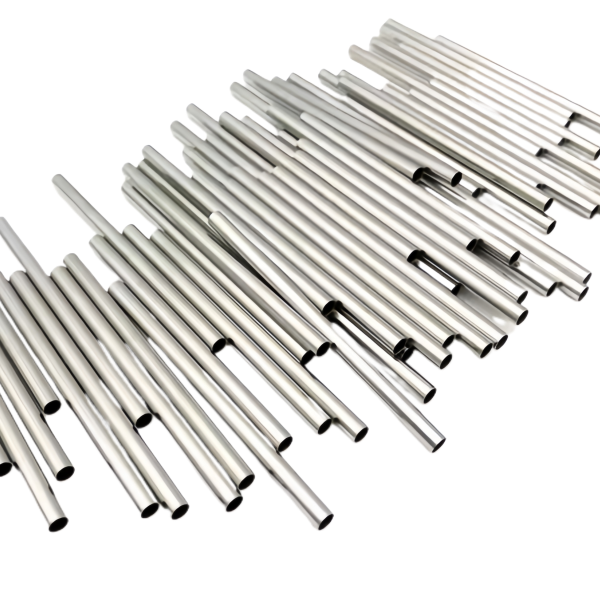
| Item | Stainless Steel Open Probe Tubes, Six-Piece |
|---|---|
| Brand | AUNOV |
| Designing | Made to your 2D/3D drawings (PDF, DWG, STEP, IGS) – unusual walls, threads or tolerances are feasibility-checked first; revisions are re-quoted once rather than silently absorbed. |
| Tooling | Dies, fixtures and gauges are made in our own toolroom, so the die charge appears as its own quotation line, and the charge is refundable against agreed volumes. |
| Samples | Pre-production samples come with a full inspection report, so the approved first article becomes the gauge reference, and mass production is gated on that approval. |
| Materials | Standard stock: carbon steel (SPCC / DC01), 304 / 316 stainless steel, aluminium, brass; the final grade is fixed with the drawing review. |
| Surface finish | Plating, coating or polishing to suit the drawing; masking and laser marking available where needed. |
| Processing | Precision tube drawing, cut to length and turned to the print; in-process checks sit between stages, not only at the end. |
| Equipment | Mechanical presses 5-250 T, decoilers and coil feeders, vibratory finishing lines and a full in-house toolroom. |
| Tolerance | +/-0.02 mm on turned diameters, wall held to the agreed band; capability is checked on the first article before the run continues. |
| Delivery terms | Freight is quoted to your door in FOB, CIF or DDP terms, payment by T/T or L/C. |
Related Products
Request a Quote for This Part
Send a drawing or sketch — get material advice, tooling cost and a per-piece price within 24 hours (working days).