
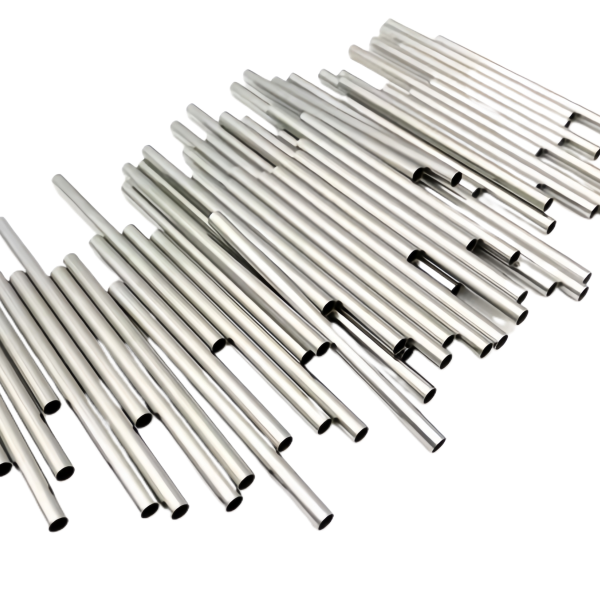
The Stainless Steel Capillary Tube Bulk Assortment is a kit: multiple bore sizes, cut lengths and wall configurations of 304 capillary, sorted, verified and packed as one managed item. This page sets out what an assortment actually contains, how mixed sizes are kept traceable when twenty SKUs share a box, and the verification that makes a mixed kit trustworthy part-for-part.
What an assortment is: kit structure, size steps and use case
A bulk assortment exists because engineering teams, labs and low-volume production lines need many capillary sizes at few parts each – and the alternative is a purchase order per size, a tooling record per size, and a receiving inspection per size. An assortment collapses that overhead into one managed item: a defined menu of bore and OD combinations, cut to standard lengths, produced on the same plug-drawing process as our dedicated capillary programs, and shipped as a labeled set. The engineering content of the kit is the menu itself: which size steps to include, and how the steps are spaced.
We design kit menus around the sensitivity of the flow function. Because capillary flow scales with bore diameter to the fourth power, evenly spaced diameters produce wildly uneven flow steps – a kit with bores at 0.5, 1.0, 1.5 and 2.0 mm does not cover a flow range evenly; the small sizes cluster at the bottom of the flow scale and the big ones crowd the top. Where the kit serves flow selection, we space the menu in approximate fourth-root steps so consecutive sizes cover a consistent flow ratio – that is the difference between a kit that lets you dial in a restriction and a kit that offers four versions of “almost the same”. Typical structure we supply:
- Flow-selection kits – bores stepped for constant flow ratio, walls sized proportionally so each size draws and handles well.
- Fabrication-stock kits – even size steps in OD with proportionate bores, serving workshops that bend, flare and solder their own assemblies.
- Instrument-repair kits – built to a customer’s device list, with lengths matched to the actual instrument spares rather than generic stock lengths.
The kit menu is a document we hold under a kit part number, so a reorder reproduces the same sizes, lengths and labels – and a menu revision is a deliberate event, not a substitution at the shelf.
Twenty SKUs in one box: sorting, labeling and traceability
Mixed-size kits are where traceability either exists or is theater. When bores differ by 0.1 mm between adjacent sizes, no receiving dock is going to sort them back out with a ruler; if the kit’s segregation fails anywhere between our final inspection and your drawer, the individual sizes are unverifiable without a gauge set. So the kit is engineered as an identity system, and the system has to fail loudly rather than silently:
- Segregation by channel. Each size ships in its own labeled channel or vial – never a loose mix – with the label carrying size, length, count and the kit lot number.
- Label verification at pack. The packer checks each channel against the kit menu with the physical parts in front of them – the verification event is “part matches label”, not “label matches paperwork”.
- Gauge-proof at source. For kits whose adjacent sizes differ by small steps, a sample from each channel is pin-gauged at pack-out, so a mis-sized channel cannot be born at the packing bench.
- Lot-level records. The kit lot ties back to the drawn lots per size: coil certificate, plug identity and anneal records per size, archived under our ISO 9001 system against the kit part number.
The reason for this stubbornness is simple economics: an assortment is bought to avoid per-size administration, and a single mislabeled channel recreates that administration for the whole kit plus a quality investigation. A few minutes of pack-stage verification is the cheapest insurance in the entire chain.
Standard lengths versus cut-to-order: where the cost actually sits
Assortments are a cost structure, and understanding it helps in choosing between a kit and dedicated production. In capillary, the cost per part is dominated by setup – tooling changeover between plug sizes, annealing batches, straightening fixtures – and barely by material. A kit amortizes each size’s setup across the kit’s build schedule rather than across a single order, which is exactly why per-piece prices in an assortment beat the sum of single-size orders for small quantities. The structure has a boundary, and it falls at repetition: once a design settles on one capillary and consumption rises past a few hundred pieces, a dedicated run of that size – with its own tooling record and batch flow – becomes cheaper per part than kit channels, and the engineering answer migrates from assortment to production part.
Standard lengths in kits are chosen for utility rather than convenience: lengths in the 100 to 300 mm band cover most fabricator and instrument uses, and we avoid mixing very short and very long channels in one kit because their handling and packaging requirements differ – a 600 mm channel demands a rigid carrier, which makes the whole kit bulky for the sake of one size. Kits needing long channels ship in tube carriers with end protection, and that packaging decision is made at menu design, not at the shelf.
Where a customer wants cut-to-order lengths inside a kit structure – device-specific spares, for instance – we hold the length list under the kit part number and cut to it per build, so the kit remains one managed item while the lengths are exactly right. The alternative, supplying stock lengths for the customer to cut, silently transfers burr control and cleanliness to whoever owns the cut-off wheel, and capillary cleanliness is not a problem that survives an unmanaged transfer.
Packaging that protects 0.4 mm walls to your bench
Assortment packaging has a functional job beyond containment: the kit has to arrive with every channel’s geometry and cleanliness intact, and with the identity system visible. Thin-wall capillary is damaged in transit by exactly three things – crushing, point contact between parts, and end damage where channels meet lids or dividers. The pack design answers all three structurally: rigid outer carton sized so channels cannot shift; each channel fully enclosed so no part-to-part contact is possible; and channel end clearance so a dropped carton lands on the carton, not on a bore end. For long-channel kits, the carrier tube is the packaging, with caps that double as dirt seals on the bore ends.
Cleanliness rides the same structure. Channels are packed after the final flush sequence, and they stay closed until opened at your bench – a channel that can be casually sampled and returned is a channel that will eventually carry shop dust into a flow path. On kits serving instrument work, we add end plugs on the bores themselves for the smallest sizes, where even a single particle matters relative to a 0.5 mm bore.
The label system is part of the pack engineering: each channel label shows size, length and count in a format that survives handling – not a hand-written code. The outer carton carries the kit part number, lot and menu revision, so a reorder conversation can reference the exact configuration received last time, and a discrepancy investigation has a lot to point at rather than a memory.
How we verify every size in a mixed assortment ships correct
Verification on kits runs per size, per lot, and then again at pack-out – the acceptance logic being that a kit is only as trustworthy as its least-verified channel:
- Per size, at draw – bore plug-gauged at the tolerance band, sample-plan pin measurement, OD and wall on the sample plan, flush and gauge-pass sequence in the routing.
- Per size, at cut – length against a hard stop with the sample plan verified, end condition confirmed at 10x, chamfer or edge-break recorded where the menu specifies it.
- First article per menu – the first kit built on a new menu gets full first-article treatment per size: measured bore, sectioned roundness and finish check, and a sectioned-bore photo archived against the menu revision.
- At pack-out – channel-by-channel label verification against the menu with parts in hand, sample pin-gauge check on tightly stepped sizes, and count verification per channel.
- Records – a kit lot file assembling the per-size records, flush and cleanliness evidence, and the menu revision, all bound to the kit lot number in the quality file, so a reorder rebuilds the same kit from the same documentation.
Tell us what the kit is for – flow selection, fabrication stock, instrument spares – and the menu will be proposed with the size steps, lengths and verification plan built around the actual job the assortment has to do.
Deep Drawn Tubes & Sleeves is the parent range for parts like this one; the overview page gathers the tooling logic, finishing options and tolerance notes that apply across the family.
Specifications
| Item | Stainless Steel Capillary Tubes Bulk Assortment |
|---|---|
| Brand | AUNOV |
| Designing | Share your print, or send a part to be measured, you get a DFM review together with the quotation. |
| Tooling | Tooling designed and cut in house, held under your part number. |
| Samples | First-off samples of the tube are sent with dimensional data plus material certs. |
| Materials | 304 / 316 stainless steel is the primary stock for this part, alongside carbon steel (SPCC / DC01), aluminium, brass and copper, per the drawing. |
| Surface finish | Zinc, nickel or chrome plating, e-coat, powder coat, anodising or passivation, per the drawing. |
| Processing | Deep drawing in stages, in-line annealing where needed, pierced and machined on the same floor. |
| Equipment | Mechanical presses 5-250 T, hydraulic presses 250-500 T, CNC cells plus a temperature-controlled CMM room. |
| Tolerance | +/-0.1 mm on as-drawn features, with machined features to +/-0.03 mm. |
| Delivery terms | FOB as standard, DDP available for EU and US destinations, payment T/T or L/C, D/P for repeat accounts, blanket orders and call-offs supported. |
Related Products


Request a Quote for This Part
Send a drawing or sketch — get material advice, tooling cost and a per-piece price within 24 hours (working days).