
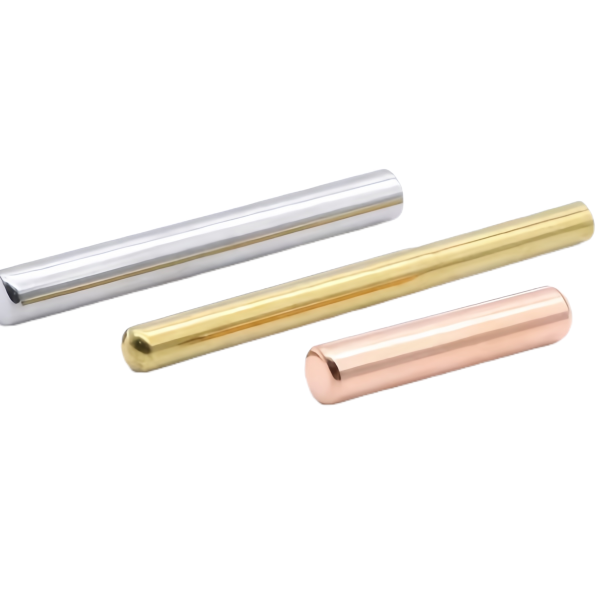
Three metals, one drawing shop: what changes per material
Steel, brass and copper precision drawn tubes come from the same benches and the same general process – a blank drawn through a die, over a plug where the bore matters – but the three metals negotiate with the process differently, and a drawing-office that treats them as interchangeable produces specifications that fit none of them well. We draw all three in carbon steel (SPCC/DC01 or 1045-class for heavier walls), brass (CW614N/C36000 and CW509L/C26000 families), and copper (C11000 electrolytic tough pitch as the default), and the per-material facts that drive our schedules are worth having on the drawing side of the conversation.
The core differences, in the order they bite:
- Work hardening rate. Copper barely work-hardens – it can take pass after pass with long intervals between anneals, and it forgives an aggressive schedule. Brass work-hardens moderately, and its zinc content introduces a season-cracking (stress-corrosion) risk if heavily cold-worked brass is stored without a stress-relief anneal in an ammonia-adjacent atmosphere. Steel work-hardens fastest of the three, and carbon-steel schedules anneal most often. The pass counts differ by up to a factor of two for the same geometry across the three materials.
- Springback. Steel returns the most, brass intermediate, copper almost none. A drawn tube springs back off the plug on exit, and the same die-and-plug set produces three slightly different bores in three materials. We tool per material – the schedule is not portable – and the drawing’s bore tolerance has to be realistic for the material it names.
- Lubricant and surface chemistry. Steel takes a phosphate or oxalate conversion film for drawing; brass and copper run on straight oil or soap films. The films change the as-drawn surface character, and they change the cleaning specification: phosphated steel needs a stripping clean, oiled brass does not.
Brass draws easier and forgives less where it counts
Brass is the friendliest of the three to cut, form and turn, which is why it is the default for tubes with machined features – threads, flats, cross-drillings – and why brass drawn tubes are economical at volumes where steel’s per-part process cost would dominate. C36000 free-machining brass runs at twice the machining rates of steel with triple the tool life, and on a tube whose value is half drawing and half machining, the brass choice can halve the finished-part price.
But the same alloy that machines so well forgives least in three specific places, and all three belong on the drawing’s radar:
- Season cracking (stress corrosion). Cold-worked brass in an ammonia-bearing environment – agricultural, marine, some cleaning chemistries, even the trace ammonia of certain industrial atmospheres – cracks along its residual stress fields, sometimes weeks after installation. The prevention is a stress-relief anneal (250-300 degrees C) after the final cold work, and on any brass tube destined for ammonia-adjacent service this is a specified step on the traveler, not an optional kindness.
- Dezincification. The higher-zinc brasses lose their zinc selectively in soft, acidic or chlorinated water service, leaving a porous copper sponge that holds its shape and loses its strength – the most insidious failure in the brass family because the part looks intact. The grade decision for wet service is between the standard two-phase brasses (susceptible at higher zinc levels) and dezincification-resistant (DZR) or single-phase low-zinc alloys, and the review makes it explicitly whenever the tube carries water.
Copper’s softness is a handling problem and a sealing advantage
Copper drawn tubes arrive with a set of behaviours that are either features or hazards depending on which side of them the design stands. Copper is soft, it seals by yielding, it work-hardens modestly and it anneals readily at temperatures low enough to do during the process. Everything about copper tube production follows from those four facts.
Where the softness is a feature:
- Sealing. Copper is the classic flare-seal and compression-fitting material precisely because it yields into the fitting’s geometry and stays sealed. A copper drawn tube for a flare or compression duty is quoted in the annealed (soft) temper, and our verification includes a flare or flare-analog test on samples – the copper’s ductility is the functional property and we test it, not assume it.
Where the softness is a hazard:
- Handling damage. A soft copper tube dents in transit and marks in a fixture. Our packing for soft-temper copper is formed-support packing, and our in-process handling uses nylon-faced contact throughout – the surface of a soft copper tube is a specified property, and “as drawn, no dents” on the report means the whole process upstream was tooled softly.
Steel in the same fixture: springback widens the tolerance you must ask for
Steel drawn tubes are the value option and the workhorse – the material is a third the price of brass and a fifth of copper, it takes every corrosion-protection option in the catalogue (zinc, chrome, phosphate-and-paint, e-coat), and it work-hardens into a strong, stable finished part. What steel asks in return is respect for its springback and its hardening, because those two behaviours set the floor of what is dimensionally realistic.
The behaviours, quantified for a typical thin-wall drawn steel tube:
- Springback off the plug: the drawn bore springs open a few microns to a few hundredths depending on wall and temper, and it varies with the steel’s yield, which varies with its coil history. The plug is cut to compensate, but the compensation is calibrated to a nominal – a bore spec that leaves no room for the springback band is a spec that ships at its edges. We hold drawn steel bores to +/-0.05 to +/-0.1 mm; machined or honed bores go tighter where the drawing pays for it.
- Work hardening through the schedule: every pass raises hardness, and a schedule pushed for economy – long runs between anneals – delivers a tube that is hard, springy and crack-prone at any downstream forming. Where the customer forms, bends or flares the tube later, we schedule the anneals to deliver in the stated temper, and the temper is a verified property, not a by-product.
The corrosion decision is steel’s real design conversation, because bare carbon-steel tube in any humid service is a rusting part. The options and their dimensional consequences:
- Zinc plating – the economical default for interior and mildly humid service; growth is a few microns, bores plate thin, and the drawing states which dimensions are post-plate.
- Hard chrome – for wear surfaces; the growth and coverage logic of chrome is a known quantity and we quote it with the bore strategy attached.
- Phosphate and paint / e-coat – for exterior and larger parts; coating thickness is 20-80 microns and functional fits are masked or machined after coating.
Interleaving three materials in one order without cross-contamination
A customer ordering the same tube geometry in steel, brass and copper – a fitting family, a mixed-material assembly, a product line with options – hands us a logistics problem as much as a manufacturing one, and the failure mode is quiet: the three materials can contaminate each other in tooling, in cleaning baths, in handling and in the plating line, and the contamination shows up weeks later as staining, pitting or a failed corrosion test on parts that measured perfectly at shipment.
The contamination routes and our controls:
- Die and plug cross-contact: steel’s phosphate film and brass’s free-cutting debris both deposit on tooling. We schedule mixed orders in a fixed material sequence (steel last, or steel on dedicated tooling), and the drawing benches are cleaned and re-lubricated at each material change – logged on the traveler per batch.
- Cleaning bath chemistry: a degrease bath that has carried brass parts contains copper and zinc ions that plate onto steel parts in the next load (a galvanic flash invisible at the time and fatal to a corrosion test). Mixed-material orders run segregated cleaning loads, and the bath logs are part of the lot record.
- Acid pickling: steel’s pickling acid dissolves copper aggressively and then re-deposits it on subsequent steel loads. Copper and brass never enter the steel pickle line; they have their own milder descaling route.
- Packing and labelling: the three materials are visually distinguishable in bright form but not after plating or coating, and a mixed shipment is only as segregated as its labelling. Every tube, bundle or layer in a mixed order is labelled by material and heat, and the packing list itemises material by line – so the customer’s receiving inspection does not have to PMI the box.
How we verify a drawn tube differently per material
Verification on multi-material drawn tube families follows a common frame with per-material protocols, because the same measurement is differently reliable in copper, brass and steel – and a report that applies steel methods to copper parts is a report full of quietly wrong numbers:
- Dimensional checks per material: OD and bore by the same gauge family across materials, but with gauge force stated per material – low-force or air methods on soft copper, standard on brass and steel. Straightness on the surface table per the drawing’s bow callout, with soft-temper copper read with support close enough that gravity is not adding its own curve to the measurement.
- Temper verification where temper is specified: hardness on samples for steel and brass (converted to the delivery condition), elongation or hardness per protocol for copper tempers – soft, drawn, half-hard each verified by their own standard, and the protocol recorded on the report.
- Bore verification: plug or air gauge at both ends per the schedule’s plug passes, with the springback band visible in the recorded readings – and for brass tubes with machined features, the bore re-verified after machining, because the machining heat and chucking can move a drawn bore by the few microns that matter on a fit.
- Material identity: PMI on lot samples across all three materials – the visual similarity of plated steel and brass, and of bare brass grades, makes PMI the only honest identity check, and every lot is sampled and recorded against its mill certificate.
- Stress-relief and anneal records: brass lots for ammonia-adjacent service carry the stress-relief anneal record; copper lots carry the temper anneal record; steel lots carry the schedule anneal record – each on the traveler and each on the certificate.
- Surface and cleanliness: as-drawn surface condition by comparison sample; cleaning verified per the film the material carries (phosphate stripping checked on steel, oil residue checked on brass and copper); and on clean-class orders, gravimetric flush test on samples per material.
- Functional checks where the drawing defines them: flare test on soft copper for sealing duty, bend test on temper-specified tubes, pressure or leak test on tubes with containment duty – run on samples or 100 percent per the drawing’s stated plan.
- The certificate set per material per lot, assembled as the order runs: mill certificate, PMI record, dimensional report with stated methods and gauge forces, temper record, and the plating or coating record where the finish is ours.
Send the drawing or a sample – in any or all three materials. The review that comes back with the quotation states the per-material schedule, tolerances, temper, the steel finish strategy, the brass grade and stress-relief logic, the copper handling plan, and the verification protocol for each.
Deep Drawn Tubes & Sleeves is the parent range for parts like this one; the overview page gathers the tooling logic, finishing options and tolerance notes that apply across the family.
Specifications
| Item | Steel Brass and Copper Precision Drawn Tubes |
|---|---|
| Brand | AUNOV |
| Designing | A drawing file or a physical sample starts the review, you get a DFM review together with the quotation. |
| Tooling | Dies engineered and produced in our own toolroom, with your part number on the tool record. |
| Samples | Pre-production samples ship with a full dimensional report and mill certificate. |
| Materials | Stock for this part leads with brass, alongside carbon steel (SPCC / DC01), 304 / 316 stainless steel, aluminium and copper, with grade selection confirmed at drawing review. |
| Surface finish | Surface treatment per the drawing: plating, e-coat, powder coating, anodising, passivation, per your print. |
| Processing | Progressive deep draw stages with in-line annealing as the draw ratio demands, then pierced and CNC-machined in house. |
| Equipment | Press capacity from 5 to 500 T across mechanical and hydraulic lines, CNC cells plus a temperature-controlled CMM room. |
| Tolerance | +/-0.1 mm on as-drawn surfaces and +/-0.03 mm on machined surfaces. |
| Delivery terms | FOB as standard, DDP available for EU and US destinations, T/T and L/C; D/P on repeat accounts, scheduled call-offs welcome. |
Related Products


Request a Quote for This Part
Send a drawing or sketch — get material advice, tooling cost and a per-piece price within 24 hours (working days).