
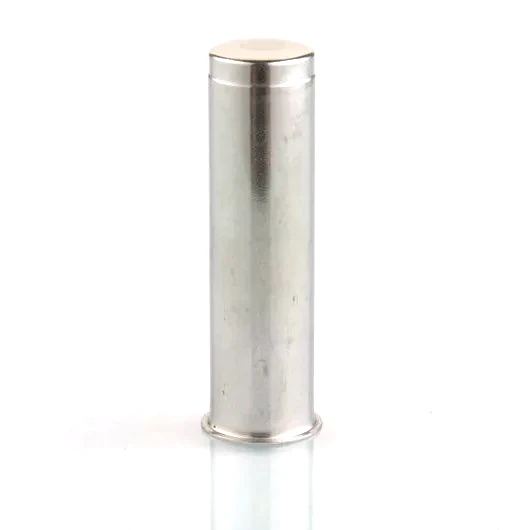
A precision rolled capillary is a tube that was never drawn, and that single fact changes its properties, its accuracy, and the arguments that decide whether it is the right part. It is rolled from strip, not drawn from a blank, so its wall is the strip’s wall – which is more uniform and more precisely held – but its form is a material condition rather than a formed one, and that condition is what this page is about.
SPCC and DC01 cold-rolled carbon steel at 0.5 to 3.0 mm, with pickled and galvanised alternatives. So the material is specified by its rolling condition, and on a capillary that is not a formality.
Rolled versus drawn, and why the difference is functional
- A drawn tube is formed from a blank, so its wall thins and varies. The wall at the tube’s ends is thinner than at the middle, and the diameter after drawing does not equal the die diameter because of springback. That makes a drawn tube’s dimensions a set of tolerances that have to be managed.
- A rolled tube is formed from strip, so its wall is the strip’s thickness along its whole length. That is a real accuracy advantage: a rolled capillary’s bore and wall are uniform along the length, which matters where the tube is a pressure line or where its flexibility has to be consistent.
- And a rolled tube is not work-hardened in the same way. Rolling is a less severe forming operation than deep drawing, so the material’s state after rolling is different – and on a part where the tube will be bent, that state matters.
So the choice between a rolled and a drawn capillary is not a price choice. It is a uniformity choice, and the right answer depends on whether the tube’s length carries anything that must be constant along it – a pressure, a flow, a bend behaviour.
The bending question, and where the material’s condition changes it
A capillary is the part that gets bent, and its bend behaviour is a function of the material’s temper as much as of its geometry.
- Cold-rolled material at a specified temper is predictable. SPCC and DC01 are cold-rolled grades with a temper that the material standard defines, and a tube made from them has a bending behaviour that can be specified. This is why precision capillary is made from cold-rolled strip with a stated temper rather than from a general-purpose grade.
- Annealing changes everything. An annealed tube is far more formable – it will take a tight radius without kinking – and it is also far weaker and more prone to kinking in service once it has been bent and then disturbed. So an annealed capillary is the right choice when the tube will be formed at installation, and a hardened one is the right choice when it will be handled repeatedly.
- And the bend radius still governs. Whatever the temper, the tube below its minimum bend radius will kink, and the kink is a permanent ovality. So the minimum bend radius remains a specification, and it is the one that prevents the most field damage.
Residual stress, which is the argument people miss
Rolling is a forming operation and it leaves residual stress in the tube – greatest at the surface, and tensile in the direction that matters for a bent tube. That stress has three consequences, and all three are relevant to a capillary.
- A rolled tube’s springback on bending is set by its temper, not by an average. So a batch-to-batch variation in temper is a batch-to-batch variation in how the tube bends, and on a capillary that has to be bent to a fixed length in an assembly this is a real variation.
- The residual stress is what causes stress-corrosion cracking in a susceptible material. A cold-rolled carbon steel capillary in an environment with a corrosive gas – and a capillary in a chemical process or a refrigeration circuit is exactly that – can develop stress-corrosion cracks along the rolling direction, and they will leak with no visible damage on the outside.
- And where the tube is subsequently bent, the residual stress combines with the bending stress. On a cold-worked material the combination is higher than the sum suggests, because the material’s yield is already raised by the rolling. So a tube that was rolled to a hard temper is more likely to crack at a bend than one that was rolled soft.
So on a capillary the material’s condition is a durability specification, not a forming one, and the environment decides whether it matters. That is worth asking about because a capillary in a benign service and one in a sour or a caustic service should not be made from the same condition.
Surface, and the case where the outside is the inside
Surface treatment matched to the duty, with the finish inspected with the dimensional report on the first article. On a capillary the finish question is dominated by one case.
- On a capillary that carries a fill or a process fluid, the interior’s condition is the functional one. It has to be free of scale, free of lubricant and free of any residue, because any of those will contaminate the fill or trap gas. Where the tube is pickled that is achieved by the pickling, and where it is not it has to be achieved by cleaning and the cleaning has to be specified.
- On a capillary that carries leads, the interior’s requirement is different – it has to be clean enough not to abrade the conductors and flexible enough to route. It is not the same requirement and a general “clean” note covers neither.
- On the exterior, the finish is conventional corrosion protection – and on a capillary the exterior is a lot of surface area and it is where handling damage happens, so a coating that survives being bent and gripped matters more here than on a larger part.
- Galvanised is available and it is worth knowing what it does: a galvanised capillary is corrosion-protected and it is stiffer and less formable than a bare one, and the zinc’s surface is rough enough to be a wear site if the tube is moved repeatedly. So a galvanised capillary is a good answer for a fixed installation in a corrosive atmosphere and a poor answer for a tube that will be rerouted.
Dimensional accuracy, and where it comes from
Deep drawing followed by CNC finishing on critical faces, at +/-0.02 mm on machined seats and sealing faces flat to drawing. On a rolled capillary the tolerance scheme has a different character than on a drawn part, because the tube itself is already dimensionally good.
- The tube’s diameter and wall come from the strip, so they are as good as the material standard allows – and they are consistent along the length in a way a drawn tube’s are not. So they belong at a general band and they do not need attention.
- The tight band goes to the ends. The sealing face’s flatness and perpendicularity, and any machined feature at the ends – a thread, a gland, a spigot.
- And the requirements that are not dimensions are the same three that are always the hardest: the minimum bend radius, the leak rate along the length, and – if it carries leads – the conductors’ number and gauge. On a capillary those three are the specification and the diameter is not.
A capillary’s bore and wall are measured at both ends
First articles verifying the whole flow before the run is released, in a climate-controlled inspection room. On a rolled capillary the inspection plan is short and should be.
- Bore and wall, measured at both ends and, if the consistency along the length matters to the application, at a third point in the middle – because on a rolled tube that check is genuinely informative and on a drawn tube it would show a known variation.
- Sealing faces at the tight band.
- A leak test along the length, where the tube is a pressure line. A capillary’s length is its weakness and an end test proves nothing.
- A bend test to the specified minimum radius on a sample, where the tube will be bent in service. This is the test that verifies the material’s condition, and it is a one-line check that catches a temper problem immediately.
Bent on site, or supplied bent to the final shape?
Will this capillary be bent during installation, or is it supplied bent to the final shape? The answer decides the material’s condition and it is not a detail, because a tube supplied straight and bent on site needs to be formable – which means a softer temper – and a tube supplied bent and left alone can be hard, which means it will resist a later nudge and will not take a field correction. It also decides the delivery format, and the delivery format decides the packaging, the minimum bend radius that has to be respected in the packaging, and whether the tube can be routed through equipment at installation at all. And there is a second question that is nearly always missed on a capillary: what is in the environment around it, as opposed to what is inside it? Because a rolled cold-worked steel capillary’s most likely failure mode is stress-corrosion cracking driven by the residual stress from the rolling, and that failure is driven by the ambient atmosphere rather than by the contents. A capillary in a refrigeration circuit with a corrosive refrigerant and moisture present is a different risk from one in dry air, and they may need different material conditions even though the inside is the same. So the question worth asking is not only what goes through it but what surrounds it.
This part sits inside our Sensor Housings range. Across the sensor housings pages you will find the process notes, common materials and inspection points behind every product in the family.
Specifications
| Item | Precision Rolled Capillary Tubes Precision Bright Steel Tubes for |
|---|---|
| Brand | AUNOV |
| Designing | Quotation follows the print, not a catalogue – DFM notes are returned before any tooling is cut; changes are priced before they are made. |
| Tooling | The tooling record travels with the part number, so maintenance history is never lost. |
| Samples | Samples are issued for approval before the run, so the sample is retained as the master, and later batches are gauged back to the signed sample. |
| Materials | SPCC / DC01 cold-rolled carbon steel, 0.5-3.0 mm, the standard stock for formed tube; pickled (SPHC) or galvanised alternatives. |
| Surface finish | Surface treatment matched to the duty: plating, coating or polishing; the finish is inspected with the dimensional report on the first article. |
| Processing | Deep drawing comes first, then CNC finishing on the critical faces; first articles verify the whole flow before the run is released. |
| Equipment | Deep drawing presses plus CNC turning centres for machined faces, backed by CNC turning centres and a climate-controlled inspection room. |
| Tolerance | +/-0.02 mm on machined seats, sealing faces flat to drawing; finer bands confirmed from capability data before quoting. |
| Delivery terms | CIF or DDP, with FOB available, payment by T/T, L/C at sight or D/P; call-off schedules are supported. |
Related Products


Frequently Asked Questions
Why is a rolled capillary not a drawn one?
It is rolled from strip rather than drawn from a blank, so the wall is the strip’s wall – more uniform and more precisely held – but the form is a material condition rather than a formed one.
Which materials are rolled for capillaries?
SPCC and DC01 cold-rolled carbon steel at 0.5 to 3.0 mm wall, with pickled and galvanised alternatives, specified by rolling condition rather than by shape.
How uniform is the wall on a rolled capillary?
Because the wall is the strip wall, it is held to the strip’s tolerance across the whole length, which is the reason to roll rather than draw when uniformity matters.
How is the capillary sealed at the ends?
The ends are the seal and the drawn form is the requirement, so the tight tolerance band is placed on the ends and the tube body is held to a looser band.
Request a Quote for This Part
Send a drawing or sketch — get material advice, tooling cost and a per-piece price within 24 hours (working days).