
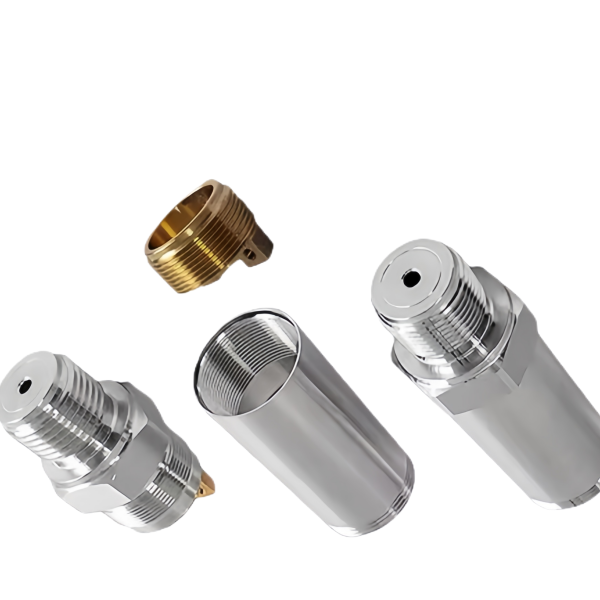
The Brass and Stainless Steel Threaded Sensor Housings are small threaded bodies that hold a sensor in place and screw into a port or a mating assembly. The family deliberately mixes two metals – brass where machinability, conductivity and cost matter, stainless steel where corrosion resistance and strength matter – and puts a threaded interface on each. That combination raises two issues that dominate the part: how the thread is specified and cut so it seals or retains reliably, and how the two metals behave differently in service when they are joined to each other or to a common assembly. This page covers the threaded interface, the choice between the two metals and the galvanic question that comes with mixing them.
A threaded housing’s thread is an interface, not just a feature
On a sensor housing the external or internal thread is doing one of two jobs: it is sealing against pressure or process fluid, or it is retaining the housing and the sensor against vibration and handling. Which job it does changes how it is specified. A retaining thread needs strength and enough engagement to resist loosening; a sealing thread needs a controlled class, often a taper or a defined engagement, so that the thread flanks or a separate seal land close off the leak path. Treating a sealing thread as a retaining thread is the classic cause of a housing that holds the sensor but weeps at the port.
- Thread class is chosen for the job, and on a sealing thread we confirm whether the seal is on the thread flanks or on a separate face, because the two need different geometry.
- Engagement length is set so the thread has enough bites to hold without needing so many that assembly torque climbs and risks galling or distortion.
- Thread is cut or rolled to a finish that resists the galling that small, frequently-assembled threads are prone to, especially on the stainless steel members of the family.
Brass and stainless steel behave differently at the same thread
When one release carries both brass and stainless steel housings, the threads look the same on the drawing but they do not cut the same. Brass is soft and free-machining; it takes a clean thread crest with light cutting force and rarely galls. Austenitic stainless steel work-hardens and galls, so the same tool that makes a perfect brass thread can tear or build up on a stainless steel one. The cutting parameters, the tool coating and even the tap or die are chosen per material, and the acceptance criteria for thread form can differ.
- Brass threads are cut with a sharp, light-pass tool; stainless steel needs a tool and a speed that stay below the galling threshold, and a lubricant suited to it.
- Thread crest and root condition is inspected per material, because stainless steel’s tendency to leave a torn or built-up crest is a real failure mode that brass almost never shows.
- Where the same housing design is offered in both metals, we hold the thread to a class that both can actually achieve in production, rather than a class one metal makes easily and the other struggles with.
The sensor seat inside the housing is a tolerance of its own
The thread is only half the housing; the other half is the bore or seat that locates and holds the sensor. That seat has to position the sensor repeatably – depth, concentricity to the thread axis, and often a sealing land for the sensor’s own O-ring or ferrule – and it has to do so on a part that is being threaded at the same time. The seat and the thread are concentric features and they have to agree, or the sensor sits crooked in a housing that screws in perfectly straight.
- Sensor seat is dimensioned from the thread axis, so the sensor and the threaded interface share a datum.
- Seat depth is held, because a sensor seated too deep or too shallow changes its reading position even though the housing assembles.
- The seating surface finish is controlled where the sensor seals against it, since an O-ring needs a smooth, defined land and not just a rough bore.
Mixing the two metals raises a galvanic question at the assembly
Putting a brass housing and a stainless steel housing into the same assembly, or a brass housing into a stainless steel port, creates galvanic couples that only matter in the presence of an electrolyte but matter a great deal when one is present. Brass is the less noble of the two and will preferentially corrode, and the effect is worse where the brass part is small relative to the stainless steel part it is coupled to. This is a material-selection conversation we raise at quotation, because by the time it shows up as a corroded housing in the field the design is fixed.
- Where the assembly sees moisture or a conductive process, we discuss isolating coatings, or narrowing the couple by plating or material choice.
- For wash-down or food duty we discuss whether brass is appropriate at all, since dezincification and leaching are grade-dependent concerns.
- Where both metals are unavoidable for function, we help the customer minimise the wetted area of the less noble metal and isolate the joint.
How we verify a threaded sensor housing
Verification on these housings checks the thread, the sensor seat and the relationship between them, per material.
- Thread: class and form verified with the appropriate gauge, with crest and root condition inspected – especially on the stainless steel members, where galling and build-up are the risk.
- Sensor seat: depth, concentricity to the thread axis and seating-surface finish confirmed against the sensor’s requirements.
- Concentricity between the seat and the thread verified, so the sensor and the threaded interface agree.
- Material certificate per lot confirming brass or stainless steel as ordered, traceable to the release.
- Finish record where the housing is plated or passivated, with thickness or passivation test attached.
- Fit check on the first article: the housing is threaded into a gauge port and the sensor is seated, proving the thread engages and the sensor locates before the run.
First articles and retention samples are kept for the programme, so a repeat run of either metal is made to the same verified thread and seat. On a family that mixes two metals on one drawing, holding each to the interface it actually has to deliver is what keeps a brass housing and a stainless steel housing both working in the same assembly.
Parts like this one sit under the Sensor Housings range, whose overview page gathers the tooling logic, finishing options and tolerance notes shared across the family.
Specifications
| Item | Brass and Stainless Steel Threaded Sensor Housings |
|---|---|
| Brand | AUNOV |
| Designing | Share your print, or send a part to be measured, a manufacturability review comes back with the quotation. |
| Tooling | Dies designed and built in our own toolroom, stored under your part number. |
| Samples | The first-article set ships with a dimensional report and material certificate. |
| Materials | Stock for this part leads with 304 / 316 stainless steel, alongside carbon steel (SPCC / DC01), aluminium, brass and copper, with grade selection confirmed at drawing review. |
| Surface finish | Finish options: plating, e-coat, powder coating, anodising or passivation, selected against the drawing requirement. |
| Processing | Staged deep drawing, with in-line annealing where the draw ratio requires, pierced and machined on the same floor. |
| Equipment | Press capacity from 5 to 500 T across mechanical and hydraulic lines, CNC turning centres, climate-controlled CMM room. |
| Tolerance | +/-0.1 mm as-drawn, +/-0.03 mm after machining. |
| Delivery terms | Standard terms FOB, DDP offered to EU and US, payment T/T or L/C, D/P for repeat accounts, scheduled call-offs welcome. |
Related Products



Frequently Asked Questions
Why mix brass and stainless steel in one family?
Brass where machinability, conductivity and cost matter, stainless steel where corrosion resistance and strength matter, each with a threaded interface doing one of two jobs.
What are the two thread jobs?
A retaining thread needs strength and engagement to resist loosening; a sealing thread needs a controlled class, often a taper or defined engagement, so the flanks or a seal land close the leak path.
What happens if a sealing thread is treated as retaining?
It holds the sensor but weeps at the port, which is the classic failure of mis-specifying the thread’s job.
How is galvanic behaviour handled?
Where the two metals meet a common assembly, the joint is specified so the galvanic pair is managed by finish or isolation rather than left to corrode.
Request a Quote for This Part
Send a drawing or sketch — get material advice, tooling cost and a per-piece price within 24 hours (working days).