
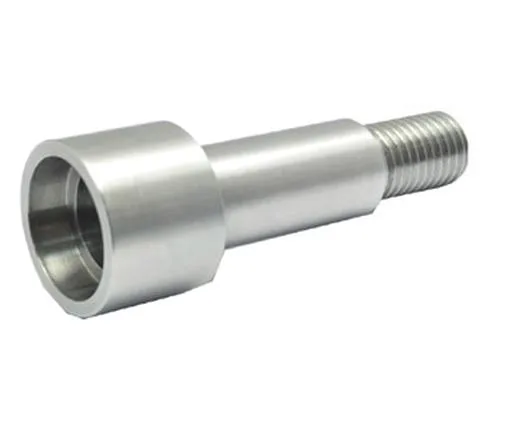
A valve nipple is the shortest fluid component on this site, and it exists because of one thing that almost no other fitting has to deal with: two different sealing systems on the same part, and two different thread standards. A nipple has one end that goes into a valve body and another end that connects to a pipe, and each end is a different thread, a different seal method, and a different torque. Everything about this part is a consequence of that.
It is also the part where the assumption is usually wrong: a nipple’s two ends are frequently assumed to be the same size because they look the same in an assembly drawing, and they are not.
The two ends, and why they are different
- The valve end. This end screws into the valve body’s port. The valve body’s port is usually a straight or tapered thread machined or formed in a heavy body, and the seal is usually at the thread – either a tapered thread’s interference or a bonded seal crushed by a flat face. On many valve bodies this end is a male thread; on some it is a female end that receives the pipe.
- The pipe end. This end is whatever the piping system uses – a pipe thread, a compression fitting’s thread, a flange, or a weld. It is almost always a different standard from the valve end, and it is almost always the end that has to be compatible with the customer’s existing pipework.
So the nipple’s specification needs to state, per end: the thread standard, the size, the class, the length, and the seal method. And the length needs a stated convention, because “length” on a nipple is measured between which faces is a matter of local practice and a 3 mm difference decides whether the pipe fitting seats.
Where the seal happens, and this is the design’s whole content
A nipple has to seal at one end, usually both, and the two seals are often of different types. Three common arrangements, and they have different consequences.
- Taper on both ends. A traditional nipple with a tapered thread on each end. Simple and completely standard, and it has the property that metal-to-metal interference seals relax with thermal cycling. On a valve connection in a hot or a cyclic service, this is a real limitation.
- A bonded seal or an O-ring at the valve end, a taper at the pipe end. This is the arrangement on most modern valves, because the valve body’s seal is the one that has to be reliable and the pipe end is the one that gets disconnected. The bonded seal gives a wide tolerance range; the taper on the pipe end gives a simple connection.
- A face seal on one end, a taper on the other. Common where the nipple must be removed frequently without damaging the seal, because a face seal with a retained gasket can be re-made and a taper cannot.
On any of these, the specific requirement that is usually missing is which face the seal is on, and what that face’s flatness and finish have to be. A metal-to-metal face seal on a nipple needs a flat, clean, correctly finished face; and a nipple that has been through a machining process will have a face finish that was not designed for sealing. Where the face seals, that face is a functional surface and it needs a specification.
Material, and the specific consequence on a nipple
Stainless Steel 304 and 316L, pickled and annealed, at 0.5 to 3.0 mm nominal wall, with the grade chosen for the corrosion duty and for formability. On a nipple the material question is straightforward but two points are specific.
- 316L is the normal answer, on the same chloride logic as everywhere else, and the L grade because a nipple is often welded into an assembly or fabricated in a way that involves heat input. On a nipple that will be welded, 316 rather than 316L risks sensitisation at the weld, and a nipple is small enough that the weld’s heat-affected zone is a significant fraction of the part.
- Pickled and annealed, and the reason both matter on this part. Annealed means the material is in a solution-treated condition with no work hardening from fabrication and no residual stress, which matters on a small part whose only job is to carry a thread and a seal. Pickled means the surface is descaled and carries a proper passive layer, which on a part whose threads are on its outside is what prevents the threads from seizing.
- Where a nipple is on a valve in a hot service, the material’s creep behaviour at temperature becomes relevant. A threaded nipple under sustained load at elevated temperature will creep – which is a well-known failure mode of threaded joints in steam, and the reason high-temperature valve designs use a different sealing arrangement entirely.
Threads, and the two practical problems
- Galling between the nipple and the body. A stainless steel nipple in a stainless steel valve body, tightened and then loosened, will gall. This is the single most common practical problem with stainless steel threaded components and it is not solved by better tolerance – it is solved by a defined break-loose torque, a dry film lubricant, a dissimilar grade pairing, or an anti-seize. It should be a stated assembly requirement.
- The thread’s plating. On a nipple, plating both ends is worse than on a larger fitting because a plated thread on a small part is a large fraction of the pitch, and because a plated nipple that has been plated after threading will have plating in the thread’s roots that will flake into the valve. Masking, or specifying the thread post-plate with an allowance, or passivating rather than plating – the last is usually right on stainless steel.
- The thread’s length and the engagement. The engagement is what carries the load, and on a nipple the thread length is set by the body it goes into. Where the nipple screws into a body whose thread is shorter than the nipple’s, the extra thread is exposed and will corrode. This is worth specifying.
Finish
Surface treatment matched to the duty – plating, coating or polishing – with alternatives quoted with the quotation and samples approved in writing. On a nipple the finish requirement is narrow and mostly about the threads and the seal face.
- The threads should be masked or passivated. On stainless steel, passivation is the answer. A plated stainless steel nipple’s threads will gall and will flake, and a plated nipple that has been nickel-plated is a maintenance problem that appears at the first service.
- The sealing face, where there is one, should be unmasked and should have a specified finish, because it is a sealing surface rather than an appearance surface.
- Where the nipple is an appearance item – on a valve in a visible position, or a railing, or a fitting – the external finish is conventional and an approved sample is the specification.
A nipple’s flagged list is short, and both ends carry a thread
+/-0.01 mm on machined faces and +/-0.05 mm on formed details, batch records filed so a repeat order starts from approved data, PPAP-style reports on request. On a nipple the flagged dimensions are short and specific.
- Each end’s thread class and pitch diameter, gauged, each to its own standard. This is the item that scales with the number of ends and it is the one most often sampled rather than checked.
- The seal face’s flatness and perpendicularity to the nipple’s axis, where there is a face seal. Perpendicularity matters because a face that is not square to the axis will not seal evenly, and on a small part it is easy to overlook.
- Overall length, with the convention stated, and this is a coordination dimension with the assembly rather than a feature.
- Concentricity of the two ends, where they are different sizes or different thread standards, because two ends that are not coaxial will not both seat.
- Roundness and cylindricity of any sealing spigot or face, as its own requirements.
- General dimensions at a general band.
A nipple is cheap, and gauging both ends is what catches the failures
- Both ends’ threads gauged, on every part. A nipple is cheap and this is the inspection that catches the failures.
- The seal face’s flatness and perpendicularity, where applicable, measured as two values.
- A functional leak test on a sample – assemble the nipple into a mating body with a gasket if that is the design, and confirm a leak-free joint at the specified torque. On a nipple this takes seconds and it tests the thread, the face and the seating together.
- Concentricity of the ends, where they differ.
- Length, against the stated convention.
- Finishing thickness and adhesion on the first article, with the masked threads and any masked seal face verified.
- Material certification with the grade and heat number, and PPAP-style reports on request – and on a valve component in a safety-related or a certified assembly, the traceability is what makes the component auditable.
Which seal the valve body’s port uses
Which seal arrangement does the valve body’s port use – tapered thread, bonded seal, or face – and is the pipe end going to be disconnected in service? Those two answers determine almost everything about this nipple. If the valve body’s port is a bonded-seal or a face-seal design, the nipple’s valve end must match that arrangement exactly, and a nipple with a taper on that end will not seal properly even though it looks correct and screws in smoothly. If the pipe end will be disconnected regularly, a taper on that end will damage the mating part and it is worth asking whether a face-sealed connection would be better. And on a nipple specifically, there is one more question worth asking because it is the one that causes the classic field problem: how is this joint expected to be broken and re-made? A stainless steel threaded nipple that is sealed, broken and re-sealed without a defined break-loose procedure will gall, and the galling is the reason it will not come apart. Stating that a dry film lubricant is to be used, or a defined break-loose torque, or a dissimilar grade pairing, costs one line on an assembly drawing and prevents the most common stainless steel fitting problem there is.
Our CNC Machining Parts range is where this part sits. The cnc machining parts pages carry the process notes, common materials and inspection points behind every product in the family.
Specifications
| Item | Stainless Steel CNC Machined Valve Nipples |
|---|---|
| Brand | AUNOV |
| Designing | Made to your 2D/3D drawings (PDF, DWG, STEP, IGS) – DFM notes are returned before any tooling is cut; the agreed version governs every later batch. |
| Tooling | Tooling is built and held under your part number, so a die can be re-cut against the approved drawing, and the die remains dedicated to your part. |
| Samples | Samples are issued for approval before the run, so the part is proven before it is made in volume, and later batches are gauged back to the signed sample. |
| Materials | Stainless Steel 304 and 316L, pickled and annealed, 0.5-3.0 mm nominal wall – one grade chosen for corrosion duty and formability of this valve. |
| Surface finish | Duty decides the surface treatment, plating, coating or polishing; we quote alternatives with the quotation and approve samples in writing. |
| Processing | CNC turning from bar or billet, concentricity held across operations; batch records are filed so a repeat order starts from approved data. |
| Equipment | Bar-fed CNC turning centres plus 3- and 4-axis machining centres; first articles and batch samples are checked on the CMM. |
| Tolerance | +/-0.01 mm on machined faces, +/-0.05 mm on formed details; GD&T per drawing, PPAP-style reports on request. |
| Delivery terms | FOB with DDP offered for EU and US addresses; payment T/T or L/C, freight quoted to destination. |
Related Products


Request a Quote for This Part
Send a drawing or sketch — get material advice, tooling cost and a per-piece price within 24 hours (working days).