
Seamless deep drawn components for automotive systems — motor housings, fuel-system covers, battery cans, sensor shells and ADAS enclosures, drawn in steel, stainless steel, aluminium and nickel alloys, made to print and built for high-volume production.
Every car carries hundreds of small metal parts that have to survive heat, vibration, fuel, road salt and a decade of use without a service call. Many of them start life as a flat blank of sheet or coil stock and become a finished shell in one or two draws. Deep drawing gives the automotive engineer a single, seamless component instead of a welded or machined assembly — no seam to crack under pressure, no joint to leak, and a wall thickness the press controls to a tolerance the welding shop cannot match. We draw starter and blower motor cans, fuel-pump covers, battery housings, power-window switch cups and the sensor shells that sit behind every ADAS camera, on mechanical and hydraulic press lines rated from 5 to 500 T, sized to the volumes a Tier-1 or OEM program actually runs.
Automotive is unforgiving about consistency. A part that draws perfectly on Monday has to draw identically on the millionth hit, with full traceability back to the coil and the die. That discipline — repeatable tooling, in-process gauging and documented secondary operations — is what separates a deep draw shop that serves the auto industry from a general stamper, and it is the standard we hold on every automotive program we run.
How We Draw for Automotive
Progressive and transfer dies. Automotive parts are rarely a single draw. A motor can may need a draw, a redraw, an ironing pass to thin the wall, an in-die pierce for the mounting ears and a trim — all sequenced so the part leaves the press finished or nearly so. We design the die string around the draw ratio and the material’s work-hardening curve so wall thickness stays uniform from the base to the open end.
Wall-thinning control. A deep drawn shell lives or dies by its thinnest point. We model the material flow before the first tool is cut, then confirm it on the press with sectioned parts and pin gauges. For aluminium blower and starter housings this matters most: the metal work-hardens fast and tears at the shoulder if the punch speed or blank holder pressure is off by a little.
In-die piercing and secondary operations. Holes, slots, louvres and vent patterns are pierced in the die where possible, then any threading, tapping, welding or staking is done as a sequenced secondary op. The aim is to hand you a component, not a rough shell, so your line spends its time assembling rather than finishing.
Finishing and validation. Automotive parts leave the draw headed for zinc plating, e-coat, powder coat or passivation depending on where they sit in the vehicle. We prepare the surface and the radii so the coating wets evenly, and we hold first-article and PPAP-style documentation on request so the part drops into your quality system without a fight.
Draw ratio, depth and MOQ.
Every automotive shell starts as a draw-ratio question. We quote the limiting draw ratio by grade — 2.1–2.2 for DC04 deep-drawing steel, 1.85–2.05 for 304 stainless, 1.80–1.95 for 5052 aluminium — and draw to 150 mm depth on press lines rated from 5 to 500 T. Past one ratio we redraw, taking 20%–30% off the diameter per pass, with an intermediate anneal where the material needs it. That is why we ask for the draw depth and the open-end diameter before quoting tooling: the number of stations is set by the ratio, and the ratio is set by the grade. New tooling starts at 1,000 pieces per part number, and first-articles carry dimensional reports against the print.
Automotive Parts We Make
These are real components we draw and stamp for automotive programs — motor housings, fuel and battery systems, sensor and switch shells, and ADAS enclosures. Open any one to see the material, the form and the finishing route.
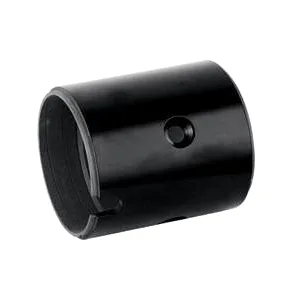 Auto starter electric motor shield housingView details →
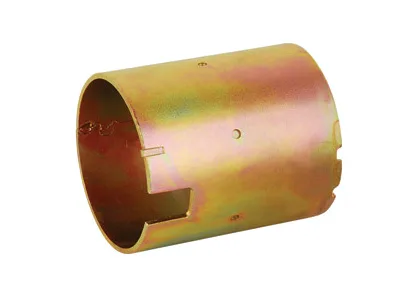 Car starter electric motor coverView details →
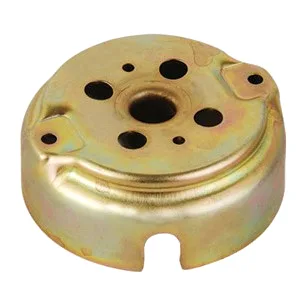 Canned Motor Cover – Deep Drawn EnclosureView details →
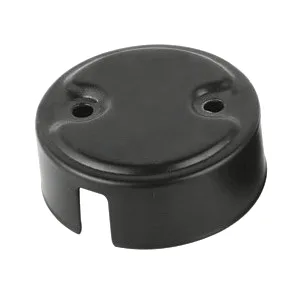 Deep drawing electric motor end coverView details →
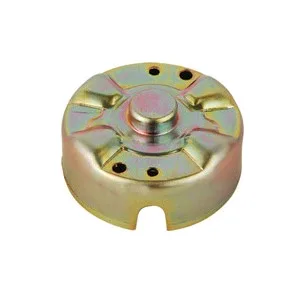 Metal forming electric motor end shieldsView details →
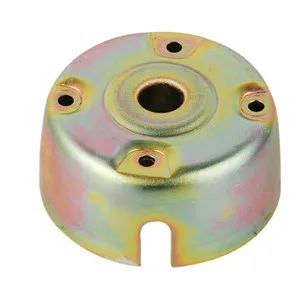 Metal Motor Covers – Custom StampingView details →
Materials & Finishes for Automotive
Low-carbon and alloy steel. The workhorse of motor cans, end shields and switch housings. Cheap, drawable and easy to plate, it carries the mechanical loads of a under-hood or in-cabin motor without complaint. We draw DC04-type and similar grades where the part sees moderate corrosion and good formability is the priority.
Stainless steel 304 and 316. For sensor housings, battery cans and anything that lives near electrolyte or road spray, stainless steel is the default. 304 draws cleanly for most shells; 316 steps in where chloride resistance matters. Where the spec says “stainless steel” we draw the full name and grade, never a bare abbreviation.
Aluminium 5xxx — EN AW-5052 and 5754. The lightweighting metal. Blower motor cans, ADAS gyro and night-vision housings are drawn in 5xxx to shed grams where it counts: it forms deep in the O and H32 tempers with low springback, and we quote a limiting draw ratio of 1.80–1.95 against 2.1–2.2 for DC04 deep-drawing steel. Where a part needs 6xxx (6016 / 6014) for strength after ageing, we form it in the T4 or O condition and age to T6 afterwards, or keep it to shallow draws — 6061 in the T6 temper is too low in elongation to draw. Aluminium work-hardens fast, so the die and the press schedule are tuned to keep it from tearing at the shoulder.
Nickel 200 / 201. Reserved for fuel-system parts that see ethanol blends and aggressive media. A deep drawn nickel fuel housing shrugs off what would pit stainless steel, which is why we keep nickel in the portfolio for pump and injector-adjacent components.
Finishes. Zinc plating for general corrosion protection, e-coat and powder coat for thicker films on exposed brackets, anodising for aluminium appearance and insulation, and passivation for stainless steel. We match the finish to where the part sits and how it is assembled.
Fuel, Battery and Sensor Systems
Fuel systems. A fuel-pump cover has to seal, hold fittings and survive a corrosive, slightly conductive liquid for the life of the car. We draw the cover in stainless steel or nickel, pierce and form the ports in the die, and prepare the seat so the gasket does its job on the first try.
Battery and energy storage. Electrification did not remove the deep drawn can — it multiplied it. Cell cans, battery housings and busbar enclosures are drawn in aluminium and stainless steel to be leak-tight and dimensionally stable across charge cycles. The same draw control that keeps a motor can round keeps a battery shell safe.
Sensor and switch shells. Every sensor that watches the engine, the cabin or the road sits in a drawn shell. Stainless steel sensor housings give EMI shielding and chemical resistance; power-window and electromagnetic switch cups are drawn to tight roundness so the actuator seats without backlash. These are small parts with outsized reliability roles.
ADAS enclosures. Gyro and night-vision housings are hydroformed or deep drawn in aluminium to package tightly behind the bumper or behind the windscreen. Light weight and a clean internal shape keep the optics stable, which is the whole point of the sensor.
What to Send Us for an Automotive Part
The drawing and the critical dimensions. A 2D print with the open-end diameter, the draw depth, wall thickness and the tolerance that actually matters. If you have a 3D model, send it — we will confirm the draw ratio before quoting tooling.
Annual volume and the program horizon. Automotive tooling is paid back over volume. Tell us the run rate and how many years the program runs; that decides whether we build a progressive die, a transfer line or a single-stage tool.
Material and finish spec. Grade, temper, coating and any OEM or industry specification. If the part sees fuel, salt or under-hood heat, say so up front so we pick the right alloy and finish.
Validation needs. First-article, PPAP level, IMDS entry or specific gauging — the earlier we know, the smoother the launch. We document coil traceability and in-process checks so the part drops into your quality system.
Frequently Asked Questions
Can you support automotive quality systems such as IATF 16949 or PPAP?
We run automotive programs to the discipline those systems expect: documented tooling, coil traceability, in-process gauging and first-article / PPAP-style documentation on request. Tell us the level your program requires and we will match it.
How do you shield sensor housings from EMI?
Stainless steel sensor housings give a continuous conductive shell that attenuates interference, and the seamless draw means no weld seam to leak signal. Where the spec calls for it we can also specify plating that improves the ground path.
Which material do you recommend for fuel-system parts?
Stainless steel 304 covers most fuel-pump applications; for ethanol blends and aggressive media we move to nickel 200 / 201. The choice comes down to the exact fluid, temperature and life target, which we confirm from your spec.
Can deep drawn parts replace machined or welded automotive components?
Often yes. A drawn shell removes the weld seam, cuts material waste and collapses several operations into one press hit. Where a feature cannot be drawn we add it as a sequenced secondary op, so you still receive a finished component.
How consistent are parts across high automotive volumes?
Consistency is the point of the process. The die fixes the geometry, the press controls the stroke, and in-process checks catch drift before it reaches your line. A part that draws correctly on the first hit draws the same on the millionth.
Can you draw aluminium for lightweighting?
Yes. We draw aluminium 5xxx — EN AW-5052 and 5754 — for blower cans, ADAS housings and other weight-sensitive parts, tuning the die and press schedule so the work-hardening metal forms without tearing; 6xxx stays limited to shallow draws or parts aged to T6 after forming. Weight saved in a motor can or sensor shell adds up across a vehicle.
Explore More
Other industries we draw for: battery & energy storage · medical & healthcare · defense & optics · industrial enclosures · sensor & probe housings · LED lighting · HVAC & refrigeration · electrical enclosures. See how we work in deep drawing, tool & die design and quality control.
Drawing an automotive part and need a supplier who runs the volumes?