
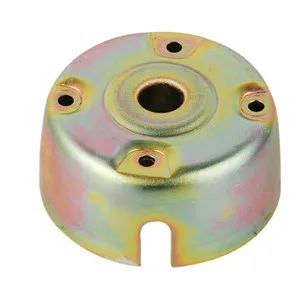
A custom stamped motor cover begins and ends with the die: the die is designed around your print, built in our own toolroom, and held under your part number. This page covers what “custom” actually buys you on a motor cover, which stamping route fits which geometry, and where the honest limits of the process sit.
What a custom die buys – and what it cannot
With your own die, every subsequent part is a press cycle: unit cost drops to material plus seconds, and repeatability is die-controlled rather than operator-controlled. Custom geometry comes free of the die once it is cut – flanges, stepped diameters, windows, louvres, piercing and in-die tapping all become one hit.
What the die cannot buy: extreme depth-to-diameter beyond roughly 2:1 without staged drawing, wall thickness variation (drawing thins the corner by design), and internal features the punch cannot reach. Those belong to machining, and we do it in house on the same floor.
Progressive die or single-stage: the honest decision
| Decision factor | Progressive die | Single-stage / transfer |
|---|---|---|
| Best for | Thin, shallow-to-medium covers at volume | Deep draws needing interstage annealing |
| Tooling cost | Higher – many stations | Lower per stage, more handling |
| Unit cost at volume | Lowest – one pass | Higher – press-to-press transfer |
| Change flexibility | Station rework needed | Stage-level changes simpler |
We quote the route the geometry and volume actually justify – and we will tell you when a simpler die is the better deal.
Design freedoms worth using
- In-die tapping. Threads formed in the same hit as the piercing keep hole position tied to the die datum, not to a secondary fixture.
- Flange geometry in the draw. Mounting flanges with bolt holes are formed and pierced in sequence – no weld-on brackets that add distortion.
- Ventilation and cable slots. Pierced in the same progression, deburred, position-accurate.
- Marking. Part number and date code can be stamped in-die for traceability at zero extra handling.
From print to approved sample
Design intent is read from the print, and any conflict in the drawing is raised before quoting – not discovered at the sample. Progressive and drawing dies are designed and built in house; the tooling charge is itemised and refundable against agreed volumes. First-article samples ship with a dimensional report and material certificate, production starts only after your written sign-off, and the signed sample is kept for future reorders.
Quality control
ISO 9001 certified production: mill certificates cover every delivery of stock, first articles are CMM-measured, and production runs are inspected against the first-article report. On the motor end cover, bearing-bore size and spigot runout are measured at first article and gauged on production runs; torque, leakage or pressure tests can be added when the service demands them.
Drawing a cover like this is a chain of decisions — draw ratio, wall thinning, radii and trim. Our deep drawn covers design guide works through each of them with worked numbers.
Tolerance stack from a flat blank to a three-dimensional cover
A cover begins as a flat blank and ends as a shape with depth, so the drawing tolerance has to be budgeted across every station, not assigned to the final part alone. We start with the blank thickness and the draw ratio, then subtract springback station by station so the last hit lands the wall where the print asks. The parts of the cover that locate the motor, the pilot and the bolt circle, are held to the tight band; the cosmetic outer wall is allowed to drift within a wider band because it does nothing functional. This split budget is why a custom cover can be both precise where it counts and economical everywhere else, and it is the first thing we explain when a print arrives with one tolerance applied to the whole part.
When stamping stops beating a formed-and-welded cover
There is a real volume below which a welded seam is cheaper than a progressive die, and a part complexity above which a single draw cannot hold the features. We quote both routes side by side when the annual volume sits in the crossover band, because the right answer changes with quantity. A welded cover wins on low volume and on parts that need an odd bracket; a stamped cover wins on high volume, on roundness, and on leak integrity because there is no seam to fail. The decision is shown openly in the quotation with the tooling cost amortized across the forecast, so the buyer sees exactly where the crossover sits for their program.
Prototype before tooling
Before a die is cut we run a soft-tool or laser-formed sample so the mounting face, pilot, and vent can be verified on the actual motor. This catches a bolt-circle error while it costs hours, not a die revision.
Specifications
| Item | Metal Motor Covers – Custom Stamping |
|---|---|
| Brand | AUNOV |
| Designing | Design intent is read from the print, and any conflict in the drawing is raised before quoting. |
| Tooling | Progressive and drawing dies are designed and built in house, so no tooling step is outsourced, and the charge is refundable against agreed volumes. |
| Samples | First-article samples ship with a dimensional report and material certificate, so any deviation is corrected at sample stage, and the signed sample is kept for future reorders. |
| Materials | Carbon steel (SPCC / DC01), 304 / 316 stainless steel, aluminium, brass and copper – the grade is matched to the duty of this cover. |
| Surface finish | Surface treatment matched to the duty: plating, coating or polishing; the finish is inspected with the dimensional report on the first article. |
| Processing | Coil feeding and progressive die blanking, forming, piercing or in-die tapping, deburring, then plating. |
| Equipment | Mechanical presses 5-250 T, decoilers and coil feeders, vibratory finishing lines and a full in-house toolroom. |
| Tolerance | +/-0.03 mm on turned secondary features, +/-0.1 mm on as-drawn walls; GD&T per drawing, PPAP-style reports on request. |
| Delivery terms | FOB Ningbo or Shanghai, payment by T/T or L/C, quoted in USD or EUR; sea or air freight is quoted to your door. |
Related Products
Frequently Asked Questions
What does a custom die buy, and what can it not buy?
It buys repeatability and unit economics: after the die exists, every part is a press cycle, so piece cost becomes material plus seconds and accuracy is die-controlled rather than operator-controlled. It cannot buy the freedom to change the shape cheaply. Every future geometry change becomes a tooling change, which is why decisions made before the die is cut are the cheap ones.
Progressive die or single-stage – how is that decided honestly?
From annual volume, feature count, and whether the form needs true drawing. Progressive tooling costs more but runs fast and holds relationships between features well, which suits long runs. Single-stage or transfer tooling costs less and tolerates change, which suits development quantities and parts needing redraws or annealing between stages. The honest answer usually starts from your volume rather than from the tooling preference.
Which freedoms are worth using while the die is still empty?
The ones that disappear the moment steel is cut. Features formed in the die instead of added afterwards, secondary operations designed out, blank orientation set deliberately, and vent patterns arranged against forming stress rather than only airflow. Each is free before tooling and expensive after, so they belong in the drawing review rather than in a value-engineering exercise later.
Where does the tolerance come from if the part starts as a flat blank?
It accumulates. Blank location, each forming stage, springback, trimming and any secondary operation each contribute, so a feature’s final position reflects the whole chain rather than one operation. That is why datum-based dimensioning governs these parts better than individual feature tolerances, and why tightening one call-out rarely improves what the assembly sees.


Request a Quote for This Part
Send a drawing or sketch — get material advice, tooling cost and a per-piece price within 24 hours (working days).