
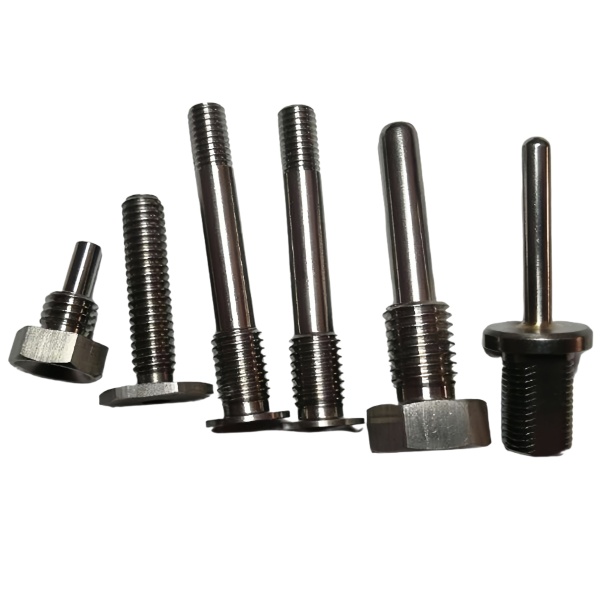
A steel hex thermowell with a long threaded stud is a temperature-measurement boss that mounts through a thick wall, flange or insulated section via an extended threaded stud, keeping full thread engagement on the far side while a hex drives installation without distorting the stud. The Steel Hex Thermowells with Long Threaded Studs are thermowells that screw into a port not through a nut or a fitting body but through a long threaded stud – an extended threaded section that lets the well reach through a thick wall, a flange or an insulated section and still have full thread engagement on the far side. The stud is what makes this variant: it has to be long enough to engage, strong enough to hold the well against internal pressure and vibration, and true enough that the well’s sensing end stays concentric with the stud it is threaded onto. This page covers the stud length, the thread strength and the runout between stud and well.
Stud length is set by what it has to pass through, plus engagement
A long threaded stud exists because the thermowell has to mount through something thick – a pressure wall, a flange, a layer of insulation – and still have enough thread on the other side to hold. The length is therefore the sum of what it passes through plus the engagement the thread needs, and it is not a dimension to trim for cost. A stud that is too short cannot engage fully through the wall; a stud that is longer than needed adds weight, cost and a longer unsupported length that is easier to bend.
- Stud length is calculated from the wall thickness it passes through plus a defined minimum engagement, and we confirm both with the customer.
- Thread length along the stud is held, because a stud that is the right overall length but threaded too short cannot actually engage.
- Where the wall thickness varies across an assembly, we size the stud for the thickest case rather than the nominal, so one part fits the range.
The thread has to hold against pressure pushing the well out
A ported thermowell is loaded by internal pressure trying to push it out of the port, and on a long-stud well that load is carried entirely by the thread engagement. That makes thread strength – how many bites are engaged and how strong each bite is – a real structural calculation, not just a fit spec. A stud that engages enough to screw in but not enough to hold pressure is a well that can be ejected, so the engagement is verified against the pressure the assembly will see.
- Engagement length is set against the internal pressure and the thread’s shear area, not against a rule of thumb.
- Thread form and class are held so the engaged bites carry load evenly rather than concentrating on the first few threads.
- We check the stud’s own tensile strength at the thread root, because a long stud is only as strong as its weakest engaged section.
Runout between the stud thread and the well is the assembly risk
The stud threads into the port and the well sits on the far end, and the whole assembly runs true only if the stud’s thread axis and the well’s axis are the same line. Any runout between them means the well is slightly off-centre even when the stud is threaded perfectly straight, and that off-centre well seats its sensor crooked and may not clear the port bore it reaches into. The concentricity between stud and well is therefore the feature that ties the two ends of the part together.
- Runout between the stud thread and the well body is measured directly on the first article, because two in-tolerance features can still be eccentric to each other.
- The well is turned and threaded from a setup that keeps both on one axis, rather than being re-fixtured between the stud and the well.
- Where the well reaches into a close-clearance port, the combined runout is checked against that clearance, not just against a general tolerance.
The hex is how a long stud gets installed without distortion
A long threaded stud is installed by turning something, and that something is the hex – the same torque interface as on any threaded fitting, but with a longer lever arm of stud behind it. That longer engagement length means more threads have to be drawn together, and more assembly torque, and the hex has to transmit all of it without rounding or without twisting the well out of true. The hex on a long-stud well is doing more work than the hex on a short fitting.
- Hex across-flats and depth are sized for the higher torque a long engagement needs, not for a short fitting’s torque.
- The hex is positioned and strong enough that tightening draws the stud home without distorting the well or cocking it in the port.
- Assembly torque is specified so the stud engages fully without galling the thread or over-stressing the hex.
How we verify a hex thermowell with a long threaded stud
Verification checks the stud, the well and the runout that connects them, because the assembly only works if all three share one axis and the engagement holds.
- Stud: length, threaded length and thread form and class verified against the engagement the pressure load requires.
- Well end: tip or sensing-end geometry and wall thickness measured against the pressure and thermal requirement.
- Runout between the stud thread and the well body measured directly, confirming the two ends share one axis.
- Hex: across-flats, depth and corner condition checked against the higher torque a long stud needs.
- Material and finish certificates per lot, with coating thickness or passivation attached as the family requires.
- Fit and pressure check on the first article: the stud threaded through a gauge wall of the specified thickness, torqued, and the assembly pressure-tested before the run.
First articles and retention samples are kept for the programme, so a repeat run of the long-stud thermowell is threaded and trued to the same verified baseline. On a part whose two ends are joined only by a shared axis and a thread that has to hold pressure, that baseline is what keeps a second batch engaging as squarely and holding as firmly as the first.
Our Sensor Housings range is where this part sits. The sensor housings pages carry the process notes, common materials and inspection points behind every product in the family.
Specifications
| Item | Steel Hex Thermowells with Long Threaded Studs |
|---|---|
| Brand | AUNOV |
| Designing | Send us your 2D drawing, or mail a sample for measurement, our engineers reply with a manufacturability assessment and pricing. |
| Tooling | Tooling designed and cut in house, with your part number on the tool record. |
| Samples | Pre-production samples ship with a full dimensional report and mill certificate. |
| Materials | Carbon steel (SPCC / DC01) leads the stock list for this part, alongside 304 / 316 stainless steel, aluminium, brass and copper, and the grade is fixed at the drawing review. |
| Surface finish | Plating, e-coat, powder coating, anodising or passivation, selected against the drawing requirement. |
| Processing | Deep drawing in stages, in-line annealing where needed, pierced and finish-machined on the same floor. |
| Equipment | Mechanical presses 5-250 T and hydraulic presses 250-500 T, CNC turning centres and a climate-controlled CMM room. |
| Tolerance | Drawn tolerances held to +/-0.1 mm, with machined features to +/-0.03 mm. |
| Delivery terms | Prices FOB, with DDP for EU and US on request, T/T and L/C accepted, D/P for established customers, blanket orders and call-offs supported. |
Related Products


Frequently Asked Questions
How is the stud length of a long-stud thermowell set?
It is the wall thickness the stud passes through plus a defined minimum engagement, sized for the thickest case in the assembly rather than the nominal, so one part fits the range. A stud that is too short cannot engage fully; one longer than needed adds weight and an easier-to-bend unsupported length.
How does the thread hold against internal pressure pushing the well out?
The load is carried entirely by thread engagement, so engagement length is set against the internal pressure and the thread’s shear area, not a rule of thumb, and verified against the pressure the assembly will see. A stud that engages enough to screw in but not enough to hold pressure can be ejected.
Why does runout between the stud and the well matter?
The well seats its sensor true only if the stud thread axis and the well axis are the same line. We turn and thread the well from one setup and measure runout on the first article, because two in-tolerance features can still be eccentric to each other.
Why is there a hex on a long threaded stud?
The hex is the torque interface, and on a long stud it has a longer lever arm behind it, so more threads draw together and more assembly torque transmits through the hex without rounding or twisting the well out of true.
How is a long-stud thermowell installed without damaging the well?
The hex is the only thing turned during installation, so the well is driven straight rather than twisted. Because the stud has a longer lever arm, the hex must transmit full assembly torque without rounding or pulling the well out of true.
Request a Quote for This Part
Send a drawing or sketch — get material advice, tooling cost and a per-piece price within 24 hours (working days).