

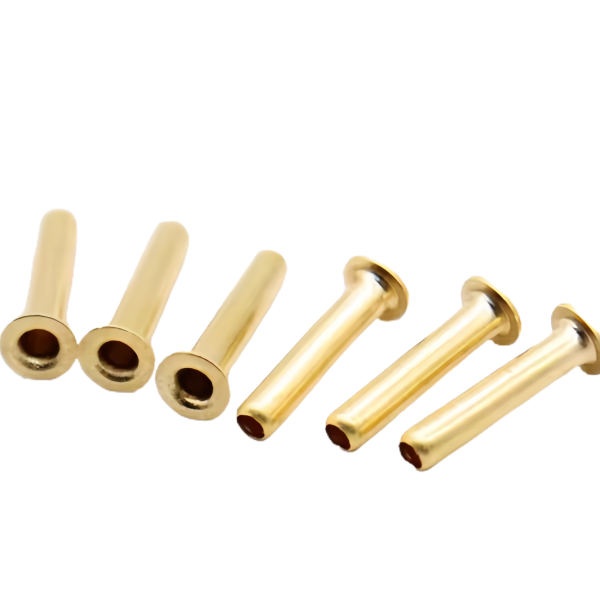
A stainless steel stepped sleeve with side vent holes is a drawn tube whose diameter changes along its length, with one or more holes pierced through the wall so process media can reach the sensing element. The step sets where the sleeve seats and how deep it inserts, while the vent holes let pressure or gas equalise instead of trapping it behind a blind wall. The whole part balances the draw that forms the step against the pierce that makes the vent, done so neither distorts the bore.
Two sizes in the title – 6 x 50 and 6 x 30 – and the difference between them is not 20 mm of metal. It is a different set of requirements.
Why PT100 and not a thermocouple or an NTC
The choice of element sets what the housing has to be, and it is worth stating why because the housing for each is genuinely different.
- Accuracy. A good platinum element is roughly a tenth of a degree over a narrow range and half a degree over a wide one, which is an order of magnitude better than a thermocouple and several times better than an NTC. That accuracy is only achievable if the element sees the process temperature and nothing else.
- Signal level, which is the reason the wiring matters. A PT100 produces a fraction of a millivolt. That is a microvolt-class signal, and it means the leads’ resistance, the connections’ resistance, and any thermal EMF in the connections all appear directly as measurement error. This is why a PT100’s housing has to be considered together with its wiring, in a way that a thermocouple’s does not.
- Stability over time. A platinum element drifts slowly and predictably, which is why it is the reference for process instrumentation and why its calibration record matters.
- Self-heating, which is the one that gets missed. A current is passed through the element to measure its resistance. That current heats the element, and if the element cannot shed that heat, the reading is high. The amount of self-heating depends on the element’s dissipation constant and on what surrounds it – and what surrounds it is the housing. So the housing’s job includes keeping the element thermally coupled to the process without insulating it, and that is a balance.
The tight band is on the thread, but the accuracy is set elsewhere
At +/-0.01 mm on thread pitch diameters and +/-0.05 mm on the drawn body, the tight band is correctly placed on the thread. But the accuracy of the assembly is set by the insertion depth, and that is a different dimension.
- The conduction error. Heat conducts from the process along the sleeve toward the wiring end, and the reading is displaced toward the cold end. The error scales with the length of the sleeve outside the process, so the exposure outside the process is what has to be minimised – not the length overall.
- And the immersion depth is a fit, not a length. The sleeve has to go deep enough for the error to be acceptable and not so deep that the stem’s mass makes the sensor slow. A 6 x 50 sleeve in a vessel that can only be entered 25 mm is a different sensor from the same sleeve in a vessel that takes 50 mm.
- On a small vessel, the sleeve’s diameter is also a constraint. A 6 mm sleeve needs a 6 mm port, and in a small pipe or a small reactor that is often not available – which is a process question rather than a sensor one, and it is worth raising before the sensor is chosen.
The wiring cavity, which is where a PT100 loses accuracy
This is the part of a PT100 housing that has no equivalent on a thermocouple or an NTC, and it is the reason the housing’s internal geometry matters so much.
- An air cavity next to the element is a thermal break. On a PT100 the element is often housed in a ceramic or a PTFE carrier with air around it, and that air is an insulator between the element and the process. The housing has to bring the process temperature to that carrier’s outer surface and let it conduct inward – and if the carrier is well-insulated the reading is a mixture of the process and the housing’s own temperature.
- The lead material matters at this junction. The lead has to get from the element to the terminal, and it passes through the region where the temperature gradient is steepest. A nickel lead conducts well and a steel lead less so, and the lead’s own conduction along the axis is a parallel path for heat that partially bypasses the element. So on a well-designed PT100 the lead arrangement and the insulation are part of the thermal design.
- And the housing’s own conduction is part of the same path. A heavy stainless steel sleeve conducts heat from the process away along its length as well as inward, so the sleeve’s mass and its material are both part of the accuracy. This is the same conduction error as above, seen from the other side.
The leads, and why PT100 wiring is a three-wire problem
This is the part that is specific to PT100 and it is worth stating because the housing’s terminal arrangement determines it.
- Two-wire, three-wire and four-wire. With two wires, the leads’ resistance is added to the element’s resistance and appears directly as error – and a 10 m run of thin copper is a significant fraction of a 100 ohm element at low temperatures. Three-wire measures the lead resistance and subtracts it. Four-wire separates the measurement entirely and removes it completely.
- So the terminal count is a design decision, not a wiring convenience. A two-terminal housing cannot be reconfigured into a three-wire measurement. On a long run, or at low temperature, or with a small element, the two-wire error can exceed the sensor’s entire accuracy claim – and the sensor will be blamed for it.
- And the connections have thermal EMFs. Microvolt-class signals are disturbed by a millivolt of thermal EMF, which is generated at every junction between two different metals. So the terminal material, the lead material, and the connection method all contribute, and dissimilar metals in a PT100’s terminal block are a real measurement problem rather than a connection detail.
A PT100 sleeve is picked on conductivity as much as corrosion
Standard stock: carbon steel, 304 and 316 stainless steel, aluminium, brass, with special grades sourced when volumes justify. On a PT100 sleeve the material is chosen by the process, and there is one thermal reason that sits alongside the corrosion one.
- 304 or 316L for the sleeve for corrosion resistance, and the L grade where there is welding. 316L for a chloride-bearing process.
- And the sleeve’s conductivity is a thermal consideration. A thin stainless steel sleeve is a better thermal path than a thick one, and a thinner wall means a faster sensor and a smaller pressure drop – but the wall is also the pressure boundary and the mechanical strength, so the wall is set by those and the conductivity is a consequence rather than a choice.
- Brass where the process is water or a benign fluid and the conductivity advantage is welcome, and its limitation is dezincification – which on a water service that runs warm over years is a real and slow problem.
- Platinum versus a cheaper element. The element is the customer’s, not ours, but the housing has to suit it. A customer specifying a cheaper element with a different dissipation constant and a different lead arrangement gets a different housing, and it is worth asking what element is intended.
A PT100 sleeve’s finish requirements are narrow and all functional
Finish selected from the drawing – plating, coating, anodising or passivation – with alternatives quoted alongside the quotation and samples approved in writing. On a PT100 sleeve the finish requirements are narrow and all functional.
- The process-facing surface, unmasked and with a defined finish. On a hygienic or a pharmaceutical application this is a documented, inspected product-contact surface with its own passivation record. On a general application it is unmasked because a coating is in the thermal path.
- The thread, masked or specified post-finish with an allowance – and on a threaded insertion probe the thread is often the process-facing seal, so it is a sealing surface rather than a fastening one.
- The lead or terminal entry, where there is one. A sealed entry is a separate design problem and a separate seal.
Tolerance, and the two numbers that decide the accuracy
+/-0.01 mm on thread pitch diameters and +/-0.05 mm on the drawn body. That is right for the mechanical part. But on a PT100 the assembly’s accuracy is set by two dimensions that are not in that scheme at all.
- The insertion depth, as a functional dimension with a tolerance, because it is what sets the conduction error.
- The element’s position in the thermal path, and whether it is close enough to the process surface for the accuracy claim to hold.
- And the terminal count, which is a design decision made at the housing stage and which cannot be changed later.
Two-wire, three-wire or four-wire, and how long are the leads?
How long are the leads, and is this a two-wire, three-wire or four-wire installation? Three questions in one, and the answer changes the sensor rather than the housing. A long lead run with two wires puts the lead resistance in series with the element, and at low temperature – where a PT100’s resistance is lowest and therefore where the lead resistance is the largest fraction of it – that error can exceed the sensor’s accuracy entirely. A three-wire or four-wire arrangement removes it, but it can only be used if the housing has three or four terminals, and that is decided when the housing is designed. So the second question is: how many terminals does this housing need? And it should be asked before the drawing is issued, because going from three terminals to four after the tooling exists is a change to the part’s end, and going from four to two after installation is a change to the whole measurement. There is also a third question that gets missed on PT100 work and that matters more than it looks: how fast does the reading have to follow? Because a PT100’s accuracy at steady state and its response to a transient are different numbers, and a housing with a good element in a heavy sleeve will have an excellent steady-state accuracy and a slow response, and those are two different products.
You will find this part in our Sensor Housings range. Process notes, common materials and inspection points for every product in the family are collected across the sensor housings pages.
Specifications
| Item | Stainless Steel Stepped Sleeve with Side Vent Holes |
|---|---|
| Brand | AUNOV |
| Designing | Driven by your drawing or a physical sample – samples are reverse-measured into a controlled drawing; the approved drawing is kept as the controlled master. |
| Tooling | Dies, fixtures and gauges are made in our own toolroom, so die cost stays transparent, and ownership is confirmed on the quotation. |
| Samples | Pre-production samples come with a full inspection report, so the sample is retained as the master, and later batches are gauged back to the signed sample. |
| Materials | Standard stock: carbon steel (SPCC / DC01), 304 / 316 stainless steel, aluminium, brass; special grades are sourced to the drawing when volumes justify. |
| Surface finish | Finish selected from the drawing: plating, coating, anodising or passivation; alternatives quoted with the quotation, samples approved in writing. |
| Processing | Deep drawing on hydraulic presses, CNC-finished where tolerances tighten; in-process checks sit between stages, not only at the end. |
| Equipment | Deep drawing presses plus CNC turning centres for machined faces, with CNC turning centres for secondary operations and CMM inspection. |
| Tolerance | +/-0.01 mm on thread pitch diameters, +/-0.05 mm on drawn body; finer bands confirmed from capability data before quoting. |
| Delivery terms | Freight is quoted to your door in FOB, CIF or DDP terms, payment by T/T or L/C. |
Related Products



Frequently Asked Questions
Why is a PT100 the most accurate temperature sensor in a drawn sleeve?
The accuracy comes from the element being a platinum resistance with a stable, repeatable resistance-to-temperature relationship, so the element is not the hard part of this design. The hard part is everything around it: the sleeve’s insertion depth, the wiring cavity and the way the leads bring a microvolt signal out of a hot, wet place. The accuracy lives in the platinum element and the wiring, not the thread band.
If the tight band is on the thread, what actually sets the accuracy?
At +/-0.01 mm on thread pitch diameters and +/-0.05 mm on the drawn body, the tight band is correctly placed on the thread, but that is not where the measurement is won. The wiring cavity has no equivalent on a thermocouple or an NTC, and it is why the housing’s internal geometry matters so much. Standard stock spans carbon steel, 304 and 316 stainless steel, aluminium and brass, with special grades sourced when volumes justify.
Why is PT100 wiring a three-wire problem?
Lead resistance adds directly to a resistance measurement, so the wiring scheme decides how much of the reading is the element and how much is the wire. Two-wire, three-wire or four-wire, together with the lead length, has to be settled before the housing is fixed. The finish is selected from the drawing, with alternatives quoted alongside and samples approved in writing.
What is the difference between the 6 x 50 and the 6 x 30 sleeve sizes?
The two sizes in the title are not simply twenty millimetres of extra metal, because insertion depth changes the conduction error along the wall. A longer immersion reduces the stem-conduction error, so the choice is a measurement decision as much as a dimensional one. Specifying the sleeve by diameter alone leaves that accuracy question unanswered.
Request a Quote for This Part
Send a drawing or sketch — get material advice, tooling cost and a per-piece price within 24 hours (working days).